Chiropractic
Featured schools near , edit
Types of Degrees Chiropractic Majors Are Earning
Those studying Chiropractic have the option of earning degrees at several award levels.
| Award Level | Graduates |
|---|---|
| Doctor’s Degree | 2,707 |
What Chiropractic Majors Need to Know
Coursework for Chiropractic emphasize a specific mix of knowledge, skills, and abilities — derived from O*NET surveys of workers in occupations that Chiropractic graduates commonly enter.
Knowledge Areas
This major prepares you for careers needing Chiropractic emphasizes the following knowledge areas:
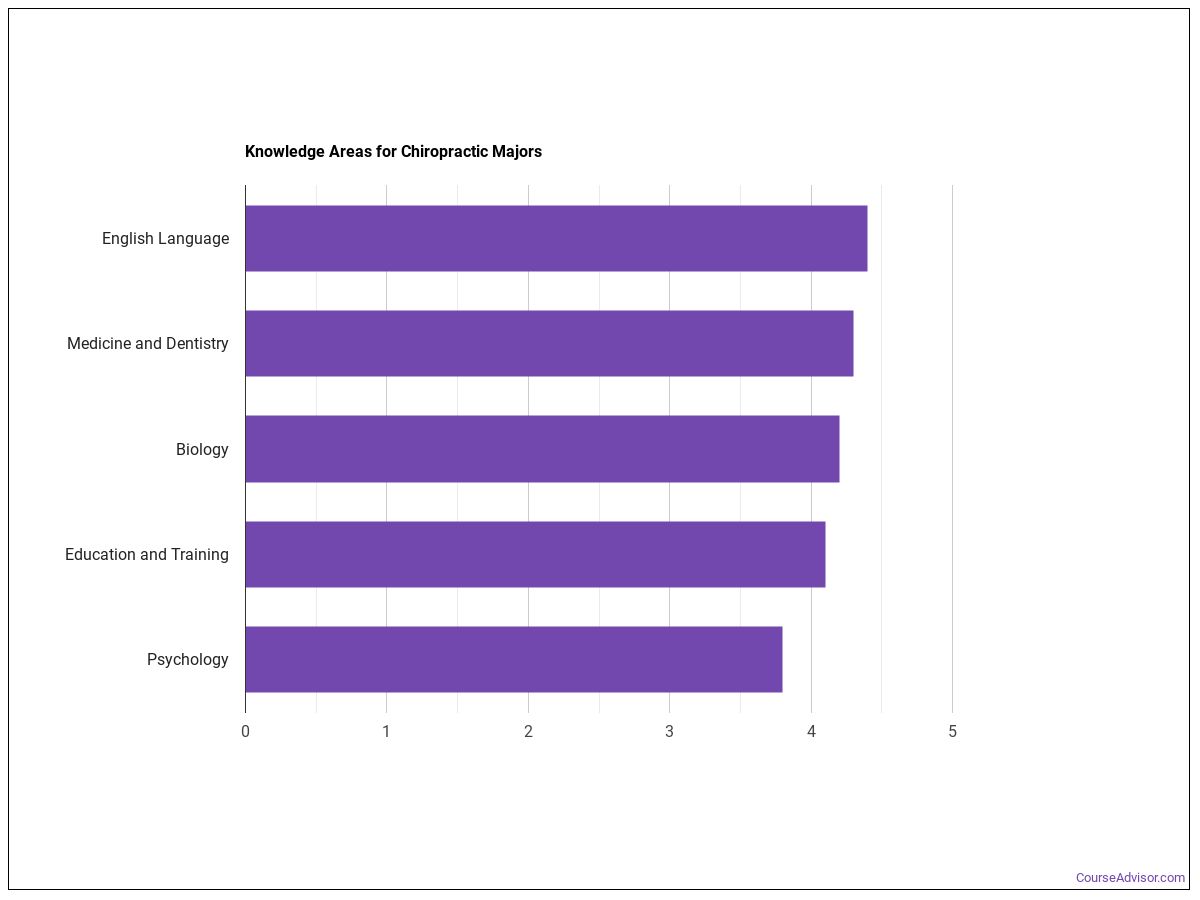
- Medicine and Dentistry — Importance 4.3 / 5; level 4.4 / 7.
- English Language — Importance 4.3 / 5; level 4.9 / 7.
- Biology — Importance 4.1 / 5; level 4.7 / 7.
- Education and Training — Importance 3.9 / 5; level 5.1 / 7.
- Psychology — Importance 3.8 / 5; level 4.8 / 7.
Importance is rated 1–5; level is 1–7. Source: ONET Online — weighted across related occupations.*
Skills
Skills emphasized by a Chiropractic program reflects the day-to-day work of related occupations:
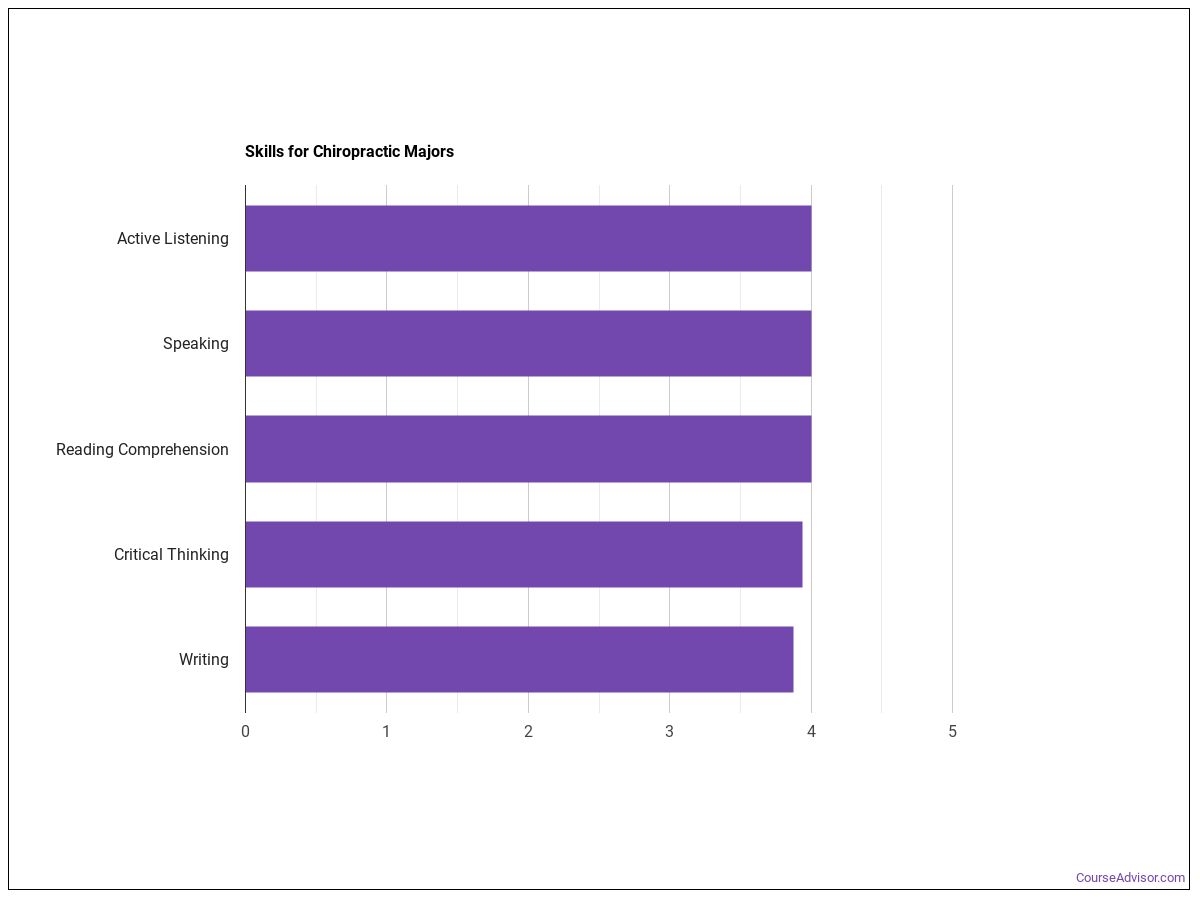
- Active Listening — Importance 4 / 5; level 4.3 / 7.
- Reading Comprehension — Importance 4.0 / 5; level 4.7 / 7.
- Speaking — Importance 4.0 / 5; level 4.3 / 7.
- Critical Thinking — Importance 3.9 / 5; level 4.1 / 7.
- Writing — Importance 3.8 / 5; level 4.3 / 7.
Abilities
Innate abilities most relevant to Chiropractic careers — again drawn from O*NET surveys of related occupations:
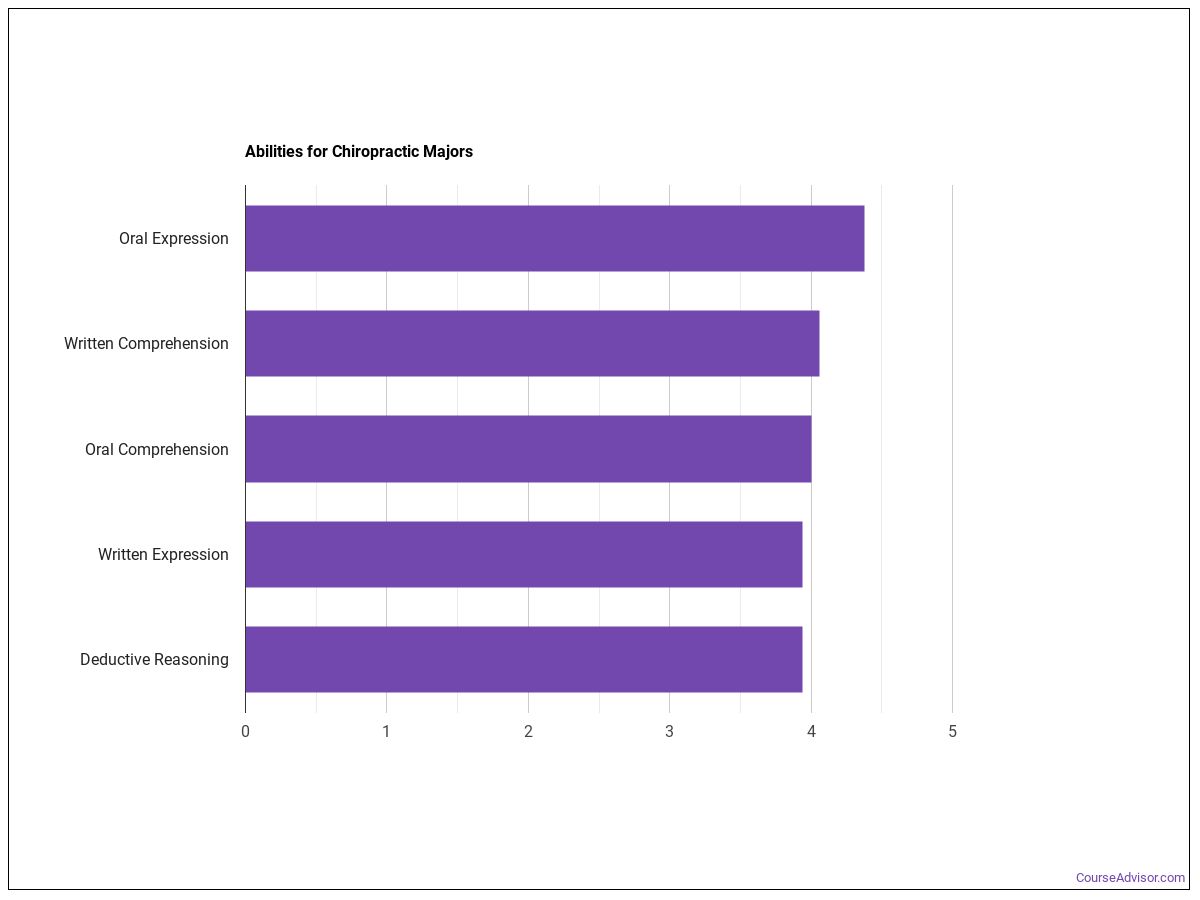
- Oral Expression — Importance 4.3 / 5; level 4.6 / 7.
- Written Comprehension — Importance 4.0 / 5; level 4.5 / 7.
- Oral Comprehension — Importance 4 / 5; level 4.8 / 7.
- Deductive Reasoning — Importance 4.0 / 5; level 4.2 / 7.
- Written Expression — Importance 3.9 / 5; level 4.4 / 7.
Common Job Activities
Day-to-day, Chiropractic graduates report doing:
| Activity | Frequency / Importance |
|---|---|
| Getting Information | 4.4 / 7 |
| Updating and Using Relevant Knowledge | 4.3 / 7 |
| Documenting/Recording Information | 4.3 / 7 |
| Making Decisions and Solving Problems | 4.2 / 7 |
| Assisting and Caring for Others | 4.2 / 7 |
| Identifying Objects, Actions, and Events | 4.1 / 7 |
| Working with Computers | 4.1 / 7 |
| Establishing and Maintaining Interpersonal Relationships | 4.0 / 7 |
| Interpreting the Meaning of Information for Others | 4.0 / 7 |
| Processing Information | 3.9 / 7 |
Technology Skills Used on the Job
Most frequently-cited tools used by Chiropractic professionals:
| Tool / Software | Category | In-Demand |
|---|---|---|
| Microsoft Office software | Office suite software | — |
| Microsoft Excel | Spreadsheet software | — |
| Microsoft Outlook | Electronic mail software | — |
| Microsoft Word | Word processing software | — |
| Electro Meridian Imaging EMI | Medical software | — |
| DataCom Software Business Products M.I.S. Clinic | Medical software | — |
| Acrendo A.I.med | Medical software | — |
| E-Z BIS Office | Medical software | — |
| Softworx Solutions ChiroWrite | Medical software | — |
| PPT4Drs Quixote | Medical software | — |
| Versatile Software Systems VersaSoft Chiro | Medical software | — |
| InPhase Technologies Group InPhase Concept | Enterprise resource planning ERP software | — |
Source: ONET Online technology skills, weighted across related occupations.*
Sample Job Titles
Real job postings for Chiropractic graduates include:
- Chiropractor
- Chiropractic Neurologist
- Chiropractic Doctor (DC)
- Chiropractic Physician
- Public Health Teacher
- Correctional Therapy Teacher
- Anesthesiology Teacher
- Hearing Therapy Teacher
- Occupational Therapy Aides Teacher
- Clinical Laboratory Service Teacher
- Recreation Therapy Teacher
- Music Therapy Teacher
- Urology Teacher
- Pathology Teacher
- Gericare Aide Teacher
Education Typically Required
Across the occupations open to Chiropractic graduates, the typical level of education actually held by current workers is distributed as:
| Education Level | Share of Workers |
|---|---|
| Doctoral degree | 59.7% |
| Master’s degree | 14.1% |
| Post-doctoral training | 7.5% |
| Postsecondary certificate | 5.2% |
| Bachelor’s degree | 4.9% |
| First professional degree | 4.6% |
| High school diploma or equivalent | 2.2% |
| Associate’s degree (or other 2-year) | 1.8% |

Source: ONET Online education / training / experience requirements.*
Who Is Earning a Degree in Chiropractic?
Gender Distribution
This field has a relatively balanced gender distribution: 46.5% women and 53.5% men among Chiropractic graduates.
| Gender | Graduates | Share |
|---|---|---|
| Women | 1,259 | 46.5% |
| Men | 1,448 | 53.5% |
Racial-Ethnic Diversity
At the national level, the racial-ethnic distribution of Chiropractic graduates is as follows:

| Race / Ethnicity | Graduates | Share |
|---|---|---|
| White | 1,622 | 59.9% |
| Asian | 209 | 7.7% |
| Hispanic or Latino | 371 | 13.7% |
| Black or African American | 164 | 6.1% |
| American Indian / Alaska Native | 19 | 0.7% |
| Native Hawaiian / Pacific Islander | 13 | 0.5% |
| Two or More Races | 70 | 2.6% |
| Race Unknown | 119 | 4.4% |
| International Students | 120 | 4.4% |
See minority definition below.
How Much Do Chiropractic Graduates Earn?
The U.S. Department of Education tracks median earnings of Chiropractic graduates 1, 4, and 5 years after completion. Wages typically rise steadily as graduates gain experience and move into mid-career roles.
| Years Out | Median Earnings |
|---|---|
| 1 year | $49,003 |
| 4 years | $52,932 |
| 5 years | $60,390 |
By year 5 out, median earnings rise to $60,390 — roughly 23% above the 1-year mark.
Source: U.S. Department of Education College Scorecard, field-of-study earnings tracker.
Is a Degree in Chiropractic Worth It?
Strictly by the federal earnings tracker, Chiropractic graduates earn a median of $52,932 four years after completion — roughly 39% above the national median for workers with only a high school diploma (~$38,000).
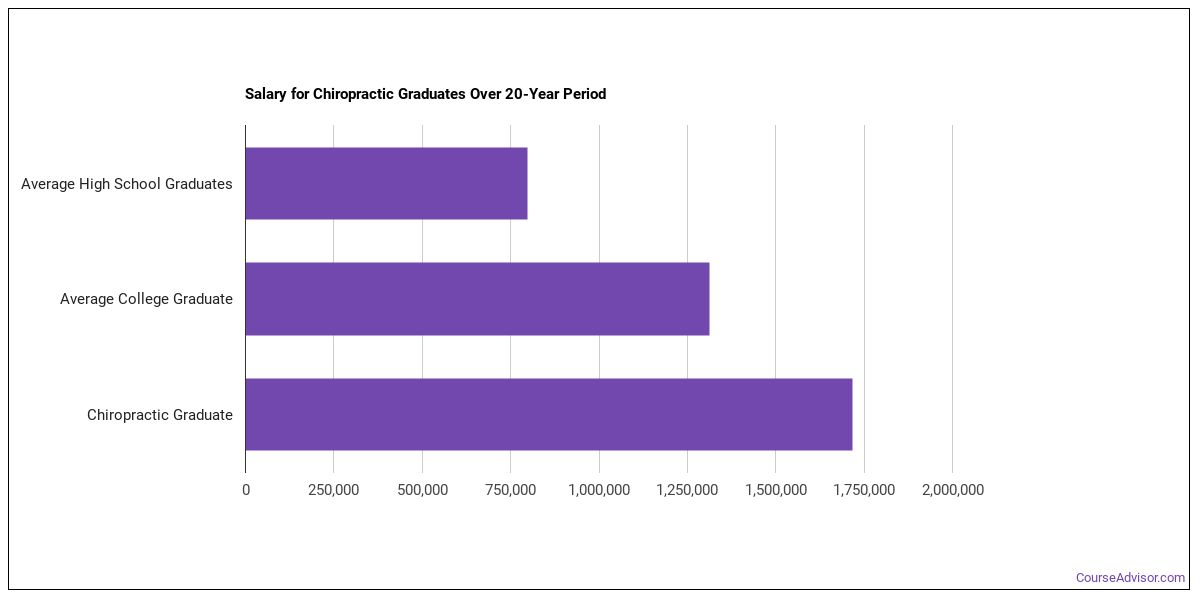
ROI estimate compares the program’s 4-yr median earnings against the 2023 BLS CPS median earnings for high-school-only workers. Source: U.S. Department of Education College Scorecard + BLS Current Population Survey.
Related Programs
You may also be interested in these closely related fields of study:
Explore Chiropractic by State
Alabama
California
District of Columbia
Idaho
Kansas
Maryland
Mississippi
Nevada
New York
Oklahoma
South Carolina
Utah
West Virginia
Alaska
Colorado
Florida
Illinois
Kentucky
Massachusetts
Missouri
New Hampshire
North Carolina
Oregon
South Dakota
Vermont
Wisconsin
References
The racial-ethnic minorities count is calculated by taking the total number of students and subtracting white students and international students. This number is then divided by the total number of students to obtain the racial-ethnic minorities percentage.
- College Factual
- National Center for Education Statistics (IPEDS)
- O*NET Online
- U.S. Bureau of Labor Statistics
- U.S. Department of Education College Scorecard
More about our data sources and methodologies.

Course Advisor provides higher-education, college and university, degree, program, career, salary, and other helpful information to students, faculty, institutions, and other internet audiences. Presented information and data are subject to change. Inclusion on this website does not imply or represent a direct relationship with the company, school, or brand. Information, though believed correct at time of publication, may not be correct, and no warranty is provided. Contact the schools to verify any information before relying on it. Financial aid may be available for those who qualify. The displayed options may include sponsored or recommended results, not necessarily based on your preferences.
© Course Advisor – All Rights Reserved.