Visual & Performing Arts Associate Degrees
A associate degree in Visual & Performing Arts is offered at 2,079 colleges in the United States, where you can earn aassociate degree in Visual & Performing Arts. This degree is more popular with female students, and about53% were students from underrepresented racial-ethnic groups. Also, 3.9% of Visual & Performing Arts graduates were international students.
Featured schools near , edit
Education Levels of Visual & Performing Arts Majors
During the most recent year for which data is available, 153,937 people earned theirVisual & Performing Arts majors across all award levels. The following table shows the number of diplomas awarded in Visual & Performing Arts at each degree level.
| Education Level | Number of Grads |
|---|---|
| Certificate | 8,919 |
| Associate’s Degree (this page) | 21,054 |
| Bachelor’s Degree | 95,619 |
| Master’s Degree | 25,861 |
| Doctor’s Degree | 1,908 |

Earnings of Visual & Performing Arts Majors With Associate Degrees (All Award Levels)
The U.S. Department of Education reports a median salary for graduates with aassociate degree in Visual & Performing Arts of $37,283 four years after graduation. These figures are reported program-wide, across all award levels.
This number may vary for many reasons. For instance, you may move to a location where people with your degree are rare and make more money.
| Years After Graduation | Median Earnings |
|---|---|
| 1 year | $27,422 |
| 4 years | $37,283 |
| 5 years | $42,578 |
Source: U.S. Department of Education College Scorecard, field-of-study earnings tracker (program-wide, all award levels).
Student Debt (All Award Levels)
We do not have the data to estimate the median debt for graduates with this degree.
Student Diversity
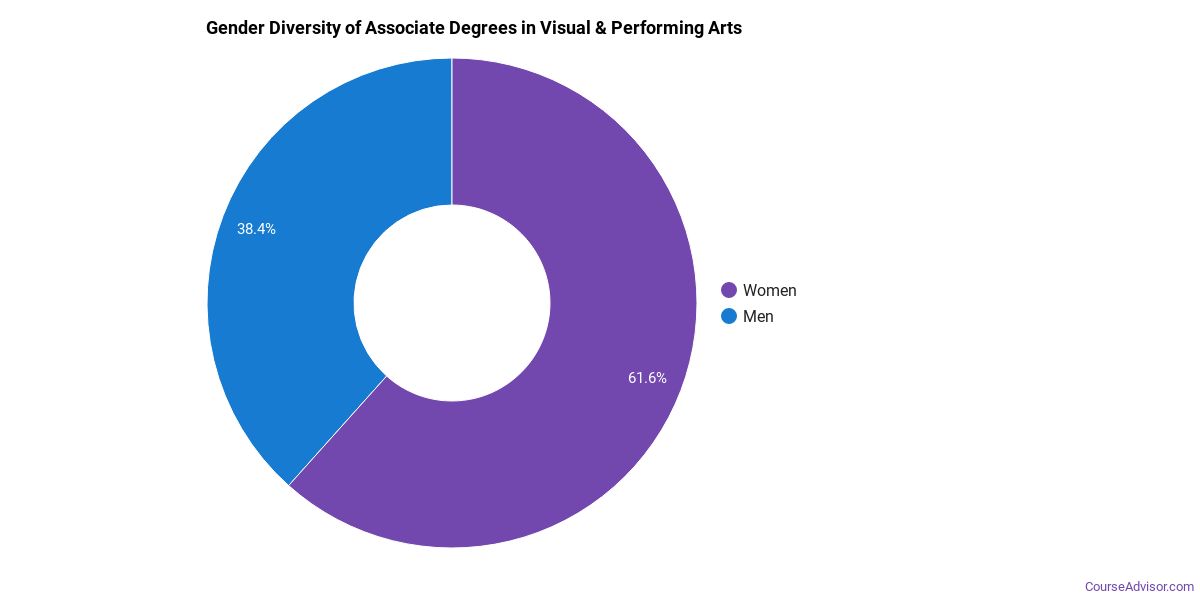
More women than men pursue their associate degree in Visual & Performing Arts. About 62.0% of graduates with this degree are women.
| Gender | Number of Grads |
|---|---|
| Men | 7,998 |
| Women | 13,056 |
The racial-ethnic distribution of Visual & Performing Arts graduates is as follows:
| Race / Ethnicity | Number of Grads | Share |
|---|---|---|
| White | 8,992 | 42.7% |
| Asian | 1,531 | 7.3% |
| Hispanic or Latino | 6,076 | 28.9% |
| Black or African American | 1,836 | 8.7% |
| American Indian / Alaska Native | 146 | 0.7% |
| Native Hawaiian / Pacific Islander | 66 | 0.3% |
| Two or More Races | 965 | 4.6% |
| Race Unknown | 625 | 3.0% |
| International Students | 817 | 3.9% |
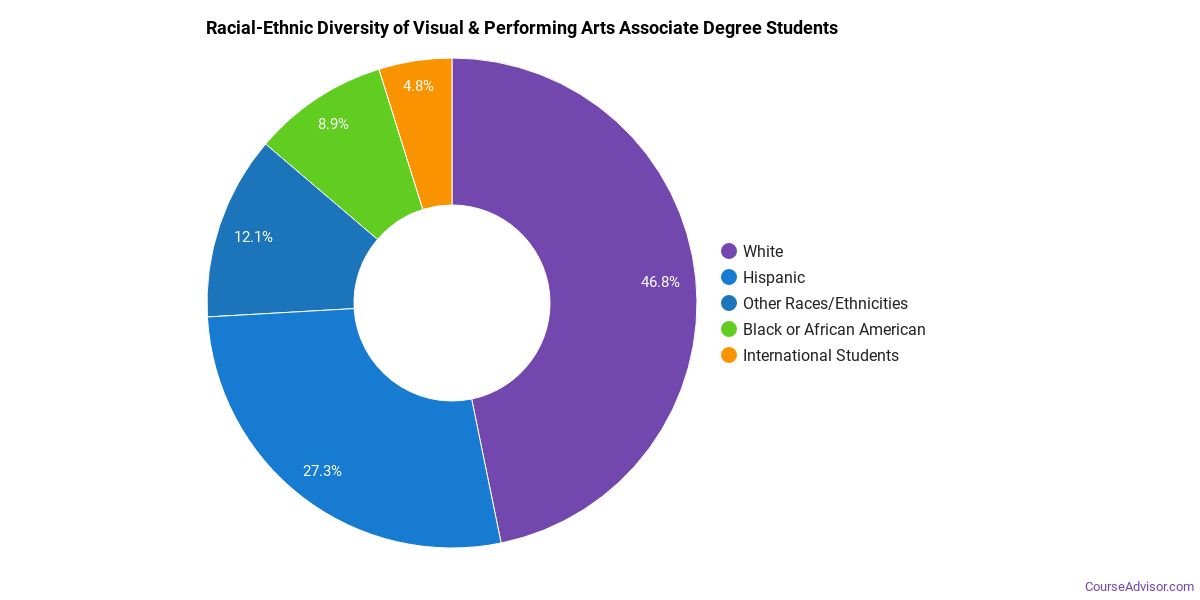
This degree is not very popular with international students. Only 3.9% of graduates fall into this category.
See the minority definition in the References below.
Most Popular Visual & Performing Arts Programs for Associate Degrees
There are 2,217 colleges that offer a associate degree in Visual & Performing Arts. Learn more about the most popular below:

The most popular school in the United States for Visual & Performing Arts students seeking a associate degree is Full Sail University. This school awarded 2,710 associate degrees in Visual & Performing Arts in the most recent reporting year. Data shows that graduates who hold this degree go on to make a median salary of $40,669.
New York University is a popular choice for Visual & Performing Arts majors seeking their associate degree. This school awarded 1,990 associate degrees in Visual & Performing Arts in the most recent reporting year. Data shows that graduates who hold this degree go on to make a median salary of $40,669.
Fashion Institute of Technology is a popular choice for Visual & Performing Arts majors seeking their associate degree. This school awarded 1,578 associate degrees in Visual & Performing Arts in the most recent reporting year. Data shows that graduates who hold this degree go on to make a median salary of $40,669.
Savannah College of Art and Design is a popular choice for Visual & Performing Arts majors seeking their associate degree. This school awarded 1,523 associate degrees in Visual & Performing Arts in the most recent reporting year. Graduates who complete their associate degree in Visual & Performing Arts here go on to a median salary of $40,669.
The New School comes in at #5 on our list of the most popular colleges offering associate degrees in Visual & Performing Arts. This school awarded 1,434 associate degrees in Visual & Performing Arts in the most recent reporting year. Graduates who complete their associate degree in Visual & Performing Arts here go on to a median salary of $40,669.
Berklee College of Music comes in at #6 on our list of the most popular colleges offering associate degrees in Visual & Performing Arts. During the most recent year for which we have data, 1,269 people received their associate degree in Visual & Performing Arts from this school. Data shows that graduates who hold this degree go on to make a median salary of $40,669.
University of Central Florida comes in at #7 on our list of the most popular colleges offering associate degrees in Visual & Performing Arts. During the most recent year for which we have data, 1,175 people received their associate degree in Visual & Performing Arts from this school. Data shows that graduates who hold this degree go on to make a median salary of $40,669.
Los Angeles Film School comes in at #8 on our list of the most popular colleges offering associate degrees in Visual & Performing Arts. During the most recent year for which we have data, 1,164 people received their associate degree in Visual & Performing Arts from this school. Data shows that graduates who hold this degree go on to make a median salary of $40,669.
University of Southern California comes in at #9 on our list of the most popular colleges offering associate degrees in Visual & Performing Arts. This school awarded 1,163 associate degrees in Visual & Performing Arts in the most recent reporting year. Graduates who complete their associate degree in Visual & Performing Arts here go on to a median salary of $40,669.
Southern New Hampshire University is a popular choice for Visual & Performing Arts majors seeking their associate degree. During the most recent year for which we have data, 1,090 people received their associate degree in Visual & Performing Arts from this school. Data shows that graduates who hold this degree go on to make a median salary of $40,669.
Mesa Community College is a popular choice for Visual & Performing Arts majors seeking their associate degree. This school awarded 1,073 associate degrees in Visual & Performing Arts in the most recent reporting year. Graduates who complete their associate degree in Visual & Performing Arts here go on to a median salary of $40,669.
California State University-Long Beach is a popular choice for Visual & Performing Arts majors seeking their associate degree. During the most recent year for which we have data, 1,005 people received their associate degree in Visual & Performing Arts from this school. Data shows that graduates who hold this degree go on to make a median salary of $40,669.
Columbia College Chicago is a popular choice for Visual & Performing Arts majors seeking their associate degree. This school awarded 989 associate degrees in Visual & Performing Arts in the most recent reporting year. Data shows that graduates who hold this degree go on to make a median salary of $40,669.
School of the Art Institute of Chicago is a popular choice for Visual & Performing Arts majors seeking their associate degree. This school awarded 958 associate degrees in Visual & Performing Arts in the most recent reporting year. Graduates who complete their associate degree in Visual & Performing Arts here go on to a median salary of $40,669.
Arizona State University Campus Immersion comes in at #15 on our list of the most popular colleges offering associate degrees in Visual & Performing Arts. This school awarded 896 associate degrees in Visual & Performing Arts in the most recent reporting year. Graduates who complete their associate degree in Visual & Performing Arts here go on to a median salary of $40,669.
University of North Texas comes in at #16 on our list of the most popular colleges offering associate degrees in Visual & Performing Arts. This school awarded 852 associate degrees in Visual & Performing Arts in the most recent reporting year. Data shows that graduates who hold this degree go on to make a median salary of $40,669.
Pratt Institute-Main is a popular choice for Visual & Performing Arts majors seeking their associate degree. This school awarded 756 associate degrees in Visual & Performing Arts in the most recent reporting year. Graduates who complete their associate degree in Visual & Performing Arts here go on to a median salary of $40,669.
Utah Valley University is a popular choice for Visual & Performing Arts majors seeking their associate degree. During the most recent year for which we have data, 750 people received their associate degree in Visual & Performing Arts from this school. Graduates who complete their associate degree in Visual & Performing Arts here go on to a median salary of $40,669.
Belmont University is a popular choice for Visual & Performing Arts majors seeking their associate degree. During the most recent year for which we have data, 727 people received their associate degree in Visual & Performing Arts from this school. Data shows that graduates who hold this degree go on to make a median salary of $40,669.
Indiana University-Bloomington is a popular choice for Visual & Performing Arts majors seeking their associate degree. During the most recent year for which we have data, 720 people received their associate degree in Visual & Performing Arts from this school. Data shows that graduates who hold this degree go on to make a median salary of $40,669.
Visual & Performing Arts Concentrations
| Major | Annual Degrees Awarded |
|---|---|
| Design and Applied Arts | 38,798 |
| Fine and Studio Arts | 37,770 |
| Music | 25,853 |
| Film/Video and Photographic Arts | 18,927 |
| Drama/Theatre Arts and Stagecraft | 16,640 |
Explore Visual & Performing Arts by State
Alabama
California
District of Columbia
Idaho
Kansas
Maryland
Mississippi
Nevada
New York
Oklahoma
South Carolina
Utah
West Virginia
Alaska
Colorado
Florida
Illinois
Kentucky
Massachusetts
Missouri
New Hampshire
North Carolina
Oregon
South Dakota
Vermont
Wisconsin
References
The racial-ethnic minority student count is calculated by taking the total number of students and subtracting white students, international students, and students whose race/ethnicity was unknown. This number is then divided by the total number of students to obtain the percentage of racial-ethnic minorities.
- College Factual
- National Center for Education Statistics (IPEDS)
- O*NET Online
- U.S. Bureau of Labor Statistics
- U.S. Department of Education College Scorecard
More about our data sources and methodologies.

Course Advisor provides higher-education, college and university, degree, program, career, salary, and other helpful information to students, faculty, institutions, and other internet audiences. Presented information and data are subject to change. Inclusion on this website does not imply or represent a direct relationship with the company, school, or brand. Information, though believed correct at time of publication, may not be correct, and no warranty is provided. Contact the schools to verify any information before relying on it. Financial aid may be available for those who qualify. The displayed options may include sponsored or recommended results, not necessarily based on your preferences.
© Course Advisor – All Rights Reserved.