Web Developers: Career Overview
Develop and implement websites, web applications, application databases, and interactive web interfaces. Evaluate code to ensure that it is properly structured, meets industry standards, and is compatible with browsers and devices. Optimize website performance, scalability, and server-side code and processes. May develop website infrastructure and integrate websites with other computer applications.
Featured schools near , edit
The Daily Work of Web Developers Do?
Typical responsibilities of web developers span:
- Write supporting code for Web applications or Web sites.
- Design, build, or maintain Web sites, using authoring or scripting languages, content creation tools, management tools, and digital media.
- Back up files from Web sites to local directories for instant recovery in case of problems.
- Select programming languages, design tools, or applications.
- Evaluate code to ensure that it is valid, is properly structured, meets industry standards, and is compatible with browsers, devices, or operating systems.
- Develop databases that support Web applications and Web sites.
- Perform Web site tests according to planned schedules, or after any Web site or product revision.
- Perform or direct Web site updates.
Key Skills and Knowledge
Successful web developers combine a mix of skills and domain knowledge.
Key Skills
These are the skills most central to this role, rated on an importance scale of 0 to 5:
Top Knowledge Areas
Other Web Developers Job Titles
This career also goes by job titles like:
- Back End Developer
- Back End Engineer
- Back End Software Engineer
- Back-End Web Developer
- Computer Graphic Artist
- Computer Graphic Designer
- Front End Developer
- Front End Engineer
Job Outlook
The U.S. employs around 539,231 web developers working in the United States today. Demand is forecast to grow by +4.6% over the projection horizon.

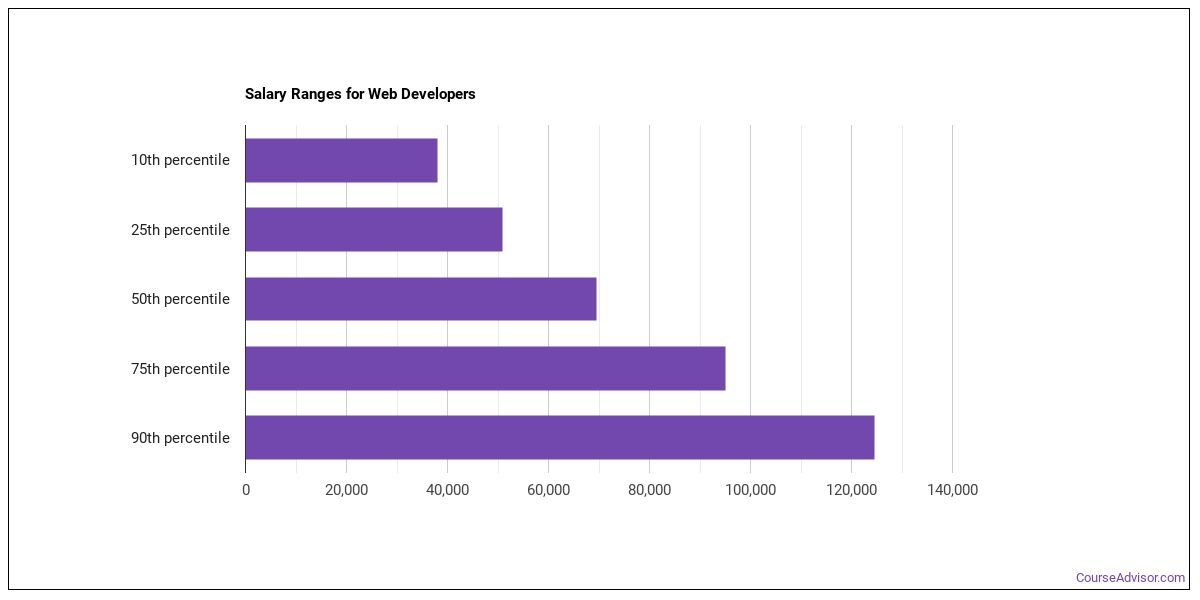
How Much Do Web Developers Make?
| Statistic | Value |
|---|---|
| Annual median | $125,527 |
| Hourly median | $60.35 |
| 10th percentile | $84,856 |
| 25th percentile | $105,192 |
| 75th percentile | $145,862 |
| 90th percentile | $166,198 |
Compensation varies based on experience, location, and industry.
Pay by State
| State | Annual median salary |
|---|---|
| District of Columbia | $121,000 |
| California | $117,380 |
| Washington | $112,010 |
| Maryland | $111,750 |
| Virginia | $110,830 |
| Massachusetts | $107,570 |
| Illinois | $103,300 |
| Alaska | $102,530 |
| Colorado | $101,760 |
| Missouri | $100,950 |
| Minnesota | $99,870 |
| Michigan | $97,690 |
| Rhode Island | $95,380 |
| North Carolina | $94,070 |
| New Hampshire | $93,810 |
| Hawaii | $93,600 |
| Texas | $93,120 |
| Ohio | $92,380 |
| Pennsylvania | $89,910 |
| New Jersey | $87,980 |
| Arizona | $87,070 |
| Idaho | $84,250 |
| South Carolina | $83,200 |
| Vermont | $82,170 |
| Florida | $81,410 |
| Kentucky | $80,960 |
| Utah | $80,350 |
| Nevada | $79,550 |
| Oregon | $79,540 |
| Oklahoma | $76,740 |
| Connecticut | $75,280 |
| Georgia | $75,000 |
| Tennessee | $74,950 |
| Louisiana | $74,500 |
| Nebraska | $74,320 |
| Indiana | $73,790 |
| Delaware | $72,800 |
| Kansas | $71,430 |
| North Dakota | $71,190 |
| West Virginia | $69,160 |
| Wisconsin | $67,970 |
| New York | $67,400 |
| Iowa | $67,110 |
| Montana | $65,490 |
| Alabama | $62,990 |
| New Mexico | $60,010 |
| Mississippi | $58,260 |
| South Dakota | $50,420 |
| Puerto Rico | $44,290 |
| Arkansas | $43,530 |
Top-Paying U.S. Regions
Earnings for web developers shift depending on where you work. These regions lead on median pay:
| Region | Median annual wage | Share of U.S. jobs | Location quotient |
|---|---|---|---|
| Far Western US | $112,532 | 22.4% | 1.47 |
| New England | $93,856 | 5.0% | 1.28 |
| Great Lakes | $91,330 | 12.4% | 0.89 |
| Southwest | $90,977 | 9.5% | 0.77 |
| Plains States | $88,100 | 6.4% | 0.94 |
| Southeast | $86,825 | 22.8% | 1.12 |
| Middle Atlantic | $84,266 | 18.3% | 1.23 |
| Rocky Mountains | $79,621 | 2.8% | 1.77 |
Highest-Paying Metro Areas for Web Developers
| Metro area | State | Median annual wage | Employment |
|---|---|---|---|
| San Jose-Sunnyvale-Santa Clara, CA | CA | $161,750 | 1,710 |
| San Francisco-Oakland-Fremont, CA | CA | $157,490 | 2,730 |
| Rochester, MN | MN | $127,700 | 40 |
| Columbia, SC | SC | $126,380 | 300 |
| Washington-Arlington-Alexandria, DC-VA-MD-WV | DC | $126,040 | 3,620 |
| Vallejo, CA | CA | $123,370 | 40 |
| Seattle-Tacoma-Bellevue, WA | WA | $120,750 | 3,420 |
| Winston-Salem, NC | NC | $120,710 | 50 |
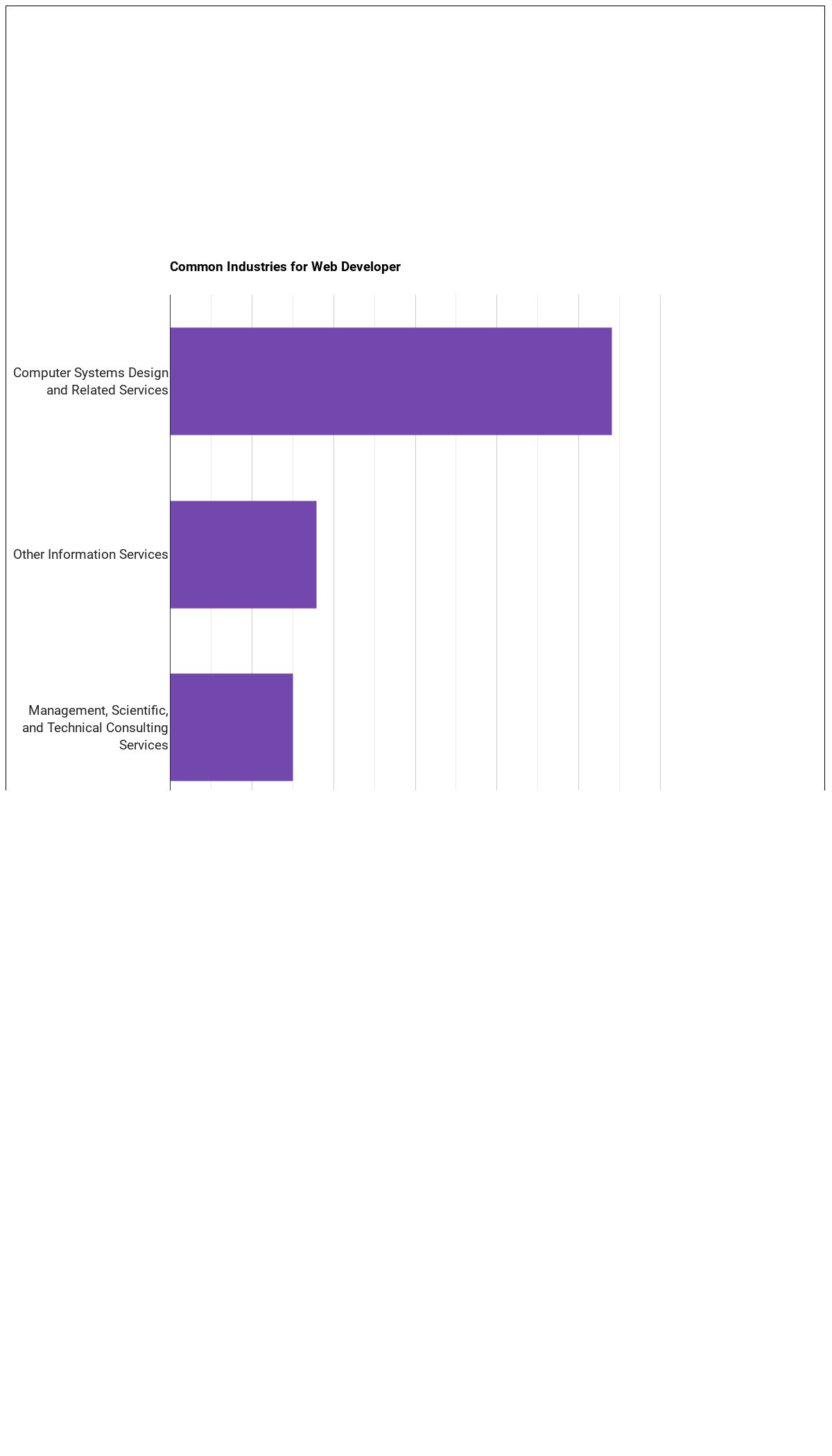
Top Industries Employing Web Developers
Most web developers work in these industries:
| Industry | Employment | Median annual wage |
|---|---|---|
| Professional, Scientific, and Technical Services | 34,260 | $85,070 |
| Information | 11,950 | $113,800 |
| Educational Services | 6,350 | $82,080 |
| Administrative and Support and Waste Management and Remediation Services | 4,540 | $115,690 |
| Finance and Insurance | 3,780 | $114,590 |
| Wholesale Trade | 3,210 | $77,620 |
| Management of Companies and Enterprises | 3,020 | $101,010 |
| Manufacturing | 2,890 | $85,640 |
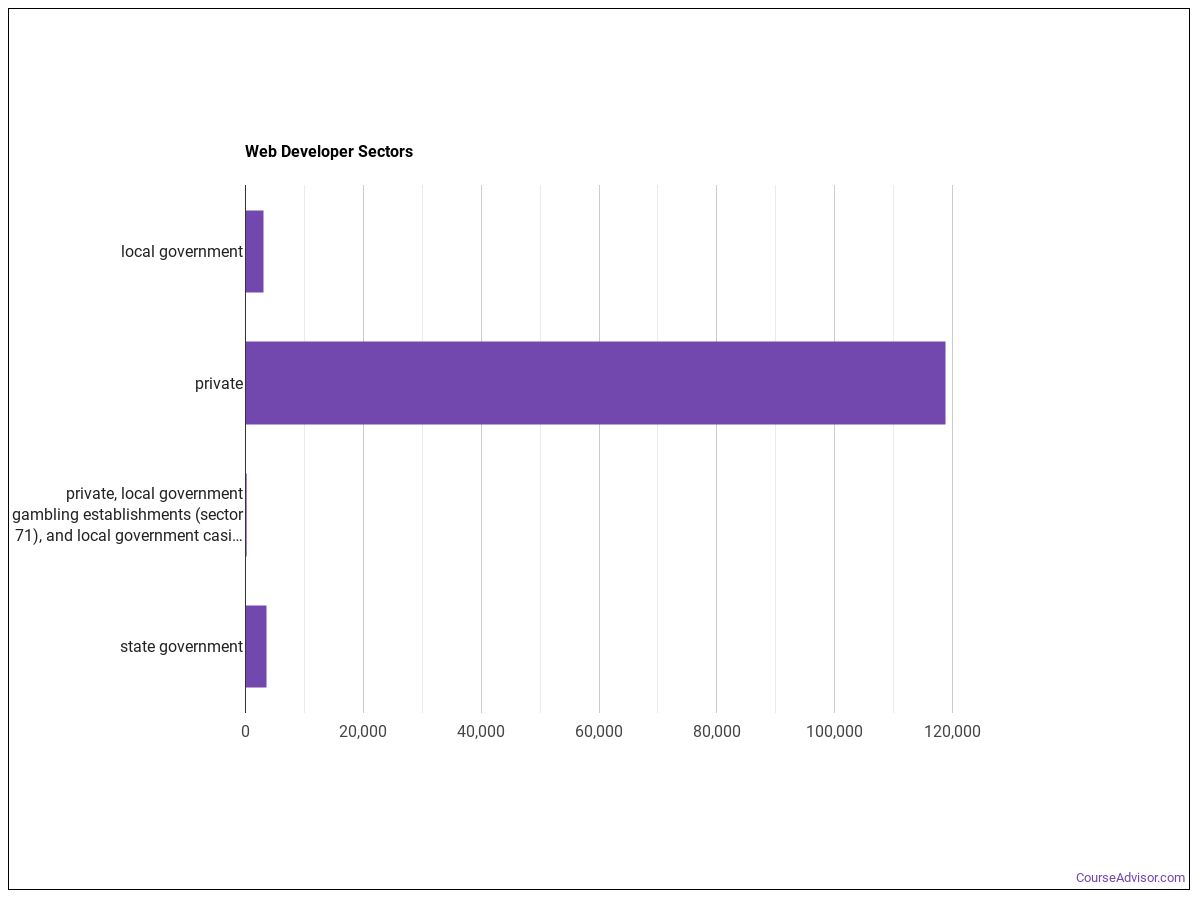
Below are examples of industries where web developers work:
Tools and Technology
- Document management software: Adobe Acrobat (hot technology)
- Video creation and editing software: Adobe After Effects (hot technology)
- Graphics or photo imaging software: Adobe Creative Cloud software (hot technology)
- Graphics or photo imaging software: Adobe Illustrator (hot technology)
- Desktop publishing software: Adobe InDesign (hot technology)
- Graphics or photo imaging software: Adobe Photoshop (hot technology)
- Web platform development software: AJAX (hot technology)
- Data base management system software: Amazon DynamoDB (hot technology)
- Data base user interface and query software: Amazon Elastic Compute Cloud EC2 (hot technology)
- Data base user interface and query software: Amazon Redshift (hot technology)
- Cloud-based management software: Amazon Web Services AWS CloudFormation (hot technology)
- Data base user interface and query software: Amazon Web Services AWS software (hot technology)
The Day-to-Day Environment
The on-the-job environment of web developers is shaped by the following characteristics:
- Spend Time Sitting
- Freedom to Make Decisions
- Indoors, Environmentally Controlled
- Face-to-Face Discussions with Individuals and Within Teams
Education and Training
Most web developers positions require a bachelor’s degree as the typical entry-level education. This occupation sits in Medium Preparation Needed (Job Zone 3), indicating the level of preparation typically expected.
Other Careers to Consider
Similar Occupations
- Search Marketing Strategists (Primary-Long)
- Computer Systems Analysts (Primary-Long)
- Computer Network Support Specialists (Supplemental)
- Computer User Support Specialists (Supplemental)
- Computer Network Architects (Supplemental)
- Database Administrators (Primary-Short)
- Database Architects (Primary-Long)
- Data Warehousing Specialists (Supplemental)
Where to Study
Students preparing for web developers typically earn programs in:
Computer and Information Sciences and Support Services
4 programs across 4 majors
Sources
Statistics shown above are sourced from the following authoritative sources:
- U.S. Bureau of Labor Statistics — Occupational Employment and Wage Statistics (OEWS) for employment and wage data by state and industry.
- BLS Employment Projections for total employment and growth forecasts.
- O*NET (Occupational Information Network) for skills, knowledge, tasks, work activities, work context, technology, and education-zone data.
SOC code: 15-1254.00 (Web Developers).

Course Advisor provides higher-education, college and university, degree, program, career, salary, and other helpful information to students, faculty, institutions, and other internet audiences. Presented information and data are subject to change. Inclusion on this website does not imply or represent a direct relationship with the company, school, or brand. Information, though believed correct at time of publication, may not be correct, and no warranty is provided. Contact the schools to verify any information before relying on it. Financial aid may be available for those who qualify. The displayed options may include sponsored or recommended results, not necessarily based on your preferences.
© Course Advisor – All Rights Reserved.