Subway and Streetcar Operators: Career Overview
Operate subway or elevated suburban trains with no separate locomotive, or electric-powered streetcar, to transport passengers. May handle fares.
Featured schools near , edit
What Do Subway and Streetcar Operators Perform?
Typical responsibilities of subway and streetcar operators include:
- Monitor lights indicating obstructions or other trains ahead and watch for car and truck traffic at crossings to stay alert to potential hazards.
- Operate controls to open and close transit vehicle doors.
- Drive and control rail-guided public transportation, such as subways, elevated trains, and electric-powered streetcars, trams, or trolleys, to transport passengers.
- Report delays, mechanical problems, and emergencies to supervisors or dispatchers, using radios.
- Regulate vehicle speed and the time spent at each stop to maintain schedules.
- Make announcements to passengers, such as notifications of upcoming stops or schedule delays.
- Direct emergency evacuation procedures.
- Complete reports, including shift summaries and incident or accident reports.
Skills and Knowledge
Effective subway and streetcar operators combine a mix of skills and domain knowledge.
Most Important Skills
The competencies most important for this role, rated on an importance scale of 0 to 5:
Knowledge Areas
Other Subway and Streetcar Operators Job Titles
Common job titles for this role include:
- Combined Rail Operator
- Electric Motorman
- Elevated Motorman
- Light Rail Operator
- Light Rail Train Operator
- Light Rail Transit Operator
- Light Rail Vehicle Operator (LRV Operator)
- Monorail Operator
Employment and Demand
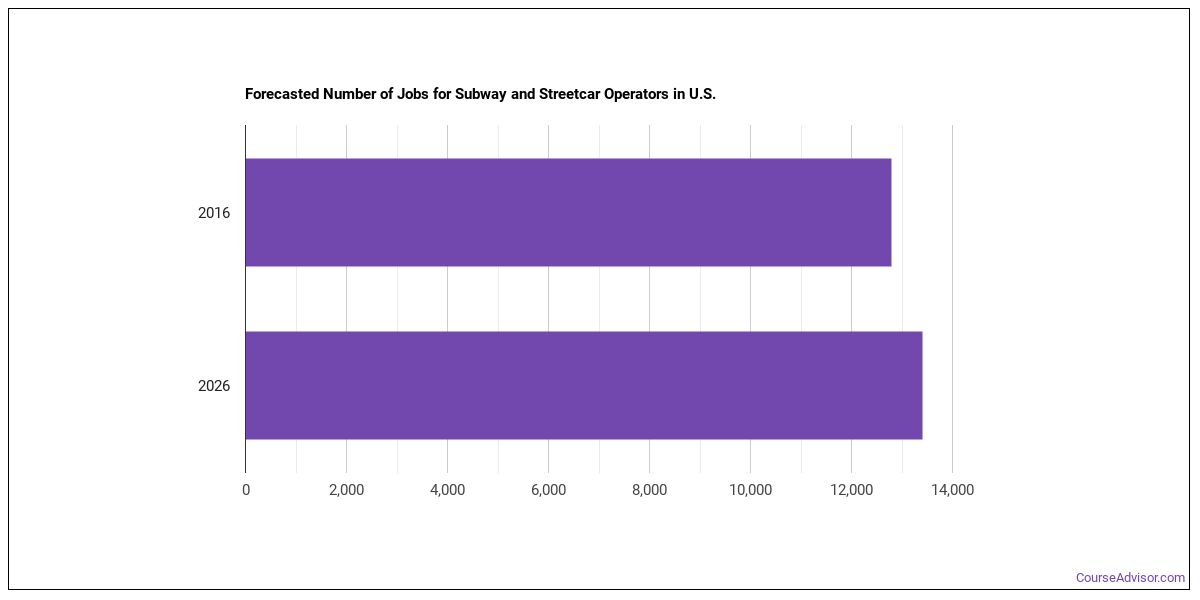
There are roughly 1,370,061 subway and streetcar operators working in the United States today. Employment is projected to decline by -4.4% over the projection horizon.
How Much Do Subway and Streetcar Operators Make?
| Statistic | Value |
|---|---|
| Annual median | $42,817 |
| Hourly median | $20.59 |
| 10th percentile | $24,964 |
| 25th percentile | $33,891 |
| 75th percentile | $51,744 |
| 90th percentile | $60,671 |
Wages vary widely based on experience, location, and industry.

Subway and Streetcar Operators Salary by State
| State | Annual median salary |
|---|---|
| Washington | $86,750 |
| Massachusetts | $84,820 |
| Maryland | $82,590 |
| California | $76,770 |
| New Jersey | $68,960 |
| Minnesota | $67,810 |
| Georgia | $58,500 |
| Utah | $57,200 |
| Texas | $57,200 |
Top-Paying U.S. Regions
Compensation for subway and streetcar operators vary by region. Top regions by median wage:
| Region | Median annual wage | Share of U.S. jobs | Location quotient |
|---|---|---|---|
| New England | $84,820 | 20.8% | 3.75 |
| Middle Atlantic | $79,382 | 17.2% | 2.57 |
| Far Western US | $78,594 | 23.5% | 0.73 |
| Plains States | $67,810 | 3.3% | 0.72 |
| Southeast | $58,500 | 6.6% | 0.88 |
| Rocky Mountains | $57,200 | 22.8% | 8.81 |
| Southwest | $57,200 | 5.8% | 0.28 |
Where the Jobs Cluster
| Metro area | State | Median annual wage | Employment |
|---|---|---|---|
| New York-Newark-Jersey City, NY-NJ | NY | $87,940 | 3,960 |
| Seattle-Tacoma-Bellevue, WA | WA | $86,750 | 170 |
| Baltimore-Columbia-Towson, MD | MD | $81,290 | 160 |
| San Diego-Chula Vista-Carlsbad, CA | CA | $75,660 | 150 |
| Minneapolis-St. Paul-Bloomington, MN-WI | MN | $67,810 | 120 |
| Atlanta-Sandy Springs-Roswell, GA | GA | $58,500 | 230 |
| Houston-Pasadena-The Woodlands, TX | TX | $57,200 | 200 |
Which Industries Hire Subway and Streetcar Operators
The largest employers of subway and streetcar operators are concentrated in the following sectors:
| Industry | Employment | Median annual wage |
|---|---|---|
| Transportation and Warehousing | 440 | $54,250 |
The table below shows some of the most common industries where those employed in this career field work.
Tech Stack
- Office suite software: Microsoft Office software (hot technology)
What the Workplace Is Like
The work environment for subway and streetcar operators is shaped by the following characteristics:
- In an Enclosed Vehicle or Operate Enclosed Equipment
- Spend Time Using Your Hands to Handle, Control, or Feel Objects, Tools, or Controls
- Importance of Being Exact or Accurate
- Spend Time Making Repetitive Motions
- Contact With Others
How to Become Subway and Streetcar Operators
Typical subway and streetcar operators positions require a high school diploma or equivalent as the typical entry-level education. This career aligns with Some Preparation Needed (Job Zone 2), indicating the level of preparation typically expected.
Other Careers to Consider
Similar Occupations
- Transit and Railroad Police (Supplemental)
- Crossing Guards and Flaggers (Supplemental)
- Dispatchers, Except Police, Fire, and Ambulance (Supplemental)
- Bus and Truck Mechanics and Diesel Engine Specialists (Supplemental)
- Commercial Pilots (Supplemental)
- Air Traffic Controllers (Primary-Long)
- Airfield Operations Specialists (Supplemental)
- Heavy and Tractor-Trailer Truck Drivers (Primary-Long)
Degree Programs
Students preparing for subway and streetcar operators typically earn programs in:
Transportation and Materials Moving
1 programs across 1 majors
References
Statistics shown above are sourced from the following authoritative sources:
- U.S. Bureau of Labor Statistics — Occupational Employment and Wage Statistics (OEWS) for employment and wage data by state and industry.
- BLS Employment Projections for total employment and growth forecasts.
- O*NET (Occupational Information Network) for skills, knowledge, tasks, work activities, work context, technology, and education-zone data.
SOC code: 53-4041.00 (Subway and Streetcar Operators).

Course Advisor provides higher-education, college and university, degree, program, career, salary, and other helpful information to students, faculty, institutions, and other internet audiences. Presented information and data are subject to change. Inclusion on this website does not imply or represent a direct relationship with the company, school, or brand. Information, though believed correct at time of publication, may not be correct, and no warranty is provided. Contact the schools to verify any information before relying on it. Financial aid may be available for those who qualify. The displayed options may include sponsored or recommended results, not necessarily based on your preferences.
© Course Advisor – All Rights Reserved.