Commercial Pilots: Career Profile
Pilot and navigate the flight of fixed-wing aircraft on nonscheduled air carrier routes, or helicopters. Requires Commercial Pilot certificate. Includes charter pilots with similar certification, and air ambulance and air tour pilots. Excludes regional, national, and international airline pilots.
Featured schools near , edit
What Do Commercial Pilots Perform?
The day-to-day responsibilities of commercial pilots cover:
- Check aircraft prior to flights to ensure that the engines, controls, instruments, and other systems are functioning properly.
- Co-pilot aircraft or perform captain's duties, as required.
- Consider airport altitudes, outside temperatures, plane weights, and wind speeds and directions to calculate the speed needed to become airborne.
- Use instrumentation to pilot aircraft when visibility is poor.
- Monitor engine operation, fuel consumption, and functioning of aircraft systems during flights.
- Order changes in fuel supplies, loads, routes, or schedules to ensure safety of flights.
- Contact control towers for takeoff clearances, arrival instructions, and other information, using radio equipment.
- Plan flights according to government and company regulations, using aeronautical charts and navigation instruments.
Key Skills and Knowledge
Successful commercial pilots draw on a mix of skills and domain knowledge.
Top Skills
These are the skills that matter most in this role, rated on an importance scale of 0 to 5:
Top Knowledge Areas
Types of Commercial Pilots Jobs
Common job titles for this role include:
- Advanced Air Mobility Operator (AAM Operator)
- Advanced Air Mobility Pilot (AAM Pilot)
- Advanced Air Mobility Technician (AAM Technician)
- Aerial Advertiser
- Aerial Crop Duster
- Aerial Hurricane Hunter
- Aerial Sprayer
- Agricultural Pilot
How Many Commercial Pilots Are There?
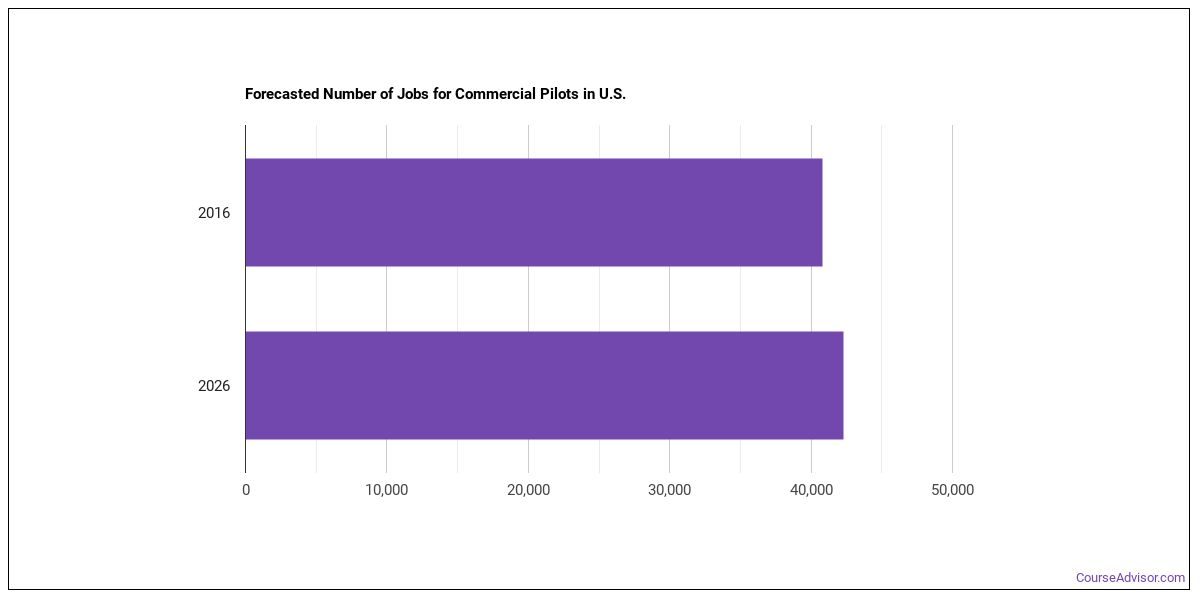
The U.S. employs around 375,310 commercial pilots working in the United States today. This occupation is expected to decline by -1.8% over the projection horizon.
Commercial Pilots Pay
| Statistic | Value |
|---|---|
| Annual median | $43,713 |
| Hourly median | $21.02 |
| 10th percentile | $27,588 |
| 25th percentile | $35,651 |
| 75th percentile | $51,775 |
| 90th percentile | $59,837 |
Compensation varies based on experience, location, and industry.

Commercial Pilots Salary by State
| State | Annual median salary |
|---|---|
| Connecticut | $227,140 |
| New York | $172,500 |
| Texas | $162,930 |
| Delaware | $155,640 |
| Georgia | $139,350 |
| Massachusetts | $137,150 |
| Maine | $134,990 |
| Nevada | $132,490 |
| Michigan | $130,560 |
| Florida | $130,530 |
| Maryland | $130,510 |
| Pennsylvania | $129,540 |
| North Carolina | $126,740 |
| Wyoming | $126,570 |
| Missouri | $124,060 |
| Washington | $123,530 |
| Colorado | $122,700 |
| California | $122,100 |
| Louisiana | $120,710 |
| South Carolina | $119,810 |
| Tennessee | $119,330 |
| Minnesota | $117,960 |
| Ohio | $116,050 |
| Virginia | $115,490 |
| Oregon | $112,620 |
| North Dakota | $111,120 |
| Alaska | $110,930 |
| Oklahoma | $108,200 |
| Alabama | $106,840 |
| Illinois | $105,290 |
| Kansas | $103,400 |
| Wisconsin | $103,290 |
| Montana | $103,110 |
| Idaho | $103,090 |
| West Virginia | $102,640 |
| Hawaii | $102,390 |
| Arizona | $102,280 |
| Rhode Island | $101,330 |
| Kentucky | $101,290 |
| Utah | $101,160 |
| Iowa | $101,040 |
| Nebraska | $100,150 |
| Mississippi | $99,920 |
| Indiana | $96,730 |
| Vermont | $95,660 |
| New Mexico | $85,140 |
| Arkansas | $84,140 |
| Puerto Rico | $79,610 |
| South Dakota | $75,740 |
| New Hampshire | $60,920 |
Top-Paying U.S. Regions
Pay for commercial pilots differ across the country. The following regions pay the most:
| Region | Median annual wage | Share of U.S. jobs | Location quotient |
|---|---|---|---|
| Southwest | $144,380 | 13.7% | 1.11 |
| New England | $136,948 | 2.4% | 0.85 |
| Southeast | $122,801 | 27.5% | 1.35 |
| Far Western US | $120,433 | 21.6% | 4.02 |
| Great Lakes | $114,076 | 15.2% | 1.42 |
| Rocky Mountains | $112,729 | 5.0% | 1.27 |
| Middle Atlantic | $112,323 | 6.0% | 0.42 |
| Plains States | $110,495 | 8.4% | 1.33 |
Where the Jobs Cluster
| Metro area | State | Median annual wage | Employment |
|---|---|---|---|
| Hartford-West Hartford-East Hartford, CT | CT | $227,140 | 80 |
| New York-Newark-Jersey City, NY-NJ | NY | $224,840 | 1,270 |
| Grand Rapids-Wyoming-Kentwood, MI | MI | $189,090 | 100 |
| Dallas-Fort Worth-Arlington, TX | TX | $188,920 | 2,480 |
| Crestview-Fort Walton Beach-Destin, FL | FL | $180,790 | 90 |
| Los Angeles-Long Beach-Anaheim, CA | CA | $177,300 | 2,110 |
| San Francisco-Oakland-Fremont, CA | CA | $170,000 | 530 |
| Lexington Park, MD | MD | $168,470 | 90 |
Which Industries Hire Commercial Pilots
The bulk of commercial pilots are concentrated in the following sectors:
| Industry | Employment | Median annual wage |
|---|---|---|
| Transportation and Warehousing | 30,970 | n/a |
| Educational Services | 5,870 | n/a |
| Health Care and Social Assistance | 3,850 | n/a |
| Professional, Scientific, and Technical Services | 2,160 | n/a |
| Management of Companies and Enterprises | 1,780 | n/a |
| Agriculture, Forestry, Fishing and Hunting | 1,110 | n/a |
| Manufacturing | 1,100 | n/a |
| Information | 730 | n/a |

Commercial Pilots work in the following industries:

Software Commercial Pilots Use
- Graphics or photo imaging software: Adobe Creative Cloud software (hot technology)
- Office suite software: Microsoft Office software (hot technology)
The Day-to-Day Environment
Daily working conditions for commercial pilots reflects the following characteristics:
- Freedom to Make Decisions
- Determine Tasks, Priorities and Goals
- Work With or Contribute to a Work Group or Team
- Health and Safety of Other Workers
Education and Training
Entry-level commercial pilots positions require some college, no degree as the typical entry-level education. This occupation sits in Medium Preparation Needed (Job Zone 3), reflecting the level of preparation typically expected.
Other Careers to Consider
Similar Occupations
- Aerospace Engineering and Operations Technologists and Technicians (Supplemental)
- Remote Sensing Technicians (Supplemental)
- Camera Operators, Television, Video, and Film (Supplemental)
- Dispatchers, Except Police, Fire, and Ambulance (Supplemental)
- Avionics Technicians (Primary-Long)
- Aircraft Mechanics and Service Technicians (Primary-Short)
- Aircraft Cargo Handling Supervisors (Supplemental)
- Airline Pilots, Copilots, and Flight Engineers (Primary-Short)
Degree Programs
Future commercial pilots commonly pursue programs in:
Transportation and Materials Moving
2 programs across 1 majors
References
Data on this page comes from the following authoritative sources:
- U.S. Bureau of Labor Statistics — Occupational Employment and Wage Statistics (OEWS) for employment and wage data by state and industry.
- BLS Employment Projections for total employment and growth forecasts.
- O*NET (Occupational Information Network) for skills, knowledge, tasks, work activities, work context, technology, and education-zone data.
SOC code: 53-2012.00 (Commercial Pilots).

Course Advisor provides higher-education, college and university, degree, program, career, salary, and other helpful information to students, faculty, institutions, and other internet audiences. Presented information and data are subject to change. Inclusion on this website does not imply or represent a direct relationship with the company, school, or brand. Information, though believed correct at time of publication, may not be correct, and no warranty is provided. Contact the schools to verify any information before relying on it. Financial aid may be available for those who qualify. The displayed options may include sponsored or recommended results, not necessarily based on your preferences.
© Course Advisor – All Rights Reserved.