Bioinformatics Scientists: Career Overview
Conduct research using bioinformatics theory and methods in areas such as pharmaceuticals, medical technology, biotechnology, computational biology, proteomics, computer information science, biology and medical informatics. May design databases and develop algorithms for processing and analyzing genomic information, or other biological information.
Featured schools near , edit
What Do Bioinformatics Scientists Take On?
Typical responsibilities of bioinformatics scientists include:
- Develop new software applications or customize existing applications to meet specific scientific project needs.
- Communicate research results through conference presentations, scientific publications, or project reports.
- Create novel computational approaches and analytical tools as required by research goals.
- Consult with researchers to analyze problems, recommend technology-based solutions, or determine computational strategies.
- Analyze large molecular datasets, such as raw microarray data, genomic sequence data, or proteomics data, for clinical or basic research purposes.
- Keep abreast of new biochemistries, instrumentation, or software by reading scientific literature and attending professional conferences.
- Develop data models and databases.
- Compile data for use in activities, such as gene expression profiling, genome annotation, or structural bioinformatics.
Skills and Knowledge
Top bioinformatics scientists rely on a mix of skills and domain knowledge.
Key Skills
The competencies most important for this role, rated on an importance scale of 0 to 5:
Knowledge Areas
Related Job Titles
People in this occupation may also be known by titles such as:
- Bioinformatician
- Bioinformaticist
- Bioinformatics Analyst
- Bioinformatics Associate
- Bioinformatics Computer Scientist
- Bioinformatics Consultant
- Bioinformatics Data Analyst
- Bioinformatics Developer
Employment and Demand
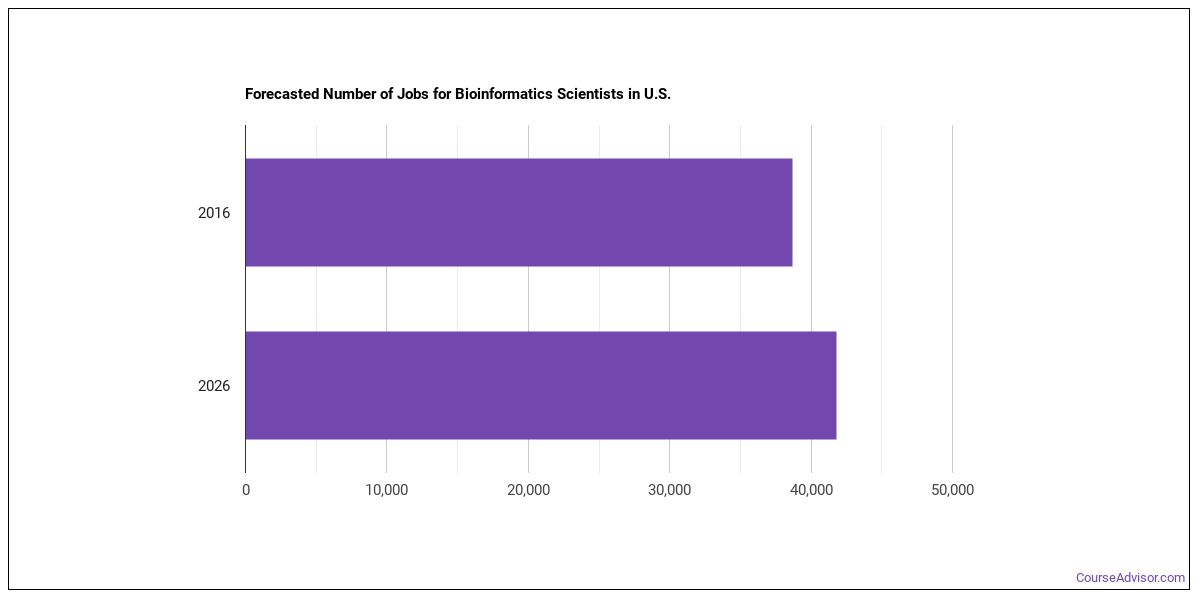
There are roughly 10,443 bioinformatics scientists working in the United States today. Demand is forecast to grow by +5.4% over the projection horizon.
Salary for Bioinformatics Scientists
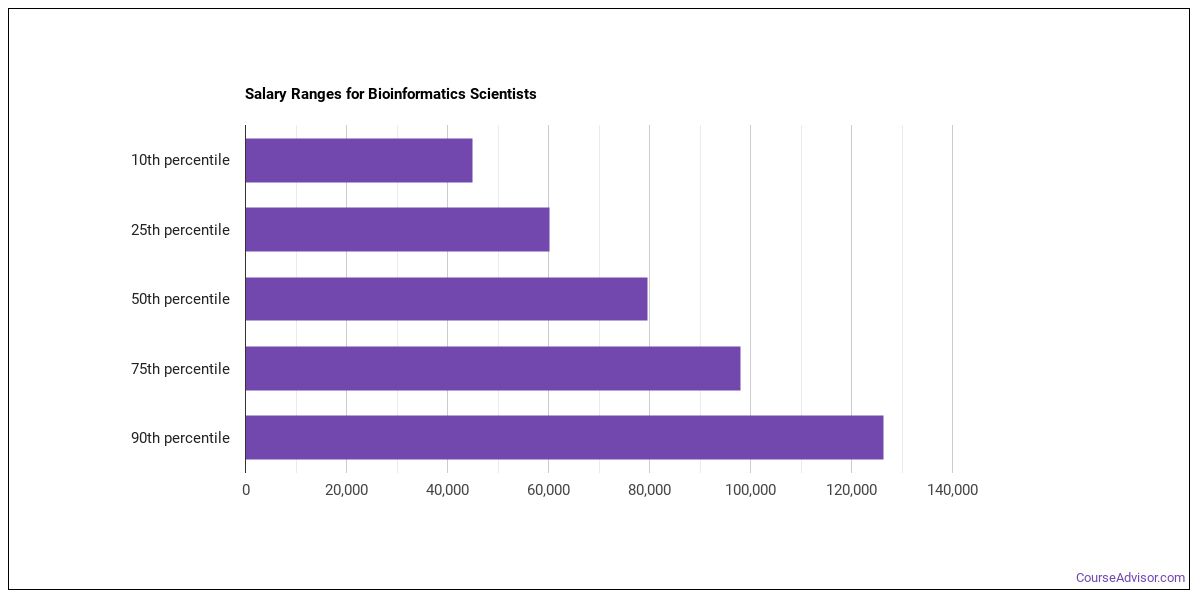
| Statistic | Value |
|---|---|
| Annual median | $92,484 |
| Hourly median | $44.46 |
| 10th percentile | $67,421 |
| 25th percentile | $79,953 |
| 75th percentile | $105,016 |
| 90th percentile | $117,547 |
Wages vary widely based on experience, location, and industry.
Pay by State
| State | Annual median salary |
|---|---|
| Connecticut | $120,880 |
| Maryland | $115,710 |
| California | $112,010 |
| New Jersey | $102,760 |
| Massachusetts | $101,140 |
| Rhode Island | $98,990 |
| Alaska | $98,220 |
| North Carolina | $97,020 |
| Colorado | $96,680 |
| Washington | $96,120 |
| Pennsylvania | $95,640 |
| Hawaii | $94,700 |
| New York | $93,070 |
| Georgia | $91,890 |
| Utah | $89,860 |
| Arizona | $88,610 |
| Indiana | $87,050 |
| Wyoming | $87,050 |
| South Carolina | $86,940 |
| Oregon | $85,840 |
| Montana | $84,640 |
| Mississippi | $84,610 |
| Maine | $84,550 |
| Virginia | $83,370 |
| District of Columbia | $82,760 |
| West Virginia | $82,760 |
| New Hampshire | $82,450 |
| Kansas | $81,780 |
| Michigan | $81,200 |
| Texas | $81,020 |
| Alabama | $80,230 |
| Puerto Rico | $79,790 |
| Idaho | $79,790 |
| Iowa | $79,170 |
| Illinois | $78,600 |
| New Mexico | $78,190 |
| Ohio | $78,170 |
| Minnesota | $77,650 |
| Wisconsin | $77,520 |
| Delaware | $76,970 |
| Oklahoma | $76,670 |
| Vermont | $76,340 |
| Nebraska | $75,670 |
| Guam | $74,960 |
| Arkansas | $74,960 |
| Kentucky | $74,960 |
| North Dakota | $74,960 |
| Nevada | $74,050 |
| Tennessee | $72,550 |
| Louisiana | $69,950 |
| South Dakota | $67,180 |
| Florida | $65,060 |
| Missouri | $63,290 |
Where Bioinformatics Scientists Earn the Most
Compensation for bioinformatics scientists differ across the country. The following regions pay the most:
| Region | Median annual wage | Share of U.S. jobs | Location quotient |
|---|---|---|---|
| Far Western US | $107,160 | 27.4% | 1.72 |
| Middle Atlantic | $103,177 | 20.0% | 2.80 |
| New England | $99,652 | 5.8% | 1.45 |
| Rocky Mountains | $89,061 | 4.4% | 1.38 |
| Southeast | $82,733 | 19.5% | 0.99 |
| Southwest | $81,496 | 6.7% | 0.64 |
| Great Lakes | $80,619 | 6.9% | 0.55 |
| Other U.S. Territories | $78,927 | 0.5% | 0.89 |
Highest-Paying Metro Areas for Bioinformatics Scientists
| Metro area | State | Median annual wage | Employment |
|---|---|---|---|
| Boulder, CO | CO | $137,940 | 180 |
| San Francisco-Oakland-Fremont, CA | CA | $132,670 | 4,320 |
| San Jose-Sunnyvale-Santa Clara, CA | CA | $132,630 | 730 |
| Grand Rapids-Wyoming-Kentwood, MI | MI | $131,250 | 70 |
| New Haven, CT | CT | $124,400 | 120 |
| Bridgeport-Stamford-Danbury, CT | CT | $123,080 | 40 |
| Dayton-Kettering-Beavercreek, OH | OH | $119,450 | 80 |
| Vallejo, CA | CA | $111,840 | 50 |
Industry Breakdown
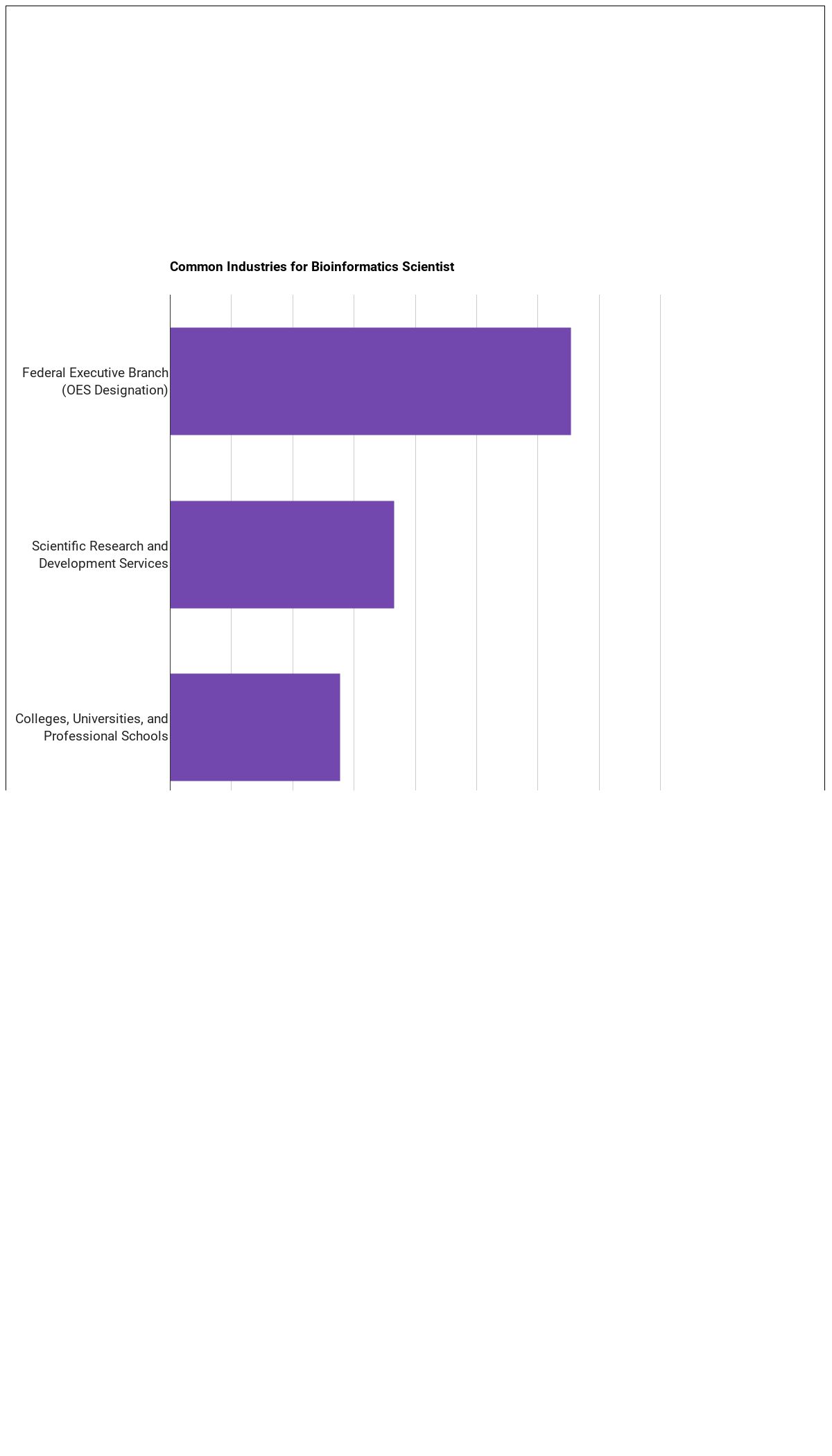
Most bioinformatics scientists are found across these industries:
| Industry | Employment | Median annual wage |
|---|---|---|
| Professional, Scientific, and Technical Services | 21,620 | $97,840 |
| Educational Services | 5,590 | $63,290 |
| Manufacturing | 4,180 | $108,160 |
| Health Care and Social Assistance | 2,440 | $91,830 |
| Wholesale Trade | 1,200 | $103,890 |
| Administrative and Support and Waste Management and Remediation Services | 900 | $92,020 |
| Management of Companies and Enterprises | 550 | $122,580 |
| Other Services (except Public Administration) | 200 | $64,090 |

Bioinformatics Scientists work in the following industries:
Tools and Technology
- Data base user interface and query software: Amazon Web Services AWS software (hot technology)
- Data base management system software: Apache Hadoop (hot technology)
- Operating system software: Bash (hot technology)
- Development environment software: C (hot technology)
- Object or component oriented development software: C# (hot technology)
- Object or component oriented development software: C++ (hot technology)
- Web platform development software: Django (hot technology)
- Application server software: Docker (hot technology)
- Enterprise application integration software: Extensible markup language XML (hot technology)
- File versioning software: Git (hot technology)
- Application server software: GitHub (hot technology)
- Web platform development software: Hypertext markup language HTML (hot technology)
Work Environment
The work environment for bioinformatics scientists tends to involve the following characteristics:
- Face-to-Face Discussions with Individuals and Within Teams
- Freedom to Make Decisions
- Spend Time Sitting
- Determine Tasks, Priorities and Goals
Getting Started in This Career
Typical bioinformatics scientists positions require a bachelor’s degree as the typical entry-level education. This occupation sits in Extensive Preparation Needed (Job Zone 5), reflecting the level of preparation typically expected.
Related Careers
Similar Occupations
- Natural Sciences Managers (Supplemental)
- Software Developers (Supplemental)
- Mathematicians (Supplemental)
- Statisticians (Primary-Long)
- Biostatisticians (Primary-Long)
- Data Scientists (Primary-Short)
- Clinical Data Managers (Supplemental)
- Bioinformatics Technicians (Primary-Short)
Top Programs to Study For This Career
Aspiring bioinformatics scientists often complete programs in:
Biological and Biomedical Sciences
59 programs across 14 majors
- General Biology
- Neurobiology & Neurosciences
- Cell Biology & Anatomical Sciences
- Ecology & Systematics Biology
- Other Biological Sciences
- Biotechnology
- Biochemistry & Biophysics
- Biomathematics & Bioinformatics
- Microbiology Science & Immunology
- Genetics
- Botany/Plant Biology
- Pharmacology & Toxicology
- Zoology
- Physiology & Pathology Sciences
Multi/Interdisciplinary Studies
3 programs across 3 majors
Psychology
1 programs across 1 majors
Mathematics and Statistics
1 programs across 1 majors
References
This profile draws on the following authoritative sources:
- U.S. Bureau of Labor Statistics — Occupational Employment and Wage Statistics (OEWS) for employment and wage data by state and industry.
- BLS Employment Projections for total employment and growth forecasts.
- O*NET (Occupational Information Network) for skills, knowledge, tasks, work activities, work context, technology, and education-zone data.
SOC code: 19-1029.01 (Biological Scientists, All Other).

Course Advisor provides higher-education, college and university, degree, program, career, salary, and other helpful information to students, faculty, institutions, and other internet audiences. Presented information and data are subject to change. Inclusion on this website does not imply or represent a direct relationship with the company, school, or brand. Information, though believed correct at time of publication, may not be correct, and no warranty is provided. Contact the schools to verify any information before relying on it. Financial aid may be available for those who qualify. The displayed options may include sponsored or recommended results, not necessarily based on your preferences.
© Course Advisor – All Rights Reserved.