Civil Engineers: Career Profile
Perform engineering duties in planning, designing, and overseeing construction and maintenance of building structures and facilities, such as roads, railroads, airports, bridges, harbors, channels, dams, irrigation projects, pipelines, power plants, and water and sewage systems.
Featured schools near , edit
What Tasks Do Civil Engineers Perform?
The core tasks performed by civil engineers cover:
- Direct engineering activities, ensuring compliance with environmental, safety, or other governmental regulations.
- Manage and direct the construction, operations, or maintenance activities at project site.
- Inspect project sites to monitor progress and ensure conformance to design specifications and safety or sanitation standards.
- Compute load and grade requirements, water flow rates, or material stress factors to determine design specifications.
- Plan and design transportation or hydraulic systems or structures, using computer-assisted design or drawing tools.
- Provide technical advice to industrial or managerial personnel regarding design, construction, program modifications, or structural repairs.
- Analyze survey reports, maps, drawings, blueprints, aerial photography, or other topographical or geologic data.
- Direct or participate in surveying to lay out installations or establish reference points, grades, or elevations to guide construction.
What Civil Engineers Need to Know
Effective civil engineers rely on a mix of skills and domain knowledge.
Most Important Skills
These are the skills most important for this role, rated on an importance scale of 0 to 5:
Knowledge Areas
Other Civil Engineers Job Titles
This career also goes by job titles like:
- Airport Engineer
- Architectural Engineer
- Asphalt Engineer
- Base Engineer
- Bridge Design Engineer
- Bridge Engineer
- Building Construction Engineer
- Building Engineer
Employment and Demand
There are roughly 249,734 civil engineers working in the United States today. This occupation is expected to grow by +11.7% over the projection horizon.

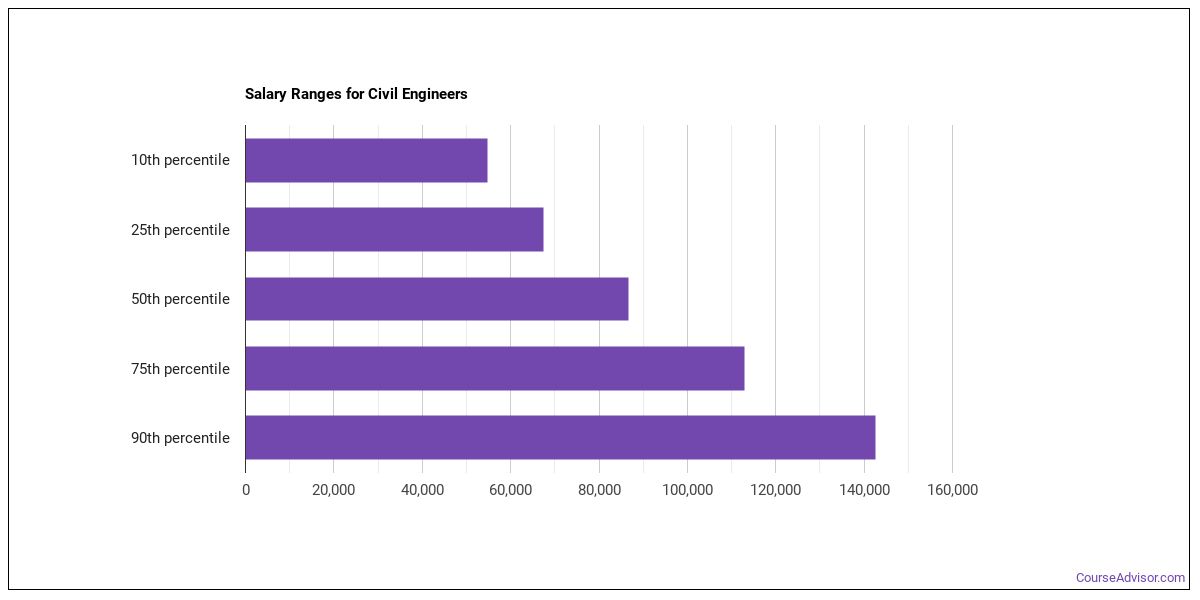
Salary for Civil Engineers
| Statistic | Value |
|---|---|
| Annual median | $72,457 |
| Hourly median | $34.84 |
| 10th percentile | $51,553 |
| 25th percentile | $62,005 |
| 75th percentile | $82,909 |
| 90th percentile | $93,361 |
Pay can vary substantially based on experience, location, and industry.
How Much Do Civil Engineers Make in Different U.S. States?
| State | Annual median salary |
|---|---|
| California | $118,450 |
| Rhode Island | $112,250 |
| Alaska | $107,240 |
| Washington | $105,090 |
| New Mexico | $104,600 |
| Massachusetts | $104,450 |
| Mississippi | $103,940 |
| New Jersey | $103,690 |
| Oregon | $103,070 |
| New York | $102,440 |
| Louisiana | $102,350 |
| District of Columbia | $102,170 |
| Connecticut | $101,800 |
| Minnesota | $101,440 |
| Maryland | $100,320 |
| Kentucky | $100,200 |
| Delaware | $99,820 |
| South Carolina | $99,680 |
| Oklahoma | $99,540 |
| Nebraska | $99,360 |
| Nevada | $98,690 |
| Alabama | $98,100 |
| Florida | $97,810 |
| Tennessee | $97,730 |
| Illinois | $97,640 |
| Virginia | $96,210 |
| North Dakota | $96,160 |
| Wyoming | $95,800 |
| South Dakota | $95,110 |
| Texas | $95,050 |
| Indiana | $95,000 |
| Idaho | $94,990 |
| Hawaii | $94,970 |
| Maine | $94,880 |
| Iowa | $94,500 |
| North Carolina | $93,590 |
| Arizona | $93,500 |
| Ohio | $93,480 |
| Missouri | $93,020 |
| Pennsylvania | $92,460 |
| New Hampshire | $92,020 |
| Utah | $92,000 |
| Wisconsin | $90,770 |
| West Virginia | $88,200 |
| Kansas | $86,780 |
| Vermont | $85,720 |
| Michigan | $85,550 |
| Arkansas | $81,930 |
| Georgia | $81,030 |
| Montana | $80,390 |
| Guam | $72,770 |
| Puerto Rico | $60,510 |
Pay by U.S. Region
Earnings for civil engineers vary by region. The following regions pay the most:
| Region | Median annual wage | Share of U.S. jobs | Location quotient |
|---|---|---|---|
| Far Western US | $113,900 | 21.6% | 1.31 |
| New England | $101,770 | 5.2% | 1.09 |
| Middle Atlantic | $99,175 | 12.9% | 0.87 |
| Southwest | $95,399 | 12.3% | 1.00 |
| Southeast | $95,315 | 23.6% | 1.02 |
| Plains States | $95,053 | 5.6% | 0.86 |
| Great Lakes | $93,032 | 11.4% | 0.84 |
| Other U.S. Territories | $62,858 | 0.7% | 1.45 |
Top Metro Areas
| Metro area | State | Median annual wage | Employment |
|---|---|---|---|
| Sacramento-Roseville-Folsom, CA | CA | $130,310 | 5,190 |
| San Jose-Sunnyvale-Santa Clara, CA | CA | $129,260 | 3,180 |
| Redding, CA | CA | $127,130 | 330 |
| San Francisco-Oakland-Fremont, CA | CA | $126,560 | 9,920 |
| Napa, CA | CA | $122,820 | 160 |
| Kennewick-Richland, WA | WA | $121,170 | 500 |
| Walla Walla, WA | WA | $119,080 | 210 |
| Deltona-Daytona Beach-Ormond Beach, FL | FL | $118,830 | 340 |
Which Industries Hire Civil Engineers
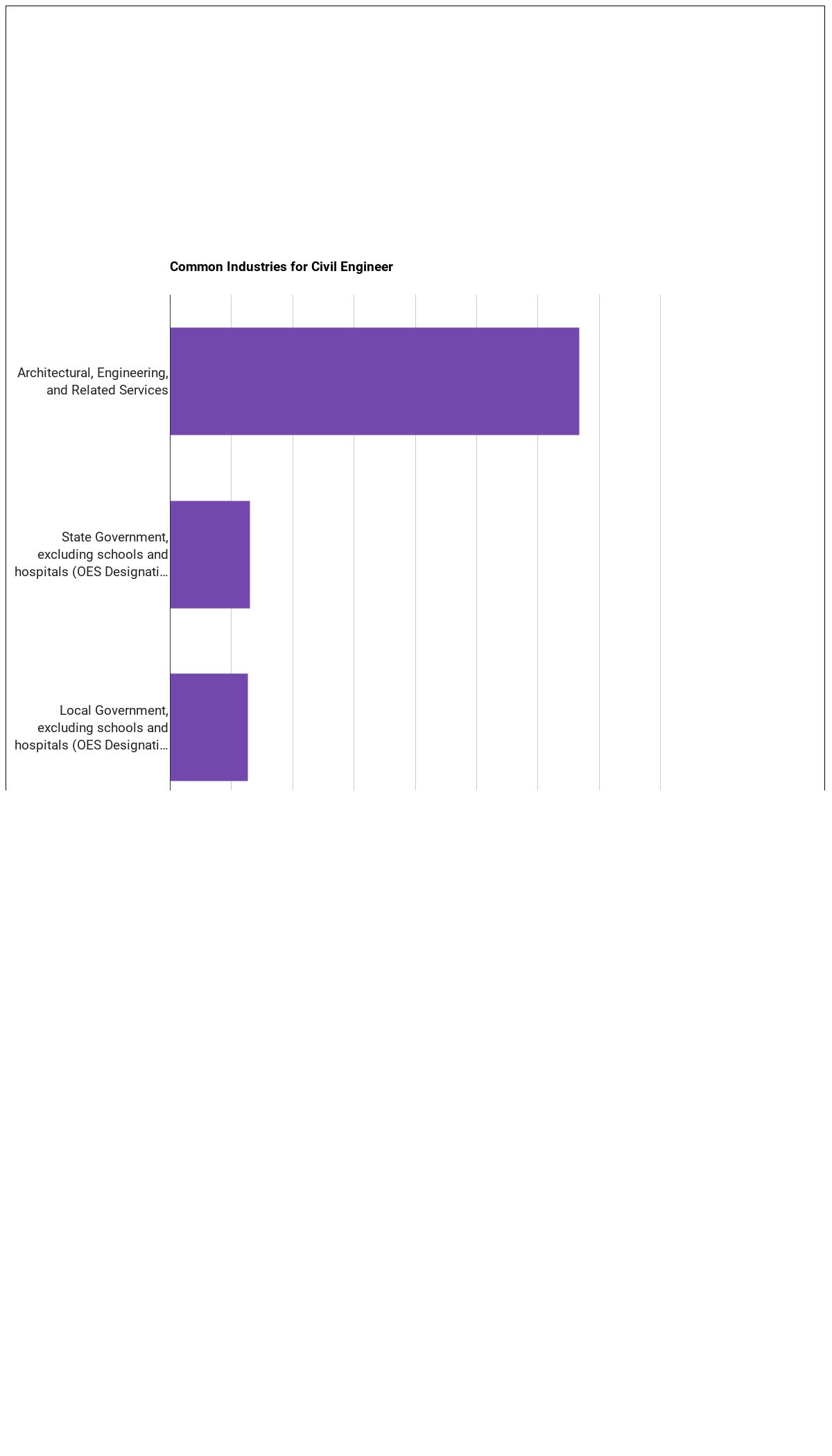
The largest employers of civil engineers work in these industries:
| Industry | Employment | Median annual wage |
|---|---|---|
| Professional, Scientific, and Technical Services | 202,800 | $99,670 |
| Construction | 44,580 | $82,970 |
| Administrative and Support and Waste Management and Remediation Services | 5,010 | $108,140 |
| Manufacturing | 4,190 | $104,310 |
| Management of Companies and Enterprises | 3,180 | $117,740 |
| Real Estate and Rental and Leasing | 2,500 | $90,510 |
| Educational Services | 2,070 | $102,000 |
| Utilities | 1,940 | $113,380 |

Below are examples of industries where civil engineers work:
Software Civil Engineers Use
- Document management software: Adobe Acrobat (hot technology)
- File versioning software: Apache Subversion SVN (hot technology)
- Computer aided design CAD software: Autodesk AutoCAD (hot technology)
- Computer aided design CAD software: Autodesk AutoCAD Civil 3D (hot technology)
- Computer aided design CAD software: Autodesk Revit (hot technology)
- Computer aided design CAD software: Bentley MicroStation (hot technology)
- Development environment software: C (hot technology)
- Computer aided design CAD software: Dassault Systemes SolidWorks (hot technology)
- Geographic information system: ESRI ArcGIS software (hot technology)
- Enterprise application integration software: Extensible markup language XML (hot technology)
- Data base user interface and query software: Microsoft Access (hot technology)
- Spreadsheet software: Microsoft Excel (hot technology)
Work Environment
The work environment for civil engineers reflects the following characteristics:
- Telephone Conversations
- Face-to-Face Discussions with Individuals and Within Teams
- Indoors, Environmentally Controlled
- Importance of Being Exact or Accurate
How to Become Civil Engineers
Typical civil engineers positions require a bachelor’s degree as the typical entry-level education. This career aligns with Considerable Preparation Needed (Job Zone 4), signaling the level of preparation typically expected.
Other Careers to Consider
Similar Occupations
- Construction Managers (Primary-Short)
- Architectural and Engineering Managers (Primary-Long)
- Brownfield Redevelopment Specialists and Site Managers (Supplemental)
- Architects, Except Landscape and Naval (Primary-Long)
- Transportation Engineers (Primary-Short)
- Water/Wastewater Engineers (Primary-Short)
- Electrical Engineers (Supplemental)
- Environmental Engineers (Primary-Long)
Top Programs to Study For This Career
Future civil engineers typically earn programs in:
Engineering
7 programs across 2 majors
References
Statistics shown above are sourced from the following authoritative sources:
- U.S. Bureau of Labor Statistics — Occupational Employment and Wage Statistics (OEWS) for employment and wage data by state and industry.
- BLS Employment Projections for total employment and growth forecasts.
- O*NET (Occupational Information Network) for skills, knowledge, tasks, work activities, work context, technology, and education-zone data.
SOC code: 17-2051.00 (Civil Engineers).

Course Advisor provides higher-education, college and university, degree, program, career, salary, and other helpful information to students, faculty, institutions, and other internet audiences. Presented information and data are subject to change. Inclusion on this website does not imply or represent a direct relationship with the company, school, or brand. Information, though believed correct at time of publication, may not be correct, and no warranty is provided. Contact the schools to verify any information before relying on it. Financial aid may be available for those who qualify. The displayed options may include sponsored or recommended results, not necessarily based on your preferences.
© Course Advisor – All Rights Reserved.