Civil Engineers in Iowa
Considering working as a Civil Engineers in Iowa? Here’s what the data says. Perform engineering duties in planning, designing, and overseeing construction and maintenance of building structures and facilities, such as roads, railroads, airports, bridges, harbors, channels, dams, irrigation projects, pipelines, power plants, and water and sewage systems. Includes architectural, structural, traffic, and geotechnical engineers. Excludes “Hydrologists” (19-2043).
What do Civil Engineers Make in Iowa?
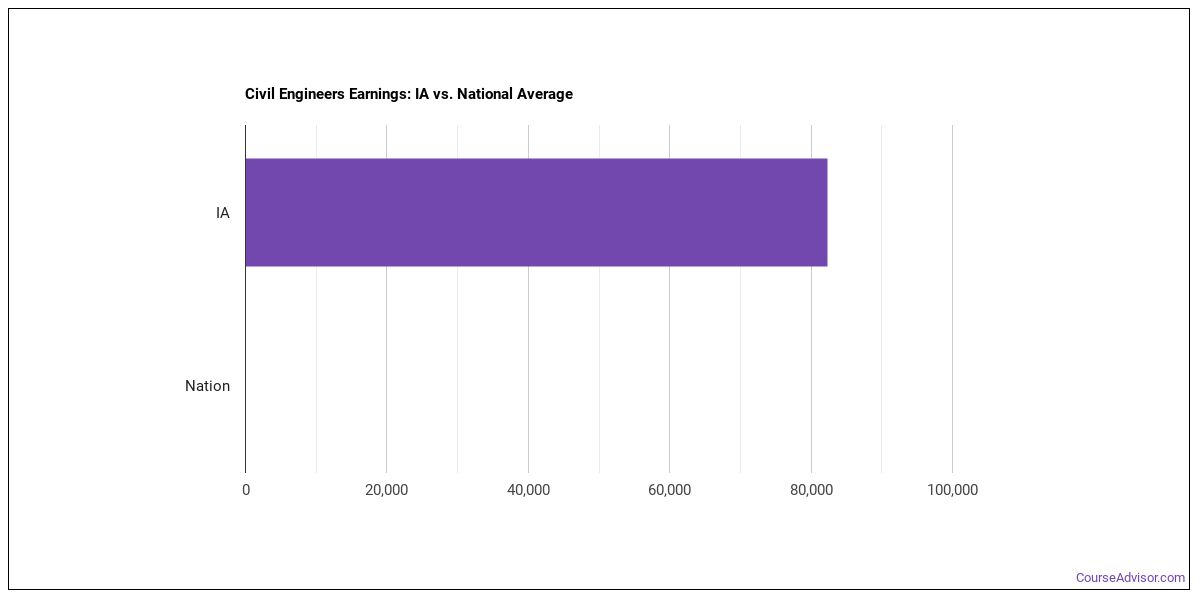
The civil engineers working in Iowa, wages run about $94,500 per year (or roughly $45.43/hour).Annual wages span from $63,860 at the 10th percentile to $134,230 at the 90th percentile.
| Wage Statistic | Annual | Hourly |
|---|---|---|
| 10th percentile | $63,860 | $30.70 |
| 25th percentile | $76,170 | $36.62 |
| Median (50th) | $94,500 | $45.43 |
| 75th percentile | $112,030 | $53.86 |
| 90th percentile | $134,230 | $64.54 |

The job concentration index in Iowa nationwide is 0.71, meaning fewer civil engineers per worker than the national average.
National Wage Comparison
Nationally, civil engineers earn a median of $72,457 per year ($34.84/hour), higher than the Iowa median.
Employment Outlook
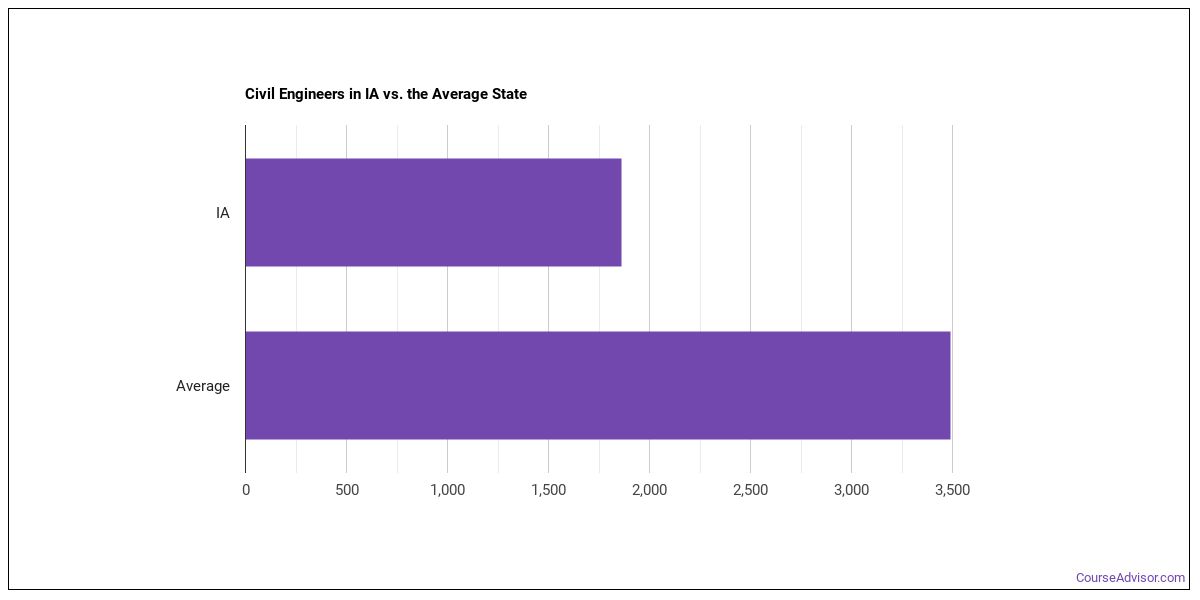
National employment for 249,734 civil engineers in the U.S.. In Iowa alone, about 2,560 people work in this role. That’s below the typical state, which employs around 4,130 civil engineers.

Top Iowa Metros for Civil Engineers
The metro areas below employ the most civil engineers in Iowa.
| Metro Area | Number Employed | Annual Median Salary |
|---|---|---|
| Des Moines-West Des Moines, IA | 780 | $96,440 |
| Davenport-Moline-Rock Island, IA-IL | 450 | $95,220 |
| Cedar Rapids, IA | 310 | $92,460 |
| Ames, IA | 270 | $101,290 |
| Iowa City, IA | 140 | $89,730 |
| Dubuque, IA | 120 | $88,680 |
| Waterloo-Cedar Falls, IA | 100 | $94,690 |
| Sioux City, IA-NE-SD | 90 | $103,260 |
Top States for Civil Engineers Employment
These states have the highest employment of civil engineers work.
| State | Number Employed |
|---|---|
| California | 54,640 |
| Texas | 33,790 |
| Florida | 22,780 |
| New York | 17,000 |
| Pennsylvania | 14,610 |
| Colorado | 13,510 |
| Illinois | 13,400 |
| North Carolina | 12,670 |
| Washington | 11,900 |
| Virginia | 11,030 |
| Massachusetts | 9,460 |
| Georgia | 8,820 |
| Ohio | 8,520 |
| Michigan | 7,760 |
| South Carolina | 7,460 |
| Wisconsin | 7,050 |
| New Jersey | 6,780 |
| Arizona | 6,270 |
| Alabama | 5,920 |
| Missouri | 5,280 |
Highest-Paying States for Civil Engineers
Where civil engineers earn the most: civil engineers.
| State | Annual Median Salary |
|---|---|
| California | $118,450 |
| Rhode Island | $112,250 |
| Alaska | $107,240 |
| Washington | $105,090 |
| New Mexico | $104,600 |
| Massachusetts | $104,450 |
| Mississippi | $103,940 |
| New Jersey | $103,690 |
| Oregon | $103,070 |
| New York | $102,440 |
Skills
The most important civil engineers skills, rated on an importance scale of 0 to 5:
Knowledge Areas
Key knowledge areas for this occupation, rated on an importance scale of 0 to 5:
Abilities
The abilities that matter most for civil engineers, rated on an importance scale of 0 to 5:
Daily Tasks
Civil Engineers typically:
- Direct engineering activities, ensuring compliance with environmental, safety, or other governmental regulations.
- Manage and direct the construction, operations, or maintenance activities at project site.
- Inspect project sites to monitor progress and ensure conformance to design specifications and safety or sanitation standards.
- Compute load and grade requirements, water flow rates, or material stress factors to determine design specifications.
- Plan and design transportation or hydraulic systems or structures, using computer-assisted design or drawing tools.
- Provide technical advice to industrial or managerial personnel regarding design, construction, program modifications, or structural repairs.
- Analyze survey reports, maps, drawings, blueprints, aerial photography, or other topographical or geologic data.
- Direct or participate in surveying to lay out installations or establish reference points, grades, or elevations to guide construction.
- Estimate quantities and cost of materials, equipment, or labor to determine project feasibility.
- Prepare or present public reports on topics such as bid proposals, deeds, environmental impact statements, or property and right-of-way descriptions.
- Design energy-efficient or environmentally sound civil structures.
- Test soils or materials to determine the adequacy and strength of foundations, concrete, asphalt, or steel.
Work Activities
- Getting Information
- Making Decisions and Solving Problems
- Communicating with Supervisors, Peers, or Subordinates
- Updating and Using Relevant Knowledge
- Evaluating Information to Determine Compliance with Standards
- Drafting, Laying Out, and Specifying Technical Devices, Parts, and Equipment
- Working with Computers
- Coordinating the Work and Activities of Others
- Communicating with People Outside the Organization
- Processing Information
- Scheduling Work and Activities
- Inspecting Equipment, Structures, or Materials
Tools & Technology
Technologies frequently used: Hot technologies: Adobe Acrobat, Apache Subversion SVN, Autodesk AutoCAD In-demand technologies: Autodesk AutoCAD
What Major Will Prepare You For This Career?
Programs that train for this career include:
- Civil Engineering
- Construction Engineering
Featured schools near , edit
Related Careers
Other careers like civil engineers include:
- Construction Managers
- Architectural and Engineering Managers
- Brownfield Redevelopment Specialists and Site Managers
- Architects, Except Landscape and Naval
- Transportation Engineers
- Water/Wastewater Engineers
Also Known As
Airport Engineer, Architectural Engineer, Asphalt Engineer, Base Engineer, Bridge Design Engineer, Bridge Engineer, Building Construction Engineer, Building Engineer, Cadastral Engineer, Cartographic Engineer, City Engineer, Civil Engineer, Civil Engineering Intern, Civil Project Engineer, Concrete Engineer.
References
- U.S. Bureau of Labor Statistics, Occupational Employment and Wage Statistics — https://www.bls.gov/oes/
- O*NET Online — https://www.onetonline.org/
- BLS Employment Projections — https://www.bls.gov/emp/
- O*NET-SOC code: 17-2051.00

Course Advisor provides higher-education, college and university, degree, program, career, salary, and other helpful information to students, faculty, institutions, and other internet audiences. Presented information and data are subject to change. Inclusion on this website does not imply or represent a direct relationship with the company, school, or brand. Information, though believed correct at time of publication, may not be correct, and no warranty is provided. Contact the schools to verify any information before relying on it. Financial aid may be available for those who qualify. The displayed options may include sponsored or recommended results, not necessarily based on your preferences.
© Course Advisor – All Rights Reserved.