Anesthesiologists in Texas
Thinking about a career as an Anesthesiologists in Texas? Below are the key facts. Administer anesthetics and analgesics for pain management prior to, during, or after surgery.
What do Anesthesiologists Make in Texas?
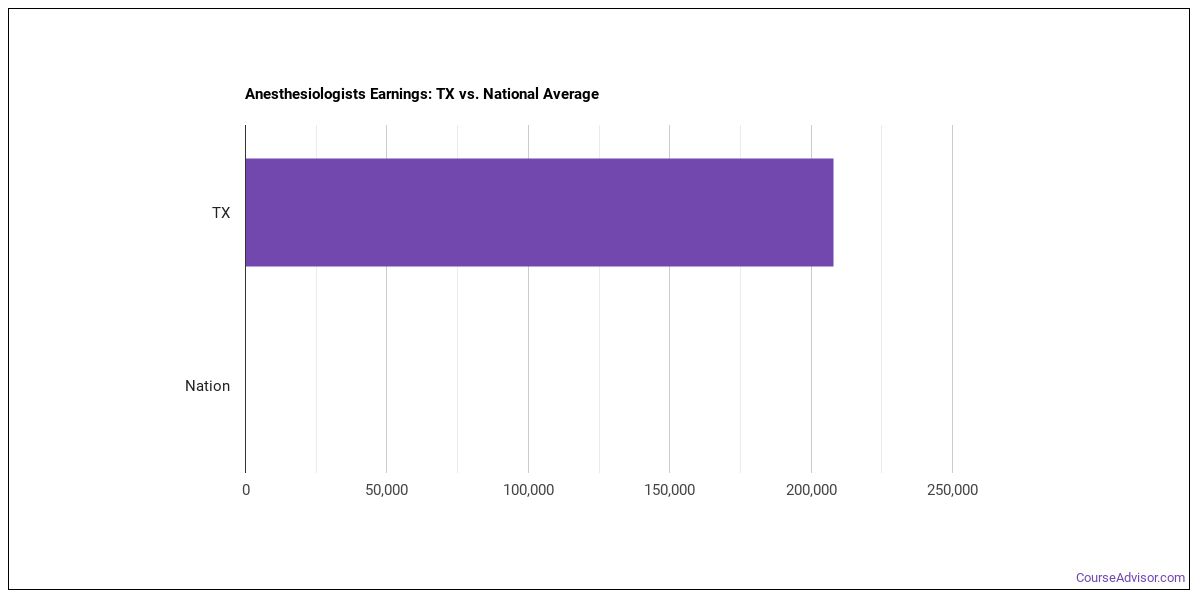
The anesthesiologists working in Texas, wages run about $203,450 per year (or roughly $97.81/hour).
| Wage Statistic | Annual | Hourly |
|---|---|---|
| 10th percentile | $176,930 | $85.06 |
| 25th percentile | $183,360 | $88.16 |
| Median (50th) | $203,450 | $97.81 |
| 75th percentile | n/a | n/a |
| 90th percentile | n/a | n/a |

The location quotient — a measure of how concentrated this occupation is in Texas compared to the national average — is 1.00.
National Wage Comparison
Nationally, anesthesiologists earn a median of $78,195 per year ($37.59/hour), higher than the Texas median.
Employment Outlook
There are roughly 2,641,515 anesthesiologists across the United States. In Texas alone, about 3,740 people work in this role. That’s higher than the typical state, which employs around 720 anesthesiologists.


Top Texas Metros for Anesthesiologists
These are the Texas metros with the most anesthesiologists in Texas.
| Metro Area | Number Employed | Annual Median Salary |
|---|---|---|
| Dallas-Fort Worth-Arlington, TX | 1,530 | $208,680 |
| Houston-Pasadena-The Woodlands, TX | 1,190 | $202,830 |
Top States for Anesthesiologists Employment
View the states that employ the most anesthesiologists work.
| State | Number Employed |
|---|---|
| California | 4,680 |
| Texas | 3,740 |
| Florida | 3,290 |
| New Jersey | 1,910 |
| New York | 1,850 |
| Michigan | 1,680 |
| Massachusetts | 1,550 |
| Indiana | 1,290 |
| Wisconsin | 1,100 |
| Illinois | 970 |
| Minnesota | 970 |
| South Carolina | 870 |
| Tennessee | 860 |
| Pennsylvania | 810 |
| Ohio | 800 |
| Oregon | 720 |
| Utah | 720 |
| Kentucky | 710 |
| Georgia | 600 |
| Kansas | 570 |
Highest-Paying States for Anesthesiologists
Where anesthesiologists earn the most: anesthesiologists.
| State | Annual Median Salary |
|---|---|
| South Carolina | $229,870 |
| New York | $215,740 |
| Georgia | $206,890 |
| Texas | $203,450 |
| West Virginia | $168,390 |
Skills
Top anesthesiologists skills, rated on an importance scale of 0 to 5:
Knowledge Areas
Important knowledge areas for this occupation, rated on an importance scale of 0 to 5:
Abilities
Top abilities for anesthesiologists, rated on an importance scale of 0 to 5:
Daily Tasks
Day-to-day, anesthesiologists typically:
- Monitor patient before, during, and after anesthesia and counteract adverse reactions or complications.
- Record type and amount of anesthesia and patient condition throughout procedure.
- Provide and maintain life support and airway management and help prepare patients for emergency surgery.
- Administer anesthetic or sedation during medical procedures, using local, intravenous, spinal, or caudal methods.
- Examine patient, obtain medical history, and use diagnostic tests to determine risk during surgical, obstetrical, and other medical procedures.
- Position patient on operating table to maximize patient comfort and surgical accessibility.
- Coordinate administration of anesthetics with surgeons during operation.
- Decide when patients have recovered or stabilized enough to be sent to another room or ward or to be sent home following outpatient surgery.
- Confer with other medical professionals to determine type and method of anesthetic or sedation to render patient insensible to pain.
- Order laboratory tests, x-rays, and other diagnostic procedures.
- Inform students and staff of types and methods of anesthesia administration, signs of complications, and emergency methods to counteract reactions.
- Provide medical care and consultation in many settings, prescribing medication and treatment and referring patients for surgery.
Work Activities
- Making Decisions and Solving Problems
- Assisting and Caring for Others
- Getting Information
- Updating and Using Relevant Knowledge
- Monitoring Processes, Materials, or Surroundings
- Evaluating Information to Determine Compliance with Standards
- Analyzing Data or Information
- Documenting/Recording Information
- Processing Information
- Identifying Objects, Actions, and Events
- Communicating with Supervisors, Peers, or Subordinates
- Inspecting Equipment, Structures, or Materials
Tools & Technology
Common tools and software used in this occupation include: Hot technologies: Epic Systems In-demand technologies: Epic Systems
What Major Will Prepare You For This Career?
Programs that train for this career include:
- Medicine
- Combined Medical Residency/Fellowship Programs
- Anesthesiology Residency/Fellowship Programs
Featured schools near , edit
Related Careers
Careers similar to anesthesiologists include:
- Physician Assistants
- Anesthesiologist Assistants
- Respiratory Therapists
- Registered Nurses
- Acute Care Nurses
- Nurse Anesthetists
Also Known As
Ambulatory Anesthesiologist, Anaesthesiologist, Anesthesiologist, Anesthesiology Pain Management Physician, Anesthesiology Physician, Anesthetist, Cardiac Anesthesiologist, DO Physician (Doctor of Osteopathic Medicine Physician), General Anesthesiologist, Medical Doctor (MD), Obstetrical Anesthesiologist, Pediatric Anesthesiologist, Staff Anesthesiologist, Staff Anesthetist.
References
- U.S. Bureau of Labor Statistics, Occupational Employment and Wage Statistics — https://www.bls.gov/oes/
- O*NET Online — https://www.onetonline.org/
- BLS Employment Projections — https://www.bls.gov/emp/
- O*NET-SOC code: 29-1211.00

Course Advisor provides higher-education, college and university, degree, program, career, salary, and other helpful information to students, faculty, institutions, and other internet audiences. Presented information and data are subject to change. Inclusion on this website does not imply or represent a direct relationship with the company, school, or brand. Information, though believed correct at time of publication, may not be correct, and no warranty is provided. Contact the schools to verify any information before relying on it. Financial aid may be available for those who qualify. The displayed options may include sponsored or recommended results, not necessarily based on your preferences.
© Course Advisor – All Rights Reserved.