Electrical Engineering at Seattle University
If you are interested in studying Electrical Engineering, take a look at what Seattle University. Get started with the following essential facts.
Seattle University is located in Seattle, WA.
During the most recent reporting year, 11 electrical engineering graduations were recorded at Seattle University.
Featured schools near , edit
Online Class Availability at Seattle University
Online coursework is an option at Seattle University. Among 7,189 students, 564 (8%) studied exclusively online and 915 (13%) took at least some classes online.
Electrical Engineering Rankings at Seattle University
Rankings can help you compare Seattle University’s Electrical Engineering program against peer institutions.
Bachelor’s-Level Rankings
| Ranking | Scope | Rank |
|---|---|---|
| Best Schools (Quality) | Washington | #7 of 8 |
| Best Value | Washington | #8 of 8 |
| Best Schools (Quality) | Far Western (Region) | #37 of 47 |
| Best Value | Far Western (Region) | #44 of 47 |
| Best Schools (Quality) | Nationwide | #167 of 310 |
| Best Value | Nationwide | #289 of 309 |
Earnings for Electrical Engineering Graduates from Seattle University
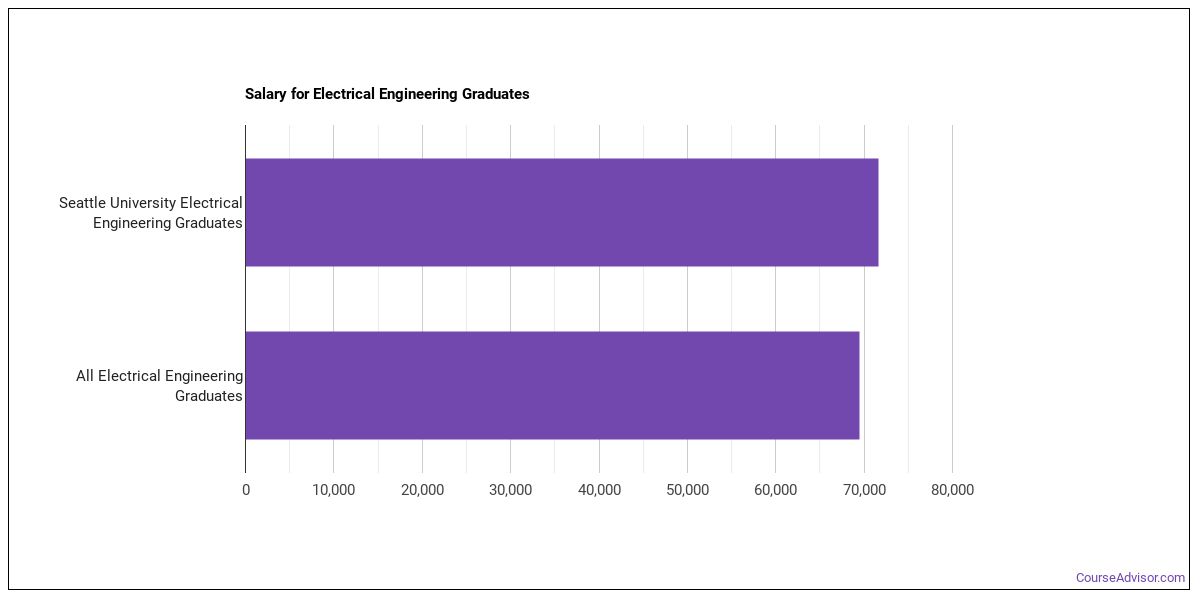
Graduates of Seattle University’s Electrical Engineering program report the following median earnings (per the U.S. Department of Education’s College Scorecard):
| Years After Graduation | Median Earnings |
|---|---|
| 1 year | $71,641 |
| 2 years | $71,473 |
| 3 years | $79,706 |
| 4 years | $86,784 |
| 5 years | $102,211 |
How does this compare to the school overall? At the four-year mark, Electrical Engineering graduates from Seattle University earn a median of $86,784, compared with $82,033 for all Seattle University graduates — about 6% higher than the school-wide median.

Median Debt at Graduation
Median student loan debt for Electrical Engineering graduates from Seattle University comes in at $25,000.
Student Demographics & Diversity
Below you’ll find the diversity of Electrical Engineering graduates at Seattle University, by degree type.
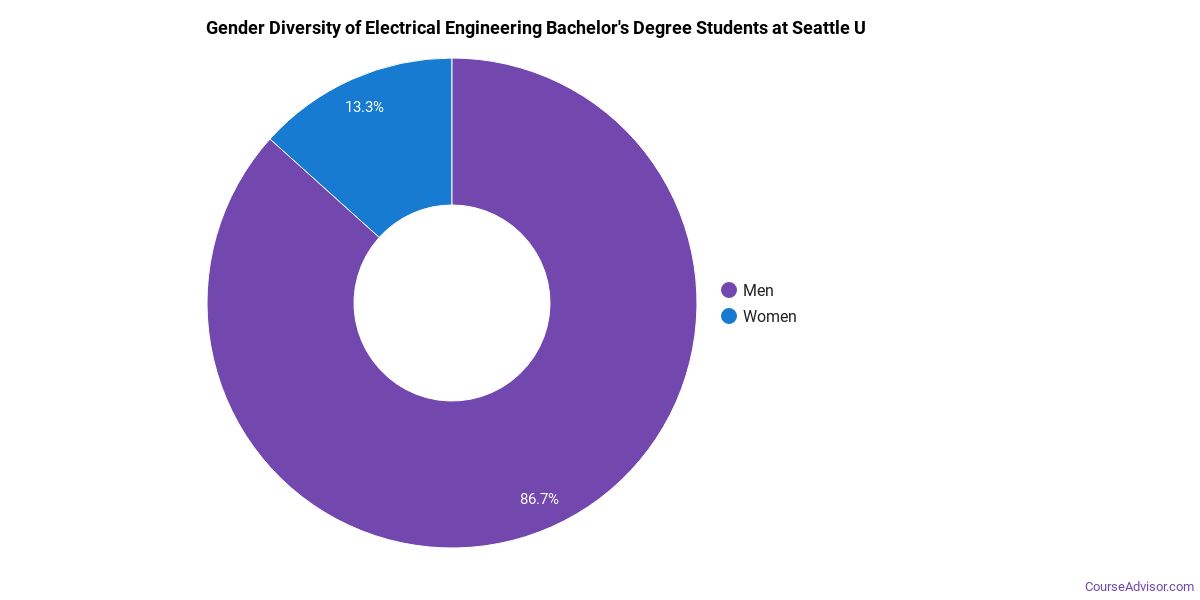
Across all degree levels, Electrical Engineering graduates at Seattle University are 18% women (2) and 82% men (9).
Electrical Engineering Bachelor’s Program at Seattle University
Among the 11 bachelor’s electrical engineering degrees awarded at Seattle University, 18% were women (2) and 82% were men (9).
The following table and chart show the race/ethnicity of Electrical Engineering bachelor’s degree recipients at Seattle University.
| Race / Ethnicity | Number of Graduates |
|---|---|
| White | 2 |
| Hispanic / Latino | 1 |
| Asian | 6 |
| International (Nonresident) | 2 |
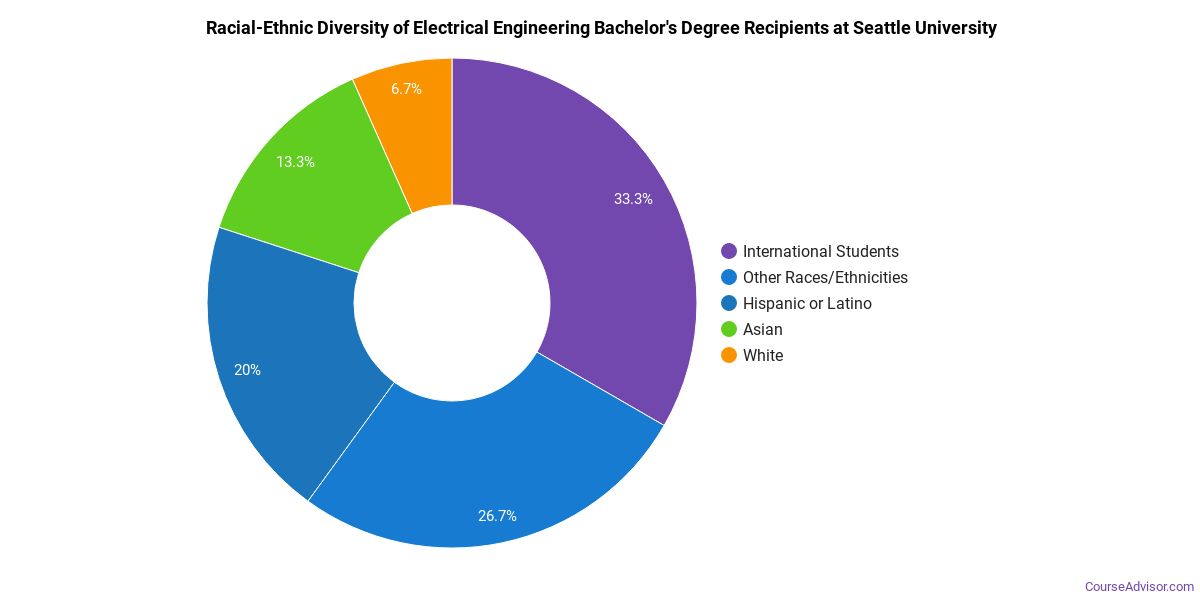
Racial-ethnic minorities make up 64% of Electrical Engineering bachelor’s degree recipients at Seattle University, above the national average of 42%.*
*The racial-ethnic minorities figure is the total number of graduates minus White, international (nonresident), and unknown-race graduates.
More Specific Electrical Engineering Concentrations at Seattle University
The Electrical Engineering program at Seattle University offers more specialized concentrations:
| Concentration | Graduates |
|---|---|
| Electrical Engineering | 11 |
Highest-Paying Careers for Electrical Engineering Graduates
Students who finish Electrical Engineering program at Seattle University work across a variety of fields. The table below ranks the top-paying careers for Electrical Engineering graduates, ordered by median annual salary:
| Occupation | Nationwide Median Wage |
|---|---|
| Engineers, All Other | $136,628 |
| Electrical Engineers | $127,814 |
| Electronics Engineers, Except Computer | $122,969 |
| Solar Energy Systems Engineers | $116,775 |
| Mechatronics Engineers | $115,569 |
| Microsystems Engineers | $104,558 |
| Architectural and Engineering Managers | $101,277 |
| Wind Energy Engineers | $98,460 |
| Biofuels/Biodiesel Technology and Product Development Managers | $89,263 |
| Photonics Engineers | $84,667 |
References
- IPEDS — Integrated Postsecondary Education Data System
- U.S. Department of Education — College Scorecard
- O*NET Online (Bureau of Labor Statistics)
- National Center for Education Statistics
More about our data sources and methodologies.

Course Advisor provides higher-education, college and university, degree, program, career, salary, and other helpful information to students, faculty, institutions, and other internet audiences. Presented information and data are subject to change. Inclusion on this website does not imply or represent a direct relationship with the company, school, or brand. Information, though believed correct at time of publication, may not be correct, and no warranty is provided. Contact the schools to verify any information before relying on it. Financial aid may be available for those who qualify. The displayed options may include sponsored or recommended results, not necessarily based on your preferences.
© Course Advisor – All Rights Reserved.