Security and Fire Alarm Systems Installers: Career Profile
Install, program, maintain, and repair security and fire alarm wiring and equipment. Ensure that work is in accordance with relevant codes.
Featured schools near , edit
The Daily Work of Security and Fire Alarm Systems Installers Perform?
Typical responsibilities of security and fire alarm systems installers span:
- Install, maintain, or repair security systems, alarm devices, or related equipment, following blueprints of electrical layouts and building plans.
- Mount and fasten control panels, door and window contacts, sensors, or video cameras, and attach electrical and telephone wiring to connect components.
- Demonstrate systems for customers and explain details, such as the causes and consequences of false alarms.
- Test and repair circuits and sensors, following wiring and system specifications.
- Feed cables through access holes, roof spaces, or cavity walls to reach fixture outlets, positioning and terminating cables, wires, or strapping.
- Examine systems to locate problems, such as loose connections or broken insulation.
- Test backup batteries, keypad programming, sirens, or other security features to ensure proper functioning or to diagnose malfunctions.
- Drill holes for wiring in wall studs, joists, ceilings, or floors.
Key Skills and Knowledge
Effective security and fire alarm systems installers draw on a mix of skills and domain knowledge.
Top Skills
These are the skills that matter most in this role, rated on an importance scale of 0 to 5:
Core Knowledge
Related Job Titles
This career also goes by job titles like:
- Access Control Technician
- Alarm Adjuster
- Alarm Installation Tech (Alarm Installation Technician)
- Alarm Installer
- Alarm Service Tech (Alarm Service Technician)
- Alarm Technician
- Burglar Alarm Inspector
- Burglar Alarm Installer
Employment and Demand
The U.S. employs around 126,053 security and fire alarm systems installers working in the United States today. Demand is forecast to grow by +5.2% over the projection horizon.

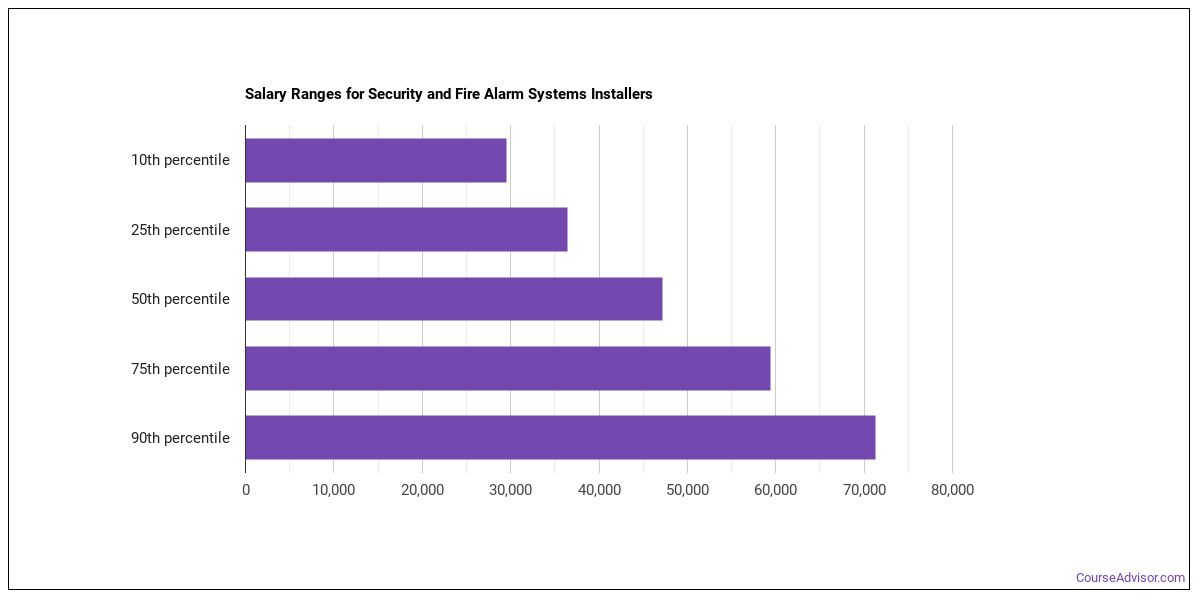
Salary for Security and Fire Alarm Systems Installers
| Statistic | Value |
|---|---|
| Annual median | $88,342 |
| Hourly median | $42.47 |
| 10th percentile | $54,275 |
| 25th percentile | $71,309 |
| 75th percentile | $105,376 |
| 90th percentile | $122,409 |
Compensation varies based on experience, location, and industry.
Security and Fire Alarm Systems Installers Salary by State
| State | Annual median salary |
|---|---|
| Oregon | $78,080 |
| Minnesota | $77,190 |
| Vermont | $73,530 |
| Rhode Island | $72,410 |
| New York | $66,280 |
| California | $66,010 |
| Maryland | $65,310 |
| Washington | $64,590 |
| Connecticut | $64,420 |
| New Jersey | $62,900 |
| Illinois | $62,550 |
| Alaska | $62,480 |
| Maine | $61,890 |
| Iowa | $61,860 |
| Colorado | $61,750 |
| Wisconsin | $61,270 |
| Ohio | $61,030 |
| Delaware | $60,820 |
| Hawaii | $60,710 |
| Virginia | $60,200 |
| Alabama | $59,660 |
| Florida | $59,570 |
| Nevada | $59,470 |
| Nebraska | $59,390 |
| Pennsylvania | $59,240 |
| North Dakota | $59,230 |
| Utah | $58,860 |
| Montana | $58,680 |
| North Carolina | $57,440 |
| Kansas | $57,230 |
| Missouri | $57,170 |
| Kentucky | $56,030 |
| Michigan | $54,020 |
| Arizona | $53,490 |
| New Hampshire | $52,640 |
| South Dakota | $51,590 |
| Idaho | $50,430 |
| Georgia | $50,050 |
| Indiana | $49,590 |
| West Virginia | $49,520 |
| Texas | $49,380 |
| Oklahoma | $48,870 |
| Tennessee | $47,400 |
| Arkansas | $47,310 |
| South Carolina | $47,170 |
| Louisiana | $46,110 |
| Mississippi | $45,990 |
| New Mexico | $45,440 |
| Wyoming | $42,350 |
| Guam | $35,600 |
| Puerto Rico | $27,270 |
Top-Paying U.S. Regions
Earnings for security and fire alarm systems installers shift depending on where you work. Top regions by median wage:
| Region | Median annual wage | Share of U.S. jobs | Location quotient |
|---|---|---|---|
| Far Western US | $66,091 | 14.2% | 0.88 |
| Middle Atlantic | $63,703 | 14.8% | 1.04 |
| Plains States | $60,037 | 6.7% | 1.25 |
| Rocky Mountains | $58,596 | 4.9% | 1.30 |
| Great Lakes | $58,267 | 9.9% | 0.72 |
| Southeast | $55,190 | 27.5% | 1.18 |
| Southwest | $49,869 | 16.7% | 1.33 |
| Other U.S. Territories | $28,175 | 0.6% | 0.90 |
Highest-Paying Metro Areas for Security and Fire Alarm Systems Installers
| Metro area | State | Median annual wage | Employment |
|---|---|---|---|
| Minneapolis-St. Paul-Bloomington, MN-WI | MN | $80,610 | 510 |
| Salem, OR | OR | $79,420 | 70 |
| San Jose-Sunnyvale-Santa Clara, CA | CA | $79,070 | 320 |
| St. Cloud, MN | MN | $78,660 | 40 |
| Portland-Vancouver-Hillsboro, OR-WA | OR | $78,110 | 840 |
| San Francisco-Oakland-Fremont, CA | CA | $77,180 | 920 |
| Providence-Warwick, RI-MA | RI | $75,830 | 410 |
| Peoria, IL | IL | $74,990 | 190 |
Which Industries Hire Security and Fire Alarm Systems Installers
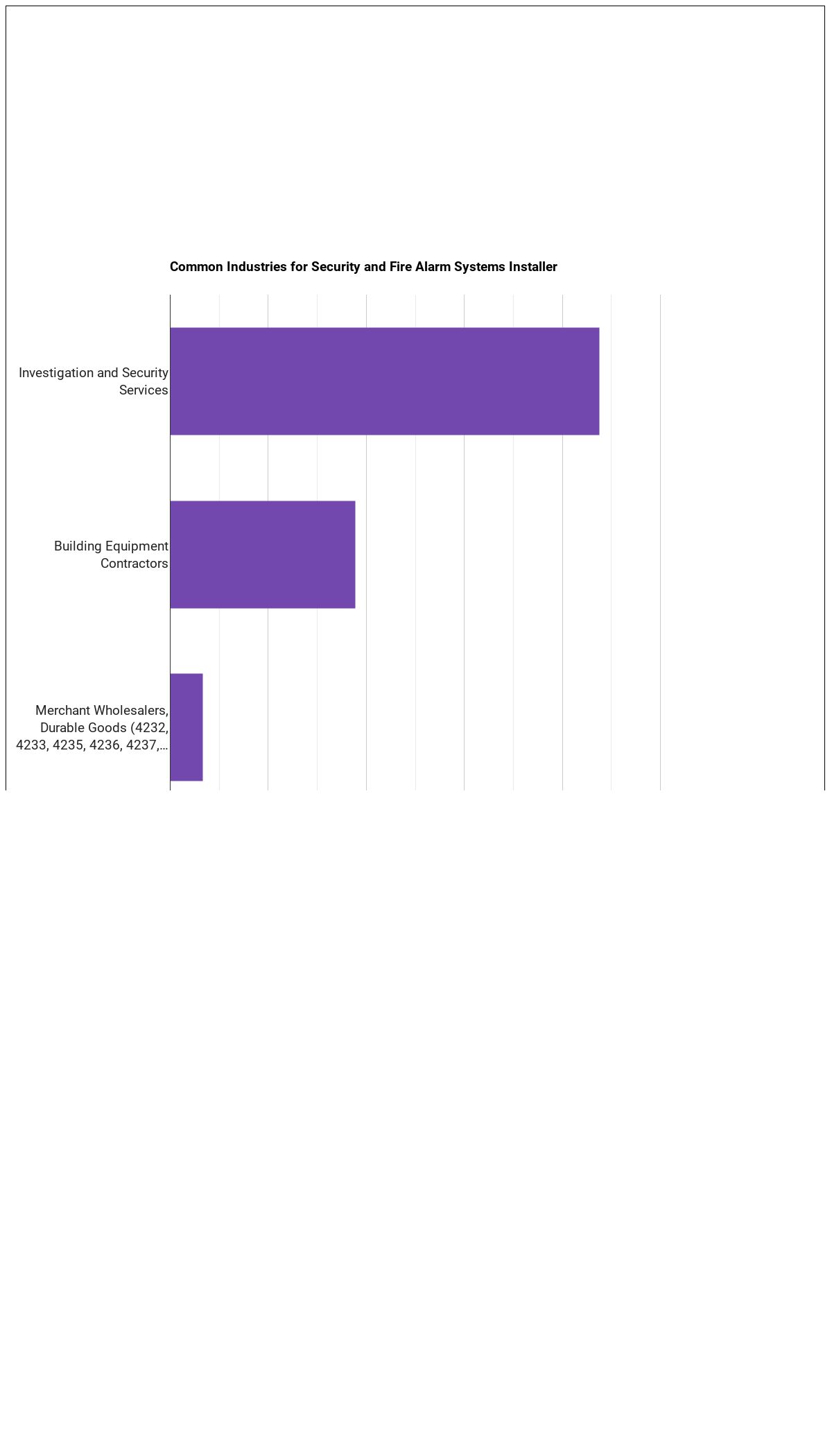
The bulk of security and fire alarm systems installers are concentrated in the following sectors:
| Industry | Employment | Median annual wage |
|---|---|---|
| Administrative and Support and Waste Management and Remediation Services | 54,570 | $59,110 |
| Construction | 18,140 | $60,500 |
| Wholesale Trade | 5,970 | $54,920 |
| Educational Services | 660 | $59,540 |
| Manufacturing | 250 | $81,900 |
| Retail Trade | 220 | $48,070 |
| Professional, Scientific, and Technical Services | 190 | $55,070 |
| Other Services (except Public Administration) | 140 | $59,770 |

The table below shows some of the most common industries where those employed in this career field work.
Tools and Technology
- Computer aided design CAD software: Autodesk AutoCAD (hot technology)
- Spreadsheet software: Microsoft Excel (hot technology)
- Office suite software: Microsoft Office software (hot technology)
- Electronic mail software: Microsoft Outlook (hot technology)
- Presentation software: Microsoft PowerPoint (hot technology)
- Operating system software: Microsoft Windows (hot technology)
- Word processing software: Microsoft Word (hot technology)
Work Environment
Daily working conditions for security and fire alarm systems installers is shaped by the following characteristics:
- Telephone Conversations
- Frequency of Decision Making
- Face-to-Face Discussions with Individuals and Within Teams
- Impact of Decisions on Co-workers or Company Results
- Wear Common Protective or Safety Equipment such as Safety Shoes, Glasses, Gloves, Hearing Protection, Hard Hats, or Life Jackets
How to Become Security and Fire Alarm Systems Installers
Entry-level security and fire alarm systems installers positions require some college, no degree as the typical entry-level education. This career aligns with Medium Preparation Needed (Job Zone 3), reflecting the level of preparation typically expected.
Other Careers to Consider
Similar Occupations
- Security Management Specialists (Primary-Long)
- Penetration Testers (Supplemental)
- Electronics Engineers, Except Computer (Supplemental)
- Fire-Prevention and Protection Engineers (Supplemental)
- Electrical and Electronic Engineering Technologists and Technicians (Primary-Long)
- Lighting Technicians (Primary-Short)
- Electricians (Primary-Long)
- Radio, Cellular, and Tower Equipment Installers and Repairers (Primary-Long)
Degree Programs
Future security and fire alarm systems installers typically earn programs in:
Construction Trades
1 programs across 1 majors
Mechanic and Repair Technologies/Technicians
1 programs across 1 majors
References
Data on this page comes from the following authoritative sources:
- U.S. Bureau of Labor Statistics — Occupational Employment and Wage Statistics (OEWS) for employment and wage data by state and industry.
- BLS Employment Projections for total employment and growth forecasts.
- O*NET (Occupational Information Network) for skills, knowledge, tasks, work activities, work context, technology, and education-zone data.
SOC code: 49-2098.00 (Security and Fire Alarm Systems Installers).

Course Advisor provides higher-education, college and university, degree, program, career, salary, and other helpful information to students, faculty, institutions, and other internet audiences. Presented information and data are subject to change. Inclusion on this website does not imply or represent a direct relationship with the company, school, or brand. Information, though believed correct at time of publication, may not be correct, and no warranty is provided. Contact the schools to verify any information before relying on it. Financial aid may be available for those who qualify. The displayed options may include sponsored or recommended results, not necessarily based on your preferences.
© Course Advisor – All Rights Reserved.