Mathematicians in Florida
Thinking about a career as a Mathematicians in Florida? Here’s what the data says. Conduct research in fundamental mathematics or in application of mathematical techniques to science, management, and other fields. Solve problems in various fields using mathematical methods.
What do Mathematicians Make in Florida?
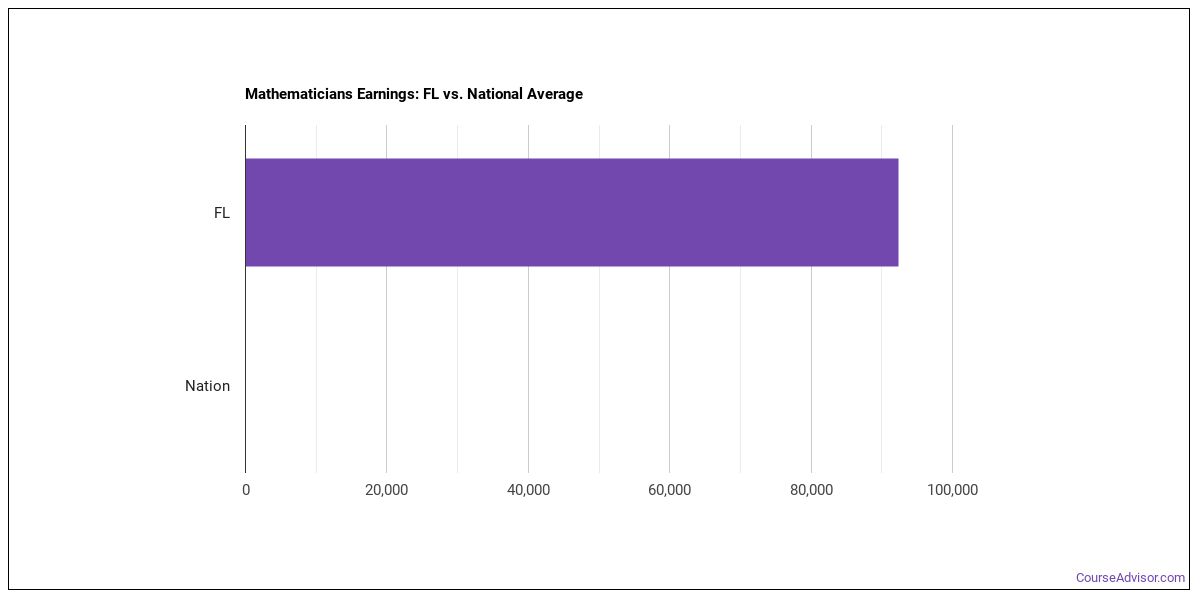
For mathematicians working in Florida, the typical annual salary is $105,370 per year (or roughly $50.66/hour).Annual wages span from $44,240 at the 10th percentile to $160,470 at the 90th percentile.
| Wage Statistic | Annual | Hourly |
|---|---|---|
| 10th percentile | $44,240 | $21.27 |
| 25th percentile | $70,570 | $33.93 |
| Median (50th) | $105,370 | $50.66 |
| 75th percentile | $134,430 | $64.63 |
| 90th percentile | $160,470 | $77.15 |

The job concentration index in Florida relative to the national average — is 0.61, meaning fewer mathematicians per worker than the national average.
National Wage Comparison
Nationally, mathematicians earn a median of $66,238 per year ($31.85/hour), higher than the Florida median.
Employment Outlook
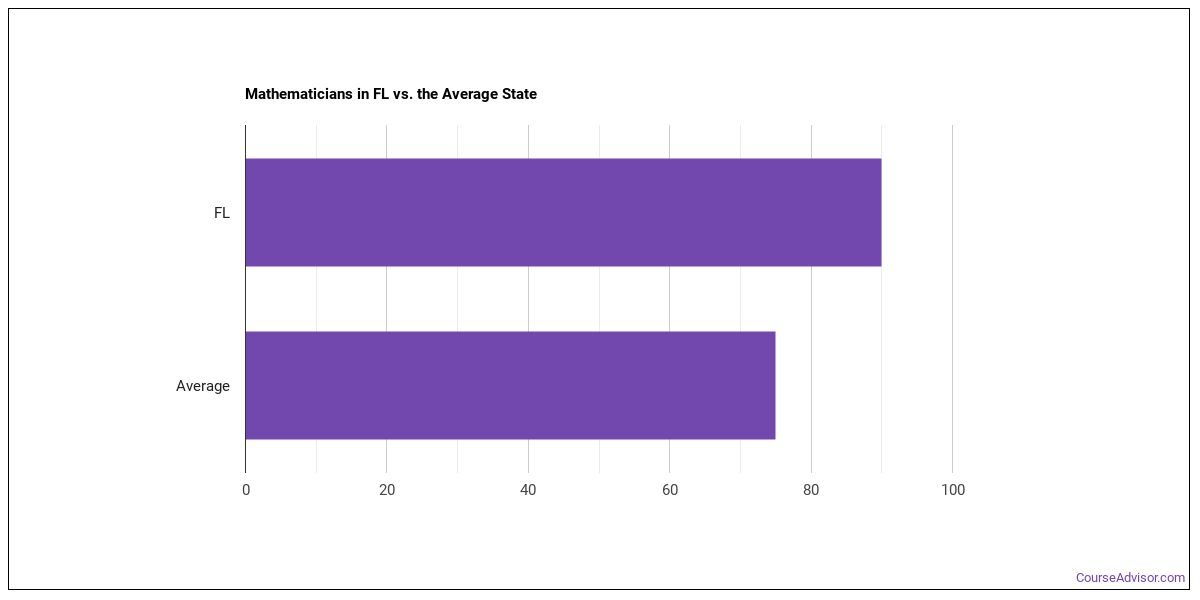
National employment for 101,262 mathematicians in the U.S.. In Florida alone, about 90 people work in this role. That matches the typical state median of 90.

Top States for Mathematicians Employment
These states have the highest employment of mathematicians work.
| State | Number Employed |
|---|---|
| Virginia | 400 |
| California | 240 |
| Washington | 180 |
| Maryland | 170 |
| New York | 150 |
| Nevada | 90 |
| Florida | 90 |
| Michigan | 80 |
| New Jersey | 70 |
| Illinois | 60 |
| Colorado | 60 |
| District of Columbia | 50 |
| Ohio | 30 |
Highest-Paying States for Mathematicians
These states pay the most for mathematicians.
| State | Annual Median Salary |
|---|---|
| District of Columbia | $154,480 |
| California | $143,890 |
| Virginia | $142,150 |
| Washington | $137,180 |
| Maryland | $128,940 |
| Illinois | $127,290 |
| Colorado | $108,500 |
| Florida | $105,370 |
| Nevada | $102,900 |
| New York | $98,620 |
Skills
Top mathematicians skills, rated on an importance scale of 0 to 5:
Knowledge Areas
Key knowledge areas for this occupation, rated on an importance scale of 0 to 5:
Abilities
The abilities that matter most for mathematicians, rated on an importance scale of 0 to 5:
Daily Tasks
Common tasks include:
- Mentor others on mathematical techniques.
- Maintain knowledge in the field by reading professional journals, talking with other mathematicians, and attending professional conferences.
- Develop new principles and new relationships between existing mathematical principles to advance mathematical science.
- Disseminate research by writing reports, publishing papers, or presenting at professional conferences.
- Assemble sets of assumptions, and explore the consequences of each set.
- Perform computations and apply methods of numerical analysis to data.
- Address the relationships of quantities, magnitudes, and forms through the use of numbers and symbols.
- Conduct research to extend mathematical knowledge in traditional areas, such as algebra, geometry, probability, and logic.
- Develop mathematical or statistical models of phenomena to be used for analysis or for computational simulation.
- Apply mathematical theories and techniques to the solution of practical problems in business, engineering, the sciences, or other fields.
- Develop computational methods for solving problems that occur in areas of science and engineering or that come from applications in business or industry.
- Design, analyze, and decipher encryption systems designed to transmit military, political, financial, or law-enforcement-related information in code.
Work Activities
- Thinking Creatively
- Analyzing Data or Information
- Updating and Using Relevant Knowledge
- Processing Information
- Working with Computers
- Training and Teaching Others
- Making Decisions and Solving Problems
- Getting Information
- Interpreting the Meaning of Information for Others
- Communicating with Supervisors, Peers, or Subordinates
- Organizing, Planning, and Prioritizing Work
- Coaching and Developing Others
Tools & Technology
Technologies frequently used: Hot technologies: Adobe Photoshop, Apple macOS, Atlassian JIRA, Bash, C In-demand technologies: Atlassian JIRA, C
What Major Will Prepare You For This Career?
Several college majors map to this occupation:
- Mathematics
- Applied Mathematics
- Statistics
- Other Statistics
- Mathematics & Computer Science
- Mathematical Economics
- Mathematics and Atmospheric/Oceanic Science
- Biomathematics & Bioinformatics
- Philosophy
Featured schools near , edit
Related Careers
Related occupations to mathematicians include:
- Financial Quantitative Analysts
- Computer and Information Research Scientists
- Software Developers
- Operations Research Analysts
- Statisticians
- Biostatisticians
Also Known As
Agent-Based Modeler, Algebraist, Applied Mathematician, Cipher Expert, Computational Mathematician, Computational Scientist, Cryptanalyst, Cryptographer, Cryptographic Vulnerability Analyst, Engineering Mathematician, Game Mathematician, Geometrician, Math Researcher (Mathematics Researcher), Mathematician, Research Computing Specialist.
References
- U.S. Bureau of Labor Statistics, Occupational Employment and Wage Statistics — https://www.bls.gov/oes/
- O*NET Online — https://www.onetonline.org/
- BLS Employment Projections — https://www.bls.gov/emp/
- O*NET-SOC code: 15-2021.00

Course Advisor provides higher-education, college and university, degree, program, career, salary, and other helpful information to students, faculty, institutions, and other internet audiences. Presented information and data are subject to change. Inclusion on this website does not imply or represent a direct relationship with the company, school, or brand. Information, though believed correct at time of publication, may not be correct, and no warranty is provided. Contact the schools to verify any information before relying on it. Financial aid may be available for those who qualify. The displayed options may include sponsored or recommended results, not necessarily based on your preferences.
© Course Advisor – All Rights Reserved.