Mathematical Science Teachers, Postsecondary: Job Description
Teach courses pertaining to mathematical concepts, statistics, and actuarial science and to the application of original and standardized mathematical techniques in solving specific problems and situations. Includes both teachers primarily engaged in teaching and those who do a combination of teaching and research.
Featured schools near , edit
The Daily Work of Mathematical Science Teachers, Postsecondary Perform?
The core tasks performed by mathematical science teachers, postsecondary cover:
- Compile, administer, and grade examinations, or assign this work to others.
- Evaluate and grade students' class work, assignments, and papers.
- Prepare and deliver lectures to undergraduate or graduate students on topics such as linear algebra, differential equations, and discrete mathematics.
- Maintain student attendance records, grades, and other required records.
- Prepare course materials, such as syllabi, homework assignments, and handouts.
- Plan, evaluate, and revise curricula, course content, and course materials and methods of instruction.
- Maintain regularly scheduled office hours to advise and assist students.
- Initiate, facilitate, and moderate classroom discussions.
What Mathematical Science Teachers, Postsecondary Need to Know
Successful mathematical science teachers, postsecondary combine a mix of skills and domain knowledge.
Key Skills
These are the skills that matter most in this role, rated on an importance scale of 0 to 5:
Core Knowledge
Related Job Titles
Common job titles for this role include:
- Actuarial Science Professor
- Actuarial Science Teacher
- Adjunct Instructor
- Adjunct Lecturer
- Adjunct Mathematics Instructor
- Adjunct Mathematics Professor (Adjunct Math Professor)
- Adjunct Professor
- Algebra Teacher
Employment and Demand
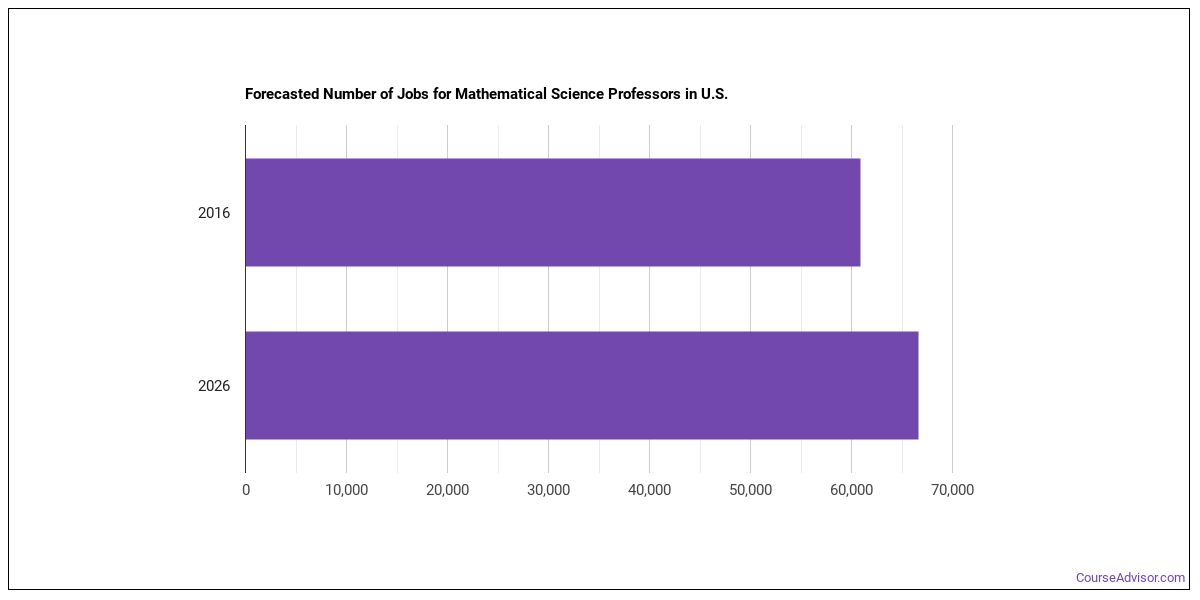
There are roughly 85,074 mathematical science teachers, postsecondary working in the United States today. Employment is projected to grow by +14.0% over the projection horizon.
How Much Do Mathematical Science Teachers, Postsecondary Make?
| Statistic | Value |
|---|---|
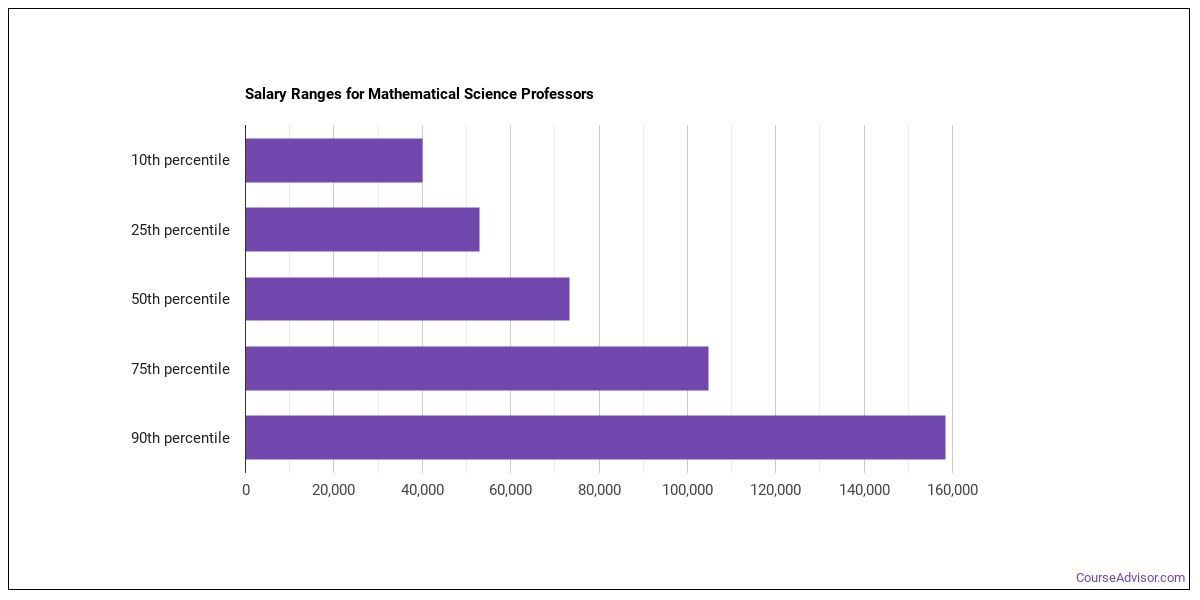
| Annual median | $40,564 |
| Hourly median | $19.50 |
| 10th percentile | $24,354 |
| 25th percentile | $32,459 |
| 75th percentile | $48,669 |
| 90th percentile | $56,775 |
Wages vary widely based on experience, location, and industry.
Pay by State
| State | Annual median salary |
|---|---|
| California | $130,750 |
| Alaska | $102,090 |
| New York | $99,460 |
| New Jersey | $97,310 |
| Rhode Island | $92,220 |
| Michigan | $90,950 |
| Oregon | $90,200 |
| Connecticut | $87,450 |
| New Hampshire | $83,250 |
| Minnesota | $82,470 |
| Maryland | $82,400 |
| Vermont | $81,440 |
| Wisconsin | $80,260 |
| Montana | $80,010 |
| Maine | $79,840 |
| Utah | $79,780 |
| Texas | $79,350 |
| Nevada | $79,210 |
| Massachusetts | $79,140 |
| Washington | $79,080 |
| District of Columbia | $78,700 |
| Pennsylvania | $78,610 |
| Iowa | $78,310 |
| Louisiana | $77,810 |
| Indiana | $77,360 |
| Nebraska | $76,370 |
| Florida | $76,270 |
| Missouri | $74,420 |
| Idaho | $74,210 |
| Ohio | $73,270 |
| Illinois | $68,480 |
| Arizona | $68,350 |
| South Carolina | $67,480 |
| North Carolina | $67,220 |
| Colorado | $66,580 |
| West Virginia | $65,570 |
| Wyoming | $65,530 |
| Alabama | $65,480 |
| Virginia | $65,480 |
| Puerto Rico | $65,470 |
| Delaware | $64,930 |
| Tennessee | $64,320 |
| Georgia | $64,290 |
| North Dakota | $64,230 |
| Kentucky | $63,800 |
| Oklahoma | $62,210 |
| South Dakota | $62,010 |
| New Mexico | $61,460 |
| Mississippi | $61,160 |
| Arkansas | $59,060 |
| Kansas | $58,220 |
| Hawaii | $52,350 |
Pay by U.S. Region
Earnings for mathematical science teachers, postsecondary differ across the country. Top regions by median wage:
| Region | Median annual wage | Share of U.S. jobs | Location quotient |
|---|---|---|---|
| Far Western US | $115,460 | 11.7% | 0.71 |
| Middle Atlantic | $91,610 | 18.5% | 1.23 |
| New England | $82,251 | 6.4% | 1.39 |
| Great Lakes | $76,861 | 14.0% | 1.00 |
| Southwest | $75,500 | 12.7% | 1.03 |
| Plains States | $73,732 | 5.7% | 0.85 |
| Rocky Mountains | $71,419 | 3.5% | 0.90 |
| Southeast | $68,944 | 27.1% | 1.14 |
Top Metro Areas
| Metro area | State | Median annual wage | Employment |
|---|---|---|---|
| Visalia, CA | CA | $160,020 | 40 |
| Riverside-San Bernardino-Ontario, CA | CA | $159,860 | 320 |
| Santa Maria-Santa Barbara, CA | CA | $158,380 | 90 |
| San Francisco-Oakland-Fremont, CA | CA | $134,670 | 690 |
| San Diego-Chula Vista-Carlsbad, CA | CA | $133,360 | 350 |
| Fresno, CA | CA | $133,150 | 90 |
| Bakersfield-Delano, CA | CA | $132,520 | 50 |
| Ann Arbor, MI | MI | $132,160 | 310 |
Industry Breakdown
The bulk of mathematical science teachers, postsecondary are concentrated in the following sectors:
| Industry | Employment | Median annual wage |
|---|---|---|
| Educational Services | 48,760 | n/a |
The table below shows some of the most common industries where those employed in this career field work.
Software Mathematical Science Teachers, Postsecondary Use
- Word processing software: Google Docs (hot technology)
- Data base user interface and query software: Microsoft Access (hot technology)
- Spreadsheet software: Microsoft Excel (hot technology)
- Office suite software: Microsoft Office software (hot technology)
- Electronic mail software: Microsoft Outlook (hot technology)
- Presentation software: Microsoft PowerPoint (hot technology)
- Development environment software: Microsoft Visual Basic (hot technology)
- Development environment software: Microsoft Visual Basic for Applications VBA (hot technology)
- Word processing software: Microsoft Word (hot technology)
- Analytical or scientific software: SAS (hot technology)
- Data base user interface and query software: Structured query language SQL (hot technology)
- Computer based training software: Learning management system LMS (in demand)
What the Workplace Is Like
The on-the-job environment of mathematical science teachers, postsecondary is shaped by the following characteristics:
- Indoors, Environmentally Controlled
- Face-to-Face Discussions with Individuals and Within Teams
- Public Speaking
- Freedom to Make Decisions
How to Become Mathematical Science Teachers, Postsecondary
Most mathematical science teachers, postsecondary positions require a doctoral or professional degree as the typical entry-level education. This occupation sits in Extensive Preparation Needed (Job Zone 5), indicating the level of preparation typically expected.
Similar Occupations
Similar Occupations
- Computer Science Teachers, Postsecondary (Primary-Short)
- Biological Science Teachers, Postsecondary (Primary-Long)
- Atmospheric, Earth, Marine, and Space Sciences Teachers, Postsecondary (Primary-Short)
- Chemistry Teachers, Postsecondary (Primary-Short)
- Physics Teachers, Postsecondary (Primary-Short)
- Economics Teachers, Postsecondary (Primary-Short)
- Geography Teachers, Postsecondary (Primary-Long)
- Psychology Teachers, Postsecondary (Primary-Long)
Top Programs to Study For This Career
Aspiring mathematical science teachers, postsecondary typically earn programs in:
Mathematics and Statistics
17 programs across 5 majors
Multi/Interdisciplinary Studies
2 programs across 2 majors
Business, Management, Marketing, and Related Support Services
1 programs across 1 majors
Education
1 programs across 1 majors
Biological and Biomedical Sciences
1 programs across 1 majors
Philosophy and Religious Studies
1 programs across 1 majors
References
Statistics shown above are sourced from the following authoritative sources:
- U.S. Bureau of Labor Statistics — Occupational Employment and Wage Statistics (OEWS) for employment and wage data by state and industry.
- BLS Employment Projections for total employment and growth forecasts.
- O*NET (Occupational Information Network) for skills, knowledge, tasks, work activities, work context, technology, and education-zone data.
SOC code: 25-1022.00 (Mathematical Science Teachers, Postsecondary).

Course Advisor provides higher-education, college and university, degree, program, career, salary, and other helpful information to students, faculty, institutions, and other internet audiences. Presented information and data are subject to change. Inclusion on this website does not imply or represent a direct relationship with the company, school, or brand. Information, though believed correct at time of publication, may not be correct, and no warranty is provided. Contact the schools to verify any information before relying on it. Financial aid may be available for those who qualify. The displayed options may include sponsored or recommended results, not necessarily based on your preferences.
© Course Advisor – All Rights Reserved.