Materials Scientists in Oregon
Want to work as a Materials Scientists in Oregon? Below are the key facts. Research and study the structures and chemical properties of various natural and synthetic or composite materials, including metals, alloys, rubber, ceramics, semiconductors, polymers, and glass. Determine ways to strengthen or combine materials or develop new materials with new or specific properties for use in a variety of products and applications. Includes glass scientists, ceramic scientists, metallurgical scientists, and polymer scientists.
What do Materials Scientists Make in Oregon?
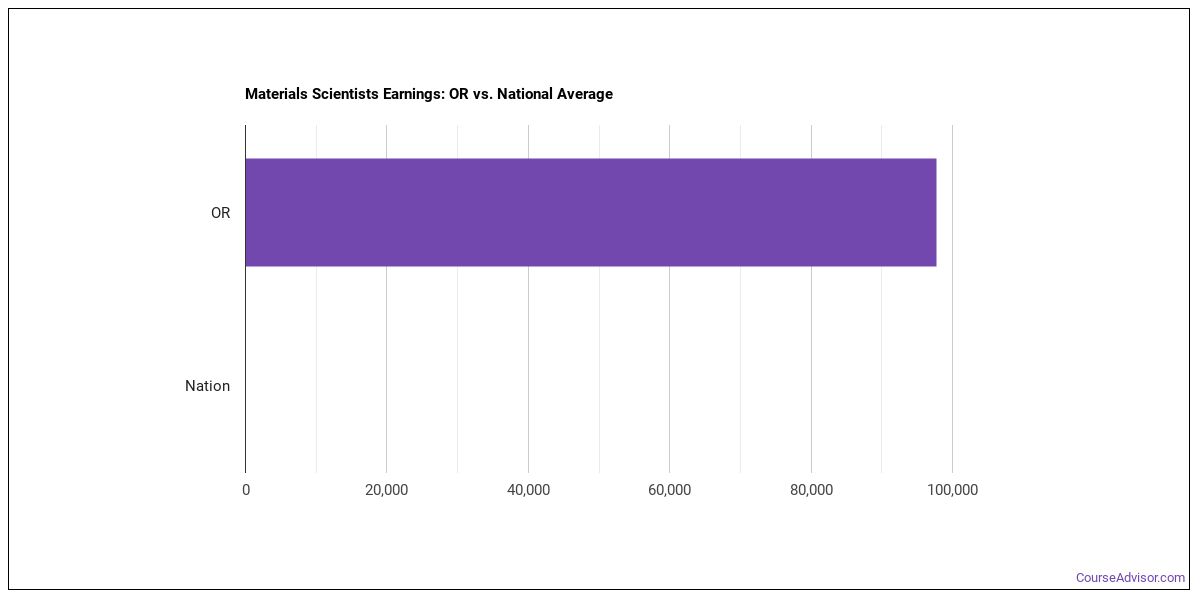
For a materials scientists working in Oregon, wages run about $103,980 per year (or roughly $49.99/hour).Pay can range from $78,960 at the 10th percentile to $185,070 at the 90th percentile.
| Wage Statistic | Annual | Hourly |
|---|---|---|
| 10th percentile | $78,960 | $37.96 |
| 25th percentile | $81,780 | $39.32 |
| Median (50th) | $103,980 | $49.99 |
| 75th percentile | $136,720 | $65.73 |
| 90th percentile | $185,070 | $88.98 |

The location quotient — a measure of how concentrated this occupation is in Oregon relative to the national average — is 1.71, meaning that materials scientists are more concentrated here than the national average.
National Wage Comparison
Nationally, materials scientists earn a median of $101,265 per year ($48.69/hour), above the Oregon median.
Employment Outlook
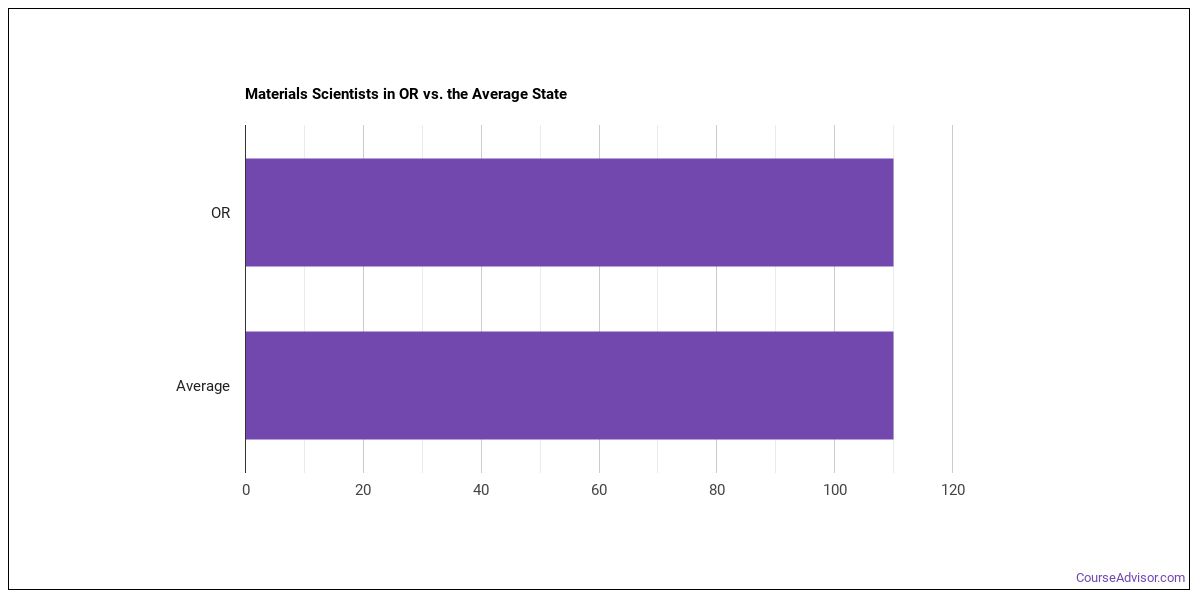
National employment for 10,106 materials scientists in the U.S.. In Oregon alone, around 180 people work in this role. That’s right around the typical state median of 180.

Top Oregon Metros for Materials Scientists
The metro areas below employ the most materials scientists in Oregon.
| Metro Area | Number Employed | Annual Median Salary |
|---|---|---|
| Portland-Vancouver-Hillsboro, OR-WA | 160 | $103,970 |
Top States for Materials Scientists Employment
View the states that employ the most materials scientists work.
| State | Number Employed |
|---|---|
| Massachusetts | 720 |
| Ohio | 670 |
| New Jersey | 630 |
| New York | 630 |
| California | 610 |
| Illinois | 470 |
| Tennessee | 430 |
| Texas | 380 |
| North Carolina | 370 |
| Minnesota | 360 |
| Washington | 290 |
| Pennsylvania | 290 |
| Georgia | 250 |
| Maryland | 200 |
| Oregon | 180 |
| Michigan | 170 |
| Iowa | 170 |
| Virginia | 160 |
| Wisconsin | 140 |
| Delaware | 100 |
Highest-Paying States for Materials Scientists
These states pay the most for materials scientists.
| State | Annual Median Salary |
|---|---|
| New Hampshire | $136,300 |
| California | $131,530 |
| Colorado | $126,980 |
| New York | $125,490 |
| Florida | $122,910 |
| Wisconsin | $120,520 |
| Illinois | $120,320 |
| Virginia | $118,820 |
| Utah | $118,720 |
| Massachusetts | $118,270 |
Skills
Key materials scientists skills, rated on an importance scale of 0 to 5:
Knowledge Areas
Important knowledge areas for this occupation, rated on an importance scale of 0 to 5:
Abilities
The abilities that matter most for materials scientists, rated on an importance scale of 0 to 5:
Daily Tasks
Common tasks include:
- Conduct research on the structures and properties of materials, such as metals, alloys, polymers, and ceramics, to obtain information that could be used to develop new products or enhance existing ones.
- Test metals to determine conformance to specifications of mechanical strength, strength-weight ratio, ductility, magnetic and electrical properties, and resistance to abrasion, corrosion, heat, and cold.
- Test material samples for tolerance under tension, compression, and shear to determine the cause of metal failures.
- Determine ways to strengthen or combine materials or develop new materials with new or specific properties for use in a variety of products and applications.
- Prepare reports, manuscripts, proposals, and technical manuals for use by other scientists and requestors, such as sponsors and customers.
- Plan laboratory experiments to confirm feasibility of processes and techniques used in the production of materials with special characteristics.
- Recommend materials for reliable performance in various environments.
- Supervise and monitor production processes to ensure efficient use of equipment, timely changes to specifications, and project completion within time frame and budget.
- Research methods of processing, forming, and firing materials to develop such products as ceramic dental fillings, unbreakable dinner plates, and telescope lenses.
- Perform experiments and computer modeling to study the nature, structure, and physical and chemical properties of metals and their alloys, and their responses to applied forces.
- Devise testing methods to evaluate the effects of various conditions on particular materials.
- Test individual parts and products to ensure that manufacturer and governmental quality and safety standards are met.
Work Activities
- Getting Information
- Analyzing Data or Information
- Processing Information
- Making Decisions and Solving Problems
- Monitoring Processes, Materials, or Surroundings
- Working with Computers
- Updating and Using Relevant Knowledge
- Documenting/Recording Information
- Thinking Creatively
- Communicating with Supervisors, Peers, or Subordinates
- Identifying Objects, Actions, and Events
- Interpreting the Meaning of Information for Others
Tools & Technology
Technologies frequently used: Hot technologies: Hypertext markup language HTML, IBM SPSS Statistics In-demand technologies: Microsoft Excel
What Major Will Prepare You For This Career?
Programs that train for this career include:
- Materials Sciences
- Textile & Apparel Studies
Featured schools near , edit
Related Careers
Related occupations to materials scientists include:
- Bioengineers and Biomedical Engineers
- Chemical Engineers
- Electrical Engineers
- Electronics Engineers, Except Computer
- Industrial Engineers
- Manufacturing Engineers
Also Known As
Analytical Scientist, Applications Scientist, Material Science Engineer, Materials Research Engineer, Materials Scientist, Metal Alloy Scientist, Metallurgical Engineer, Metallurgist, Micro Electrical/Mechanical Systems Device Scientist (MEMS Device Scientist), Plastics Scientist, Polymer Materials Consultant, Polymer Specialist, R and D Scientist (Research and Development Scientist), Research Development Specialist, Research Scientist.
References
- U.S. Bureau of Labor Statistics, Occupational Employment and Wage Statistics — https://www.bls.gov/oes/
- O*NET Online — https://www.onetonline.org/
- BLS Employment Projections — https://www.bls.gov/emp/
- O*NET-SOC code: 19-2032.00

Course Advisor provides higher-education, college and university, degree, program, career, salary, and other helpful information to students, faculty, institutions, and other internet audiences. Presented information and data are subject to change. Inclusion on this website does not imply or represent a direct relationship with the company, school, or brand. Information, though believed correct at time of publication, may not be correct, and no warranty is provided. Contact the schools to verify any information before relying on it. Financial aid may be available for those who qualify. The displayed options may include sponsored or recommended results, not necessarily based on your preferences.
© Course Advisor – All Rights Reserved.