Geoscientists, Except Hydrologists and Geographers in Utah
Considering working as a Geoscientists, Except Hydrologists and Geographers in Utah? Here’s what you need to know. Study the composition, structure, and other physical aspects of the Earth. May use geological, physics, and mathematics knowledge in exploration for oil, gas, minerals, or underground water; or in waste disposal, land reclamation, or other environmental problems. May study the Earth’s internal composition, atmospheres, and oceans, and its magnetic, electrical, and gravitational forces. Includes mineralogists, paleontologists, stratigraphers, geodesists, and seismologists.
What do Geoscientists, Except Hydrologists and Geographers Make in Utah?
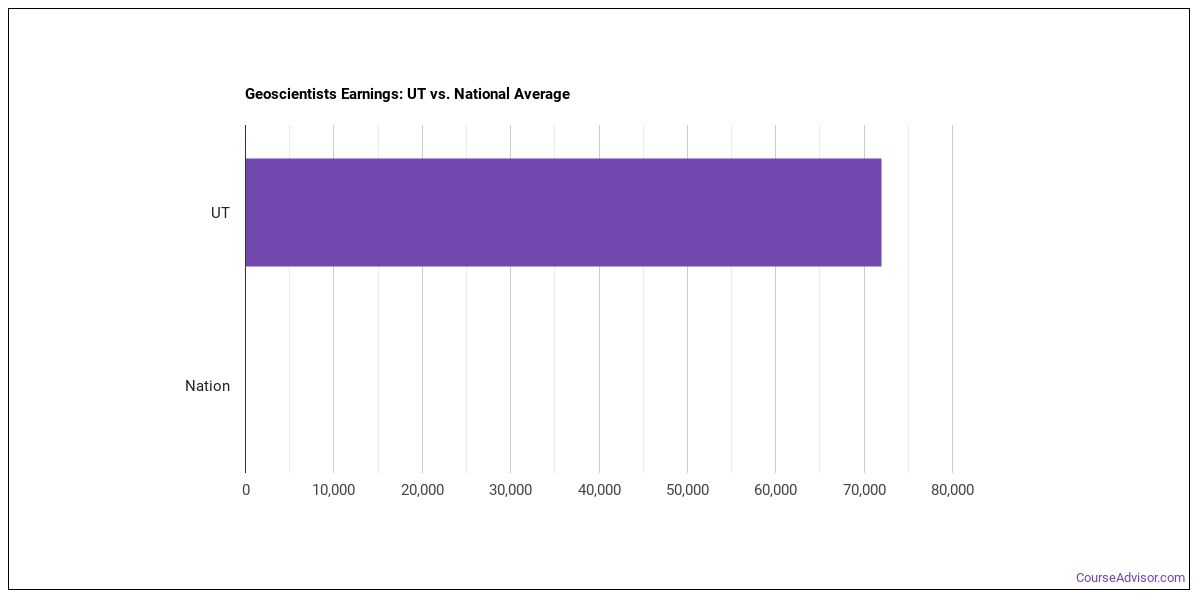
The geoscientists, except hydrologists and geographers working in Utah, wages run about $104,000 per year (or about $50.00/hour).Pay can range from $61,600 at the 10th percentile to $162,320 at the 90th percentile.
| Wage Statistic | Annual | Hourly |
|---|---|---|
| 10th percentile | $61,600 | $29.61 |
| 25th percentile | $77,830 | $37.42 |
| Median (50th) | $104,000 | $50.00 |
| 75th percentile | $118,300 | $56.88 |
| 90th percentile | $162,320 | $78.04 |

The job concentration index in Utah relative to the national average — is 1.34, indicating that geoscientists, except hydrologists and geographers are more concentrated here than the national average.
National Wage Comparison
Nationally, geoscientists, except hydrologists and geographers earn a median of $58,500 per year ($28.13/hour), exceeding the Utah median.
Employment Outlook
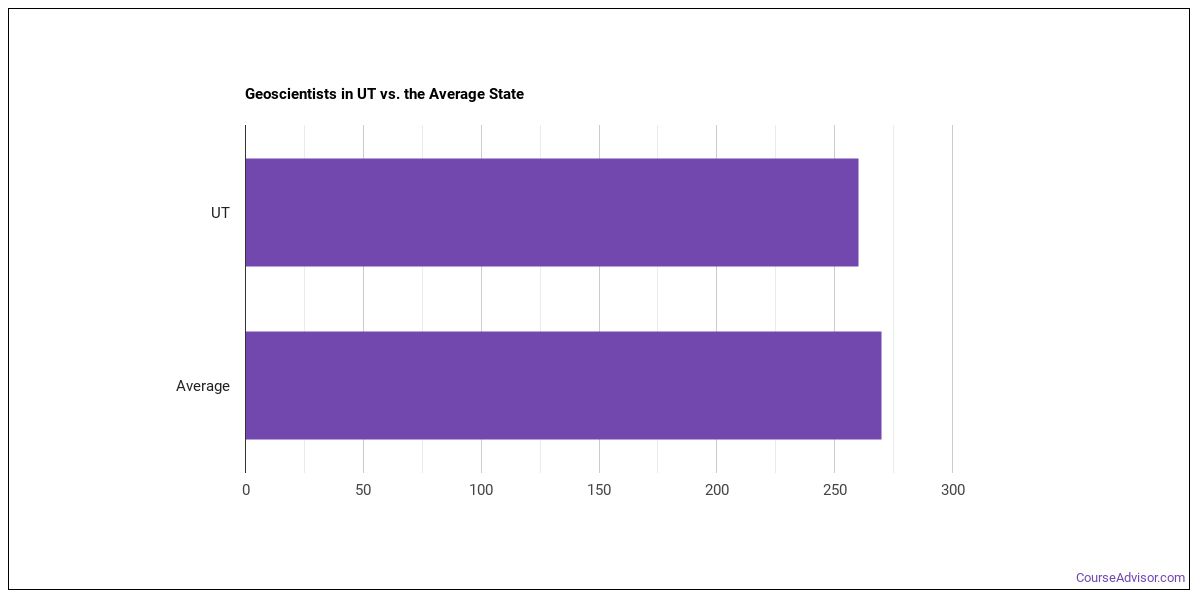
National employment for 144,001 geoscientists, except hydrologists and geographers in the U.S.. In Utah alone, around 340 people work in this role. That’s higher than the typical state, which employs around 280 geoscientists, except hydrologists and geographers.

Top Utah Metros for Geoscientists, Except Hydrologists and Geographers
These are the Utah metros with the most geoscientists, except hydrologists and geographers in Utah.
| Metro Area | Number Employed | Annual Median Salary |
|---|---|---|
| Salt Lake City-Murray, UT | 210 | $98,130 |
Top States for Geoscientists, Except Hydrologists and Geographers Employment
View the states that employ the most geoscientists, except hydrologists and geographers work.
| State | Number Employed |
|---|---|
| Texas | 3,620 |
| California | 3,150 |
| Colorado | 1,420 |
| Oklahoma | 910 |
| Washington | 840 |
| Florida | 760 |
| Pennsylvania | 750 |
| New York | 700 |
| Nevada | 510 |
| Arizona | 510 |
| North Carolina | 490 |
| Oregon | 450 |
| Louisiana | 420 |
| Michigan | 400 |
| Ohio | 400 |
| New Jersey | 380 |
| Alaska | 370 |
| Maryland | 370 |
| Utah | 340 |
| Georgia | 330 |
Highest-Paying States for Geoscientists, Except Hydrologists and Geographers
Where geoscientists, except hydrologists and geographers earn the most: geoscientists, except hydrologists and geographers.
| State | Annual Median Salary |
|---|---|
| Texas | $155,330 |
| Rhode Island | $128,870 |
| Oklahoma | $128,240 |
| Mississippi | $113,730 |
| California | $111,400 |
| Alaska | $105,910 |
| Utah | $104,000 |
| Vermont | $102,190 |
| Hawaii | $100,690 |
| Colorado | $99,900 |
Skills
Key geoscientists, except hydrologists and geographers skills, rated on an importance scale of 0 to 5:
Knowledge Areas
Key knowledge areas for this occupation, rated on an importance scale of 0 to 5:
Abilities
The abilities that matter most for geoscientists, except hydrologists and geographers, rated on an importance scale of 0 to 5:
Daily Tasks
Day-to-day, geoscientists, except hydrologists and geographers typically:
- Plan or conduct geological, geochemical, or geophysical field studies or surveys, sample collection, or drilling and testing programs used to collect data for research or application.
- Analyze and interpret geological data, using computer software.
- Investigate the composition, structure, or history of the Earth's crust through the collection, examination, measurement, or classification of soils, minerals, rocks, or fossil remains.
- Analyze and interpret geological, geochemical, or geophysical information from sources, such as survey data, well logs, bore holes, or aerial photos.
- Identify risks for natural disasters, such as mudslides, earthquakes, or volcanic eruptions.
- Prepare geological maps, cross-sectional diagrams, charts, or reports concerning mineral extraction, land use, or resource management, using results of fieldwork or laboratory research.
- Communicate geological findings by writing research papers, participating in conferences, or teaching geological science at universities.
- Locate and estimate probable natural gas, oil, or mineral ore deposits or underground water resources, using aerial photographs, charts, or research or survey results.
- Advise construction firms or government agencies on dam or road construction, foundation design, land use, or resource management.
- Measure characteristics of the Earth, such as gravity or magnetic fields, using equipment such as seismographs, gravimeters, torsion balances, or magnetometers.
- Locate and review research articles or environmental, historical, or technical reports.
- Conduct geological or geophysical studies to provide information for use in regional development, site selection, or development of public works projects.
Work Activities
- Getting Information
- Analyzing Data or Information
- Working with Computers
- Communicating with Supervisors, Peers, or Subordinates
- Identifying Objects, Actions, and Events
- Updating and Using Relevant Knowledge
- Processing Information
- Thinking Creatively
- Making Decisions and Solving Problems
- Organizing, Planning, and Prioritizing Work
- Documenting/Recording Information
- Interpreting the Meaning of Information for Others
Tools & Technology
Common tools and software used in this occupation include: Hot technologies: Adobe Acrobat, Adobe Photoshop, Autodesk AutoCAD In-demand technologies: Autodesk AutoCAD
What Major Will Prepare You For This Career?
Programs that train for this career include:
- Geological & Earth Sciences
- Marine Science
- Environmental Geosciences
- Earth Systems Science
- Geoarcheaology
- Geobiology
Featured schools near , edit
Related Careers
Other careers like geoscientists, except hydrologists and geographers include:
- Water Resource Specialists
- Data Scientists
- Surveyors
- Geodetic Surveyors
- Mining and Geological Engineers, Including Mining Safety Engineers
- Petroleum Engineers
Also Known As
Consultant Geologist, Core Analysis Operator, Core Analyst, Crystallographer, Development Geologist, Engineering Geologist, Environmental Engineer, Environmental Geologist, Environmental Protection Geologist, Exploration Geologist, Field Geologist, Geochemist, Geodesist, Geological Scout, Geological Specialist.
References
- U.S. Bureau of Labor Statistics, Occupational Employment and Wage Statistics — https://www.bls.gov/oes/
- O*NET Online — https://www.onetonline.org/
- BLS Employment Projections — https://www.bls.gov/emp/
- O*NET-SOC code: 19-2042.00

Course Advisor provides higher-education, college and university, degree, program, career, salary, and other helpful information to students, faculty, institutions, and other internet audiences. Presented information and data are subject to change. Inclusion on this website does not imply or represent a direct relationship with the company, school, or brand. Information, though believed correct at time of publication, may not be correct, and no warranty is provided. Contact the schools to verify any information before relying on it. Financial aid may be available for those who qualify. The displayed options may include sponsored or recommended results, not necessarily based on your preferences.
© Course Advisor – All Rights Reserved.