Forest and Conservation Workers in Pennsylvania
Want to work as a Forest and Conservation Workers in Pennsylvania? Below are the key facts. Under supervision, perform manual labor necessary to develop, maintain, or protect areas such as forests, forested areas, woodlands, wetlands, and rangelands through such activities as raising and transporting seedlings; combating insects, pests, and diseases harmful to plant life; and building structures to control water, erosion, and leaching of soil. Includes forester aides, seedling pullers, tree planters, and gatherers of nontimber forestry products such as pine straw.
What do Forest and Conservation Workers Make in Pennsylvania?
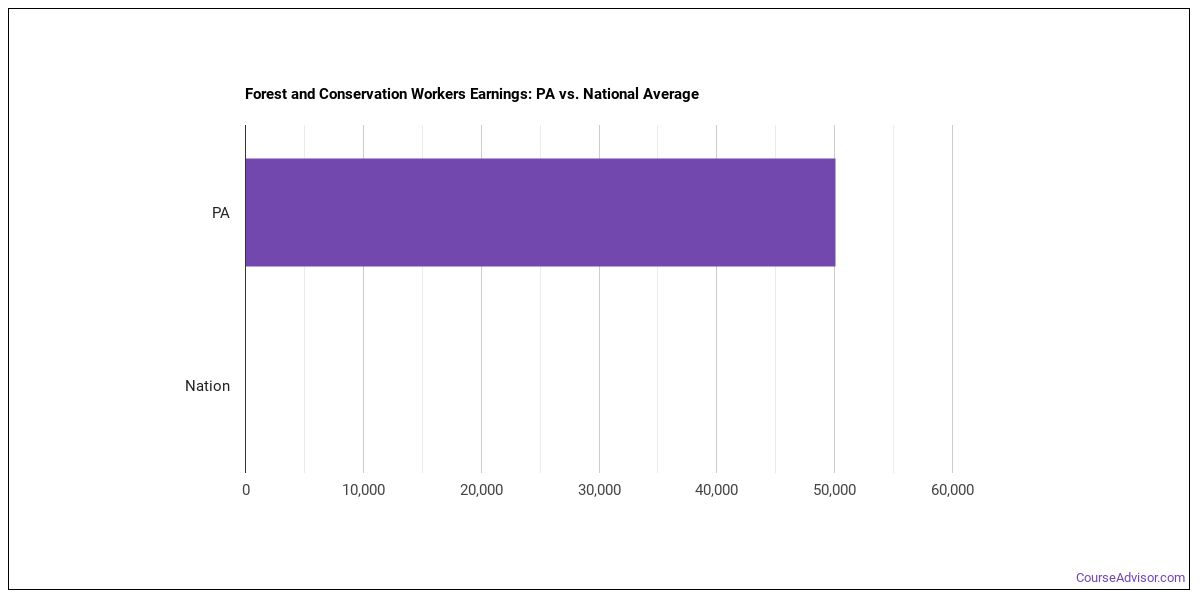
The forest and conservation workers working in Pennsylvania, the typical annual salary is $49,160 per year (or roughly $23.64/hour).Annual wages span from $43,680 at the 10th percentile to $62,460 at the 90th percentile.
| Wage Statistic | Annual | Hourly |
|---|---|---|
| 10th percentile | $43,680 | $21.00 |
| 25th percentile | $45,860 | $22.05 |
| Median (50th) | $49,160 | $23.64 |
| 75th percentile | $57,080 | $27.44 |
| 90th percentile | $62,460 | $30.03 |

Location quotient — how concentrated this career is in Pennsylvania compared to the national average — is 1.02.
National Wage Comparison
Nationally, forest and conservation workers earn a median of $22,542 per year ($10.84/hour), exceeding the Pennsylvania median.
Employment Outlook
National employment for 360,249 forest and conservation workers in the U.S.. In Pennsylvania alone, approximately 220 people work in this role. That’s higher than the typical state, which employs around 140 forest and conservation workers.


Top Pennsylvania Metros for Forest and Conservation Workers
The metro areas below employ the most forest and conservation workers in Pennsylvania.
| Metro Area | Number Employed | Annual Median Salary |
|---|---|---|
| Philadelphia-Camden-Wilmington, PA-NJ-DE-MD | 130 | $39,040 |
| Pittsburgh, PA | 40 | $48,050 |
| Harrisburg-Carlisle, PA | 30 | $48,200 |
Top States for Forest and Conservation Workers Employment
View the states that employ the most forest and conservation workers work.
| State | Number Employed |
|---|---|
| California | 1,840 |
| South Dakota | 670 |
| Wisconsin | 280 |
| Pennsylvania | 220 |
| Tennessee | 220 |
| Louisiana | 210 |
| South Carolina | 210 |
| Washington | 200 |
| Georgia | 180 |
| Oregon | 140 |
| Florida | 100 |
| Ohio | 80 |
| Illinois | 60 |
| New Jersey | 60 |
| Colorado | 60 |
| Idaho | 60 |
| Connecticut | 50 |
| Texas | 50 |
| Indiana | 40 |
Highest-Paying States for Forest and Conservation Workers
Where forest and conservation workers earn the most: forest and conservation workers.
| State | Annual Median Salary |
|---|---|
| Illinois | $64,430 |
| Ohio | $53,350 |
| Pennsylvania | $49,160 |
| Arkansas | $46,110 |
| Idaho | $46,010 |
| Colorado | $45,420 |
| California | $43,680 |
| Massachusetts | $43,630 |
| Washington | $43,480 |
| Missouri | $43,330 |
Skills
Key forest and conservation workers skills, rated on an importance scale of 0 to 5:
Knowledge Areas
Core knowledge areas for this occupation, rated on an importance scale of 0 to 5:
Abilities
Top abilities for forest and conservation workers, rated on an importance scale of 0 to 5:
Daily Tasks
Common tasks include:
- Check equipment to ensure that it is operating properly.
- Fight forest fires or perform prescribed burning tasks under the direction of fire suppression officers or forestry technicians.
- Perform fire protection or suppression duties, such as constructing fire breaks or disposing of brush.
- Confer with other workers to discuss issues, such as safety, cutting heights, or work needs.
- Maintain tallies of trees examined and counted during tree marking or measuring efforts.
- Explain or enforce regulations regarding camping, vehicle use, fires, use of buildings, or sanitation.
- Operate skidders, bulldozers, or other prime movers to pull a variety of scarification or site preparation equipment over areas to be regenerated.
- Spray or inject vegetation with insecticides to kill insects or to protect against disease or with herbicides to reduce competing vegetation.
- Thin or space trees, using power thinning saws.
- Identify diseased or undesirable trees and remove them, using power saws or hand saws.
- Select or cut trees according to markings or sizes, types, or grades.
- Prune or shear tree tops or limbs to control growth, increase density, or improve shape.
Work Activities
- Operating Vehicles, Mechanized Devices, or Equipment
- Performing General Physical Activities
- Getting Information
- Communicating with Supervisors, Peers, or Subordinates
- Making Decisions and Solving Problems
- Monitoring Processes, Materials, or Surroundings
- Identifying Objects, Actions, and Events
- Inspecting Equipment, Structures, or Materials
- Handling and Moving Objects
- Performing for or Working Directly with the Public
- Processing Information
- Establishing and Maintaining Interpersonal Relationships
Tools & Technology
Technologies frequently used: Hot technologies: ESRI ArcGIS software, Microsoft Access
What Major Will Prepare You For This Career?
Programs that train for this career include:
- Forestry
- Horticulture
Featured schools near , edit
Related Careers
Other careers like forest and conservation workers include:
- Soil and Plant Scientists
- Conservation Scientists
- Range Managers
- Foresters
- Environmental Scientists and Specialists, Including Health
- Environmental Restoration Planners
Also Known As
Blister Rust Eradicator, Box Chipper, Box Cutter, Brusher, Chemical Sprayer, Chopper, Christmas Tree Farm Worker, Christmas Tree Farmer, Christmas Tree Grader, Christmas Tree Grower, Cone Picker, Conservation Coordinator, Conservation Officer, Conservation Specialist, Conservation Worker.
References
- U.S. Bureau of Labor Statistics, Occupational Employment and Wage Statistics — https://www.bls.gov/oes/
- O*NET Online — https://www.onetonline.org/
- BLS Employment Projections — https://www.bls.gov/emp/
- O*NET-SOC code: 45-4011.00

Course Advisor provides higher-education, college and university, degree, program, career, salary, and other helpful information to students, faculty, institutions, and other internet audiences. Presented information and data are subject to change. Inclusion on this website does not imply or represent a direct relationship with the company, school, or brand. Information, though believed correct at time of publication, may not be correct, and no warranty is provided. Contact the schools to verify any information before relying on it. Financial aid may be available for those who qualify. The displayed options may include sponsored or recommended results, not necessarily based on your preferences.
© Course Advisor – All Rights Reserved.