Environmental Scientists and Specialists, Including Health in Mississippi
Want to work as an Environmental Scientists and Specialists, Including Health in Mississippi? Here’s what the data says. Conduct research or perform investigation for the purpose of identifying, abating, or eliminating sources of pollutants or hazards that affect either the environment or public health. Using knowledge of various scientific disciplines, may collect, synthesize, study, report, and recommend action based on data derived from measurements or observations of air, food, soil, water, and other sources. Excludes “Zoologists and Wildlife Biologists” (19-1023), “Conservation Scientists” (19-1031), “Forest and Conservation Technicians” (19-4071), “Occupational Health and Safety Specialists” (19-5011), “Fish and Game Wardens” (33-3031), and “Forest and Conservation Workers” (45-4011).
What do Environmental Scientists and Specialists, Including Health Make in Mississippi?
The environmental scientists and specialists, including health working in Mississippi, the typical annual salary is $55,110 per year (or roughly $26.50/hour).Annual wages span from $40,280 at the 10th percentile to $109,020 at the 90th percentile.
| Wage Statistic | Annual | Hourly |
|---|---|---|
| 10th percentile | $40,280 | $19.36 |
| 25th percentile | $45,400 | $21.83 |
| Median (50th) | $55,110 | $26.50 |
| 75th percentile | $79,790 | $38.36 |
| 90th percentile | $109,020 | $52.41 |

Location quotient — how concentrated this career is in Mississippi relative to the national average — is 0.59, meaning fewer environmental scientists and specialists, including health per worker than the national average.
National Wage Comparison
Nationally, environmental scientists and specialists, including health earn a median of $90,139 per year ($43.34/hour), below the Mississippi median.

Employment Outlook
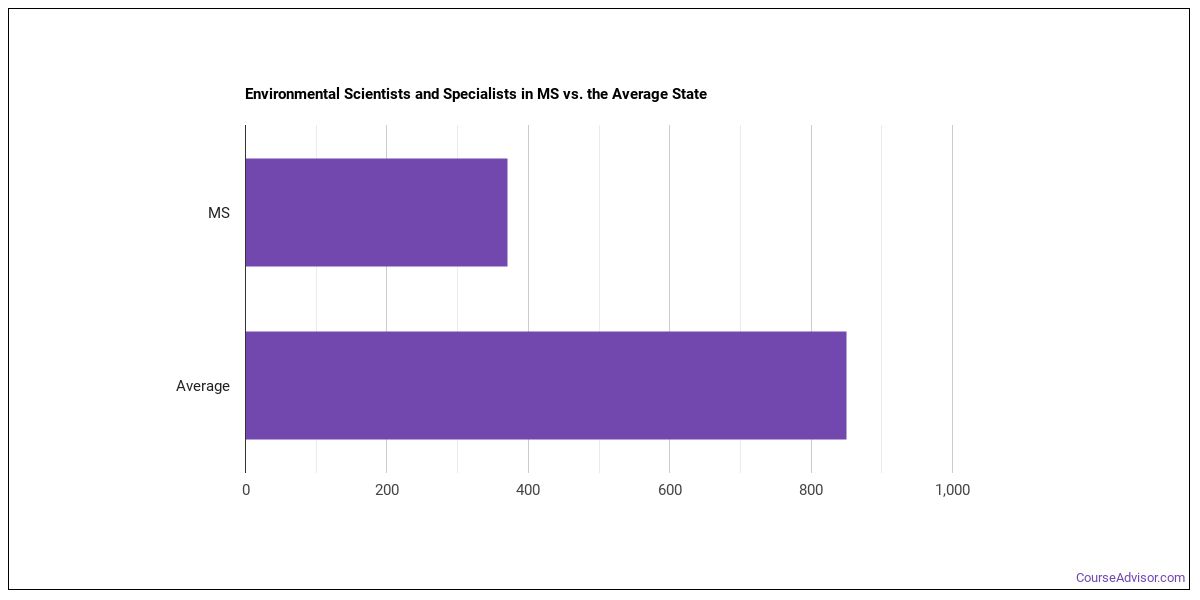
Nationally, total employment in this occupation is 65,098 environmental scientists and specialists, including health across the United States. In Mississippi alone, approximately 380 people work in this role. That’s fewer than the typical state, which employs around 920 environmental scientists and specialists, including health.

Top Mississippi Metros for Environmental Scientists and Specialists, Including Health
The largest metro-area employers of environmental scientists and specialists, including health in Mississippi.
| Metro Area | Number Employed | Annual Median Salary |
|---|---|---|
| Jackson, MS | 160 | $55,110 |
| Gulfport-Biloxi, MS | 70 | $66,230 |
Top States for Environmental Scientists and Specialists, Including Health Employment
These states have the highest employment of environmental scientists and specialists, including health work.
| State | Number Employed |
|---|---|
| California | 13,200 |
| Florida | 5,840 |
| North Carolina | 4,330 |
| Washington | 4,280 |
| Texas | 4,090 |
| New York | 3,500 |
| New Jersey | 2,990 |
| Massachusetts | 2,890 |
| Michigan | 2,700 |
| Virginia | 2,700 |
| Ohio | 2,570 |
| Pennsylvania | 2,570 |
| Colorado | 2,480 |
| Minnesota | 1,980 |
| Maryland | 1,800 |
| Arizona | 1,590 |
| Georgia | 1,530 |
| Louisiana | 1,520 |
| District of Columbia | 1,480 |
| Oregon | 1,400 |
Highest-Paying States for Environmental Scientists and Specialists, Including Health
These states pay the most for environmental scientists and specialists, including health.
| State | Annual Median Salary |
|---|---|
| District of Columbia | $122,440 |
| California | $97,520 |
| Massachusetts | $96,330 |
| Oregon | $93,560 |
| Rhode Island | $90,460 |
| Illinois | $89,010 |
| Washington | $88,670 |
| Minnesota | $87,210 |
| Alaska | $87,060 |
| Colorado | $86,720 |
Skills
The most important environmental scientists and specialists, including health skills, rated on an importance scale of 0 to 5:
Knowledge Areas
Key knowledge areas for this occupation, rated on an importance scale of 0 to 5:
Abilities
The abilities that matter most for environmental scientists and specialists, including health, rated on an importance scale of 0 to 5:
Daily Tasks
Common tasks include:
- Communicate scientific or technical information to the public, organizations, or internal audiences through oral briefings, written documents, workshops, conferences, training sessions, or public hearings.
- Monitor effects of pollution or land degradation and recommend means of prevention or control.
- Collect, synthesize, analyze, manage, and report environmental data, such as pollution emission measurements, atmospheric monitoring measurements, meteorological or mineralogical information, or soil or water samples.
- Review and implement environmental technical standards, guidelines, policies, and formal regulations that meet all appropriate requirements.
- Provide scientific or technical guidance, support, coordination, or oversight to governmental agencies, environmental programs, industry, or the public.
- Process and review environmental permits, licenses, or related materials.
- Conduct environmental audits or inspections or investigations of violations.
- Provide advice on proper standards and regulations or the development of policies, strategies, or codes of practice for environmental management.
- Prepare charts or graphs from data samples, providing summary information on the environmental relevance of the data.
- Research sources of pollution to determine their effects on the environment and to develop theories or methods of pollution abatement or control.
- Supervise or train students, environmental technologists, technicians, or other related staff.
- Monitor environmental impacts of development activities.
Work Activities
- Evaluating Information to Determine Compliance with Standards
- Getting Information
- Working with Computers
- Communicating with People Outside the Organization
- Analyzing Data or Information
- Identifying Objects, Actions, and Events
- Communicating with Supervisors, Peers, or Subordinates
- Making Decisions and Solving Problems
- Monitoring Processes, Materials, or Surroundings
- Updating and Using Relevant Knowledge
- Processing Information
- Establishing and Maintaining Interpersonal Relationships
Tools & Technology
Software and systems commonly involved: Hot technologies: Adobe Acrobat, Adobe Illustrator, Autodesk AutoCAD In-demand technologies: ESRI ArcGIS software
What Major Will Prepare You For This Career?
Related college programs include:
- Natural Resources Conservation
- Sustainability Science
- Geography and Environmental Studies
- Marine Science
- Environmental Geosciences
- Public Health
- Pharmacology & Toxicology
- Chemistry
Featured schools near , edit
Related Careers
Careers similar to environmental scientists and specialists, including health include:
- Water Resource Specialists
- Brownfield Redevelopment Specialists and Site Managers
- Environmental Compliance Inspectors
- Environmental Engineers
- Health and Safety Engineers, Except Mining Safety Engineers and Inspectors
- Environmental Engineering Technologists and Technicians
Also Known As
Air Analyst, Ecological Modeler, Environmental Analyst, Environmental Consultant, Environmental Designer, Environmental Health Specialist, Environmental Health and Safety Specialist (EHS Specialist), Environmental Permitting Specialist, Environmental Planner, Environmental Programs Specialist, Environmental Project Specialist, Environmental Protection Specialist, Environmental Resources Specialist, Environmental Safety Specialist, Environmental Scientist.
References
- U.S. Bureau of Labor Statistics, Occupational Employment and Wage Statistics — https://www.bls.gov/oes/
- O*NET Online — https://www.onetonline.org/
- BLS Employment Projections — https://www.bls.gov/emp/
- O*NET-SOC code: 19-2041.00

Course Advisor provides higher-education, college and university, degree, program, career, salary, and other helpful information to students, faculty, institutions, and other internet audiences. Presented information and data are subject to change. Inclusion on this website does not imply or represent a direct relationship with the company, school, or brand. Information, though believed correct at time of publication, may not be correct, and no warranty is provided. Contact the schools to verify any information before relying on it. Financial aid may be available for those who qualify. The displayed options may include sponsored or recommended results, not necessarily based on your preferences.
© Course Advisor – All Rights Reserved.