Environmental Science and Protection Technicians, Including Health in Oregon
Want to work as an Environmental Science and Protection Technicians, Including Health in Oregon? Here’s what you need to know. Perform laboratory and field tests to monitor the environment and investigate sources of pollution, including those that affect health, under the direction of an environmental scientist, engineer, or other specialist. May collect samples of gases, soil, water, and other materials for testing.
What do Environmental Science and Protection Technicians, Including Health Make in Oregon?
The environmental science and protection technicians, including health working in Oregon, the median annual wage is $53,350 per year (or about $25.65/hour).Annual wages span from $35,870 at the 10th percentile to $97,330 at the 90th percentile.
| Wage Statistic | Annual | Hourly |
|---|---|---|
| 10th percentile | $35,870 | $17.24 |
| 25th percentile | $42,680 | $20.52 |
| Median (50th) | $53,350 | $25.65 |
| 75th percentile | $71,840 | $34.54 |
| 90th percentile | $97,330 | $46.79 |

The location quotient — a measure of how concentrated this occupation is in Oregon relative to the national average — is 0.87, meaning fewer environmental science and protection technicians, including health per worker than the national average.
National Wage Comparison
Nationally, environmental science and protection technicians, including health earn a median of $41,550 per year ($19.98/hour), exceeding the Oregon median.

Employment Outlook
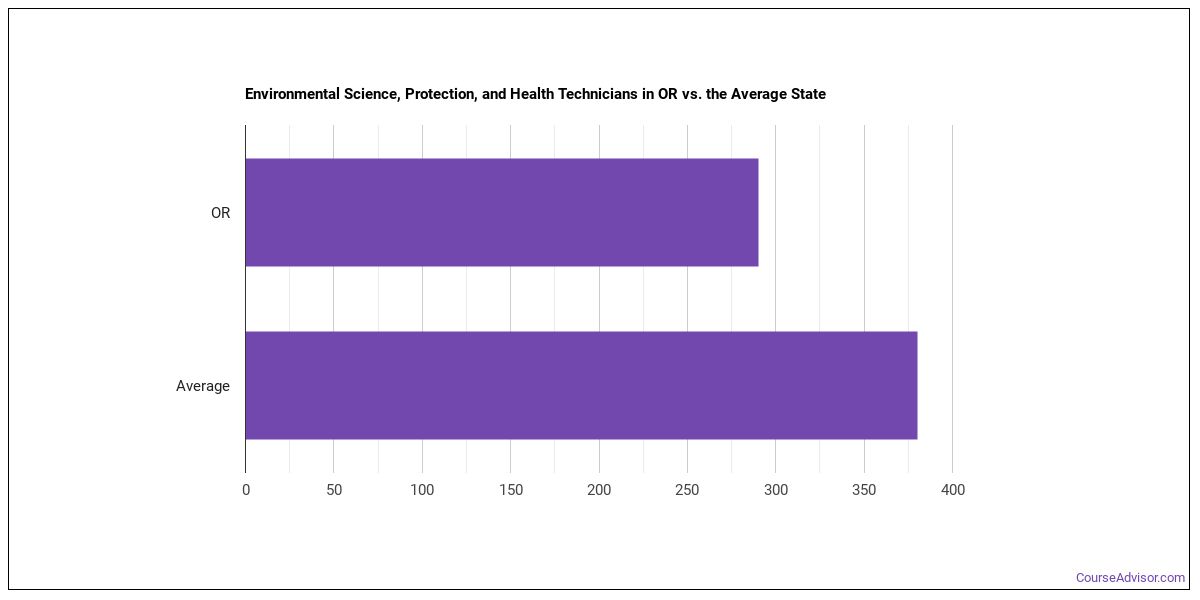
National employment for 153,621 environmental science and protection technicians, including health nationwide. In Oregon alone, around 440 people work in this role. That puts the state above the typical state, which employs around 350 environmental science and protection technicians, including health.

Top Oregon Metros for Environmental Science and Protection Technicians, Including Health
The largest metro-area employers of environmental science and protection technicians, including health in Oregon.
| Metro Area | Number Employed | Annual Median Salary |
|---|---|---|
| Portland-Vancouver-Hillsboro, OR-WA | 310 | $52,010 |
Top States for Environmental Science and Protection Technicians, Including Health Employment
The table below shows the states where the most environmental science and protection technicians, including health work.
| State | Number Employed |
|---|---|
| Texas | 3,490 |
| New York | 2,470 |
| Illinois | 1,740 |
| Florida | 1,660 |
| New Jersey | 1,200 |
| Pennsylvania | 1,160 |
| Virginia | 1,150 |
| Ohio | 910 |
| North Carolina | 880 |
| Washington | 850 |
| Colorado | 850 |
| Minnesota | 730 |
| Michigan | 710 |
| Indiana | 660 |
| Massachusetts | 630 |
| Georgia | 620 |
| Maryland | 610 |
| West Virginia | 530 |
| Arizona | 510 |
| New Mexico | 460 |
Highest-Paying States for Environmental Science and Protection Technicians, Including Health
The highest-paying states for environmental science and protection technicians, including health.
| State | Annual Median Salary |
|---|---|
| Washington | $78,270 |
| District of Columbia | $76,420 |
| Nebraska | $67,720 |
| Connecticut | $64,370 |
| Nevada | $63,300 |
| Pennsylvania | $60,060 |
| New York | $59,380 |
| Iowa | $58,730 |
| Minnesota | $58,200 |
| New Mexico | $57,930 |
Skills
Key environmental science and protection technicians, including health skills, rated on an importance scale of 0 to 5:
Knowledge Areas
Key knowledge areas for this occupation, rated on an importance scale of 0 to 5:
Abilities
Top abilities for environmental science and protection technicians, including health, rated on an importance scale of 0 to 5:
Daily Tasks
Common tasks include:
- Collect samples of gases, soils, water, industrial wastewater, or asbestos products to conduct tests on pollutant levels or identify sources of pollution.
- Investigate hazardous conditions or spills or outbreaks of disease or food poisoning, collecting samples for analysis.
- Record test data and prepare reports, summaries, or charts that interpret test results.
- Prepare samples or photomicrographs for testing and analysis.
- Discuss test results and analyses with customers.
- Inspect workplaces to ensure the absence of health and safety hazards, such as high noise levels, radiation, or potential lighting hazards.
- Weigh, analyze, or measure collected sample particles, such as lead, coal dust, or rock, to determine concentration of pollutants.
- Calibrate microscopes or test instruments.
- Provide information or technical or program assistance to government representatives, employers, or the general public on the issues of public health, environmental protection, or workplace safety.
- Maintain files, such as hazardous waste databases, chemical usage data, personnel exposure information, or diagrams showing equipment locations.
- Set up equipment or stations to monitor and collect pollutants from sites, such as smoke stacks, manufacturing plants, or mechanical equipment.
- Develop or implement programs for monitoring of environmental pollution or radiation.
Work Activities
- Documenting/Recording Information
- Getting Information
- Evaluating Information to Determine Compliance with Standards
- Communicating with Supervisors, Peers, or Subordinates
- Scheduling Work and Activities
- Working with Computers
- Identifying Objects, Actions, and Events
- Updating and Using Relevant Knowledge
- Establishing and Maintaining Interpersonal Relationships
- Processing Information
- Analyzing Data or Information
- Organizing, Planning, and Prioritizing Work
Tools & Technology
Technologies frequently used: Hot technologies: Adobe Acrobat, Autodesk AutoCAD In-demand technologies: Microsoft Excel
What Major Will Prepare You For This Career?
Programs that train for this career include:
- Natural Resources Conservation
- Sustainability Science
- Geography and Environmental Studies
- Environmental Geosciences
- Other Science Technologies
- Physical Science Technicians
- Environmental Control Technology
- Pharmacology & Toxicology
- Chemistry
Featured schools near , edit
Related Careers
Other careers like environmental science and protection technicians, including health include:
- Water Resource Specialists
- Brownfield Redevelopment Specialists and Site Managers
- Environmental Compliance Inspectors
- Water/Wastewater Engineers
- Environmental Engineers
- Health and Safety Engineers, Except Mining Safety Engineers and Inspectors
Also Known As
Air Analyst, Air Pollution Auditor, Air Quality Technician (Air Quality Tech), Analytical Lab Tech (Analytical Laboratory Technician), Asbestos Abatement Technician (Asbestos Abatement Tech), Asbestos Microscopist, Biological Lab Tech (Biological Laboratory Technician), Biotechnician, Certified Indoor Environmentalist, Chemical Lab Tech (Chemical Laboratory Technician), Compliance Technician (Compliance Tech), Decontamination Technician (Decontamination Tech), Emergency Spill Response Technician (Emergency Spill Response Tech), Energy and Conservation Technician (Energy and Conservation Tech), Environmental Analyst.
References
- U.S. Bureau of Labor Statistics, Occupational Employment and Wage Statistics — https://www.bls.gov/oes/
- O*NET Online — https://www.onetonline.org/
- BLS Employment Projections — https://www.bls.gov/emp/
- O*NET-SOC code: 19-4042.00

Course Advisor provides higher-education, college and university, degree, program, career, salary, and other helpful information to students, faculty, institutions, and other internet audiences. Presented information and data are subject to change. Inclusion on this website does not imply or represent a direct relationship with the company, school, or brand. Information, though believed correct at time of publication, may not be correct, and no warranty is provided. Contact the schools to verify any information before relying on it. Financial aid may be available for those who qualify. The displayed options may include sponsored or recommended results, not necessarily based on your preferences.
© Course Advisor – All Rights Reserved.