Conservation Scientists in Georgia
Thinking about a career as a Conservation Scientists in Georgia? Here’s what you need to know. Manage, improve, and protect natural resources to maximize their use without damaging the environment. May conduct soil surveys and develop plans to eliminate soil erosion or to protect rangelands. May instruct farmers, agricultural production managers, or ranchers in best ways to use crop rotation, contour plowing, or terracing to conserve soil and water; in the number and kind of livestock and forage plants best suited to particular ranges; and in range and farm improvements, such as fencing and reservoirs for stock watering. Excludes “Zoologists and Wildlife Biologists” (19-1023) and “Foresters” (19-1032).
What do Conservation Scientists Make in Georgia?
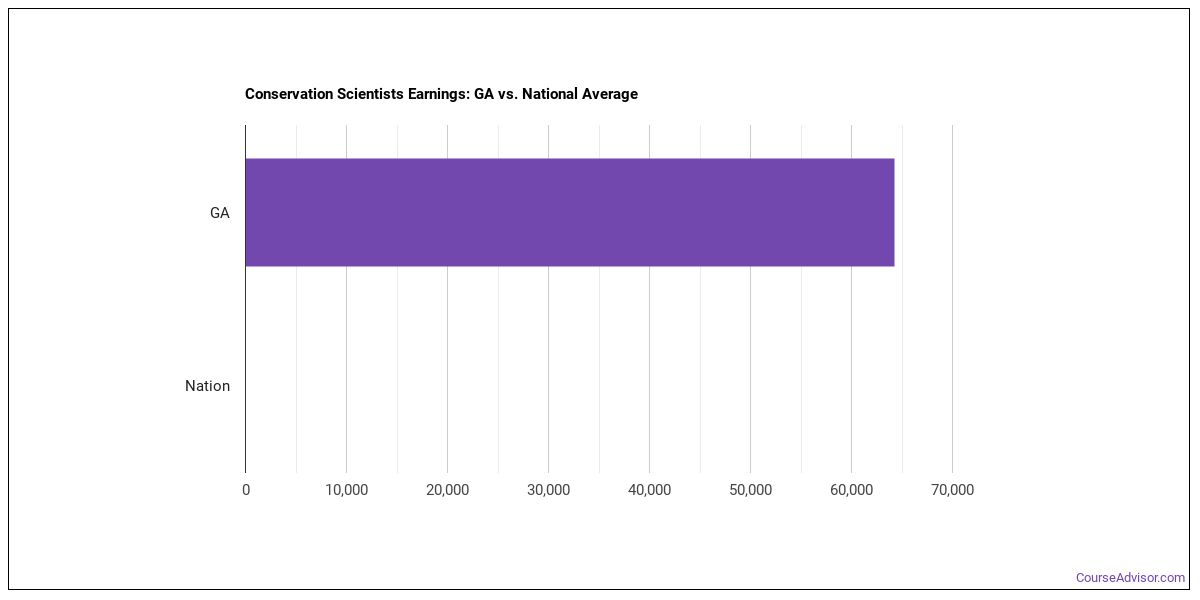
For conservation scientists working in Georgia, wages run about $67,950 per year (or about $32.67/hour).Earnings range from $46,180 at the 10th percentile to $119,450 at the 90th percentile.
| Wage Statistic | Annual | Hourly |
|---|---|---|
| 10th percentile | $46,180 | $22.20 |
| 25th percentile | $59,190 | $28.46 |
| Median (50th) | $67,950 | $32.67 |
| 75th percentile | $95,640 | $45.98 |
| 90th percentile | $119,450 | $57.43 |

Location quotient — how concentrated this career is in Georgia compared to the national average — is 0.38, meaning fewer conservation scientists per worker than the national average.
National Wage Comparison
Nationally, conservation scientists earn a median of $81,436 per year ($39.15/hour), below the Georgia median.
Employment Outlook
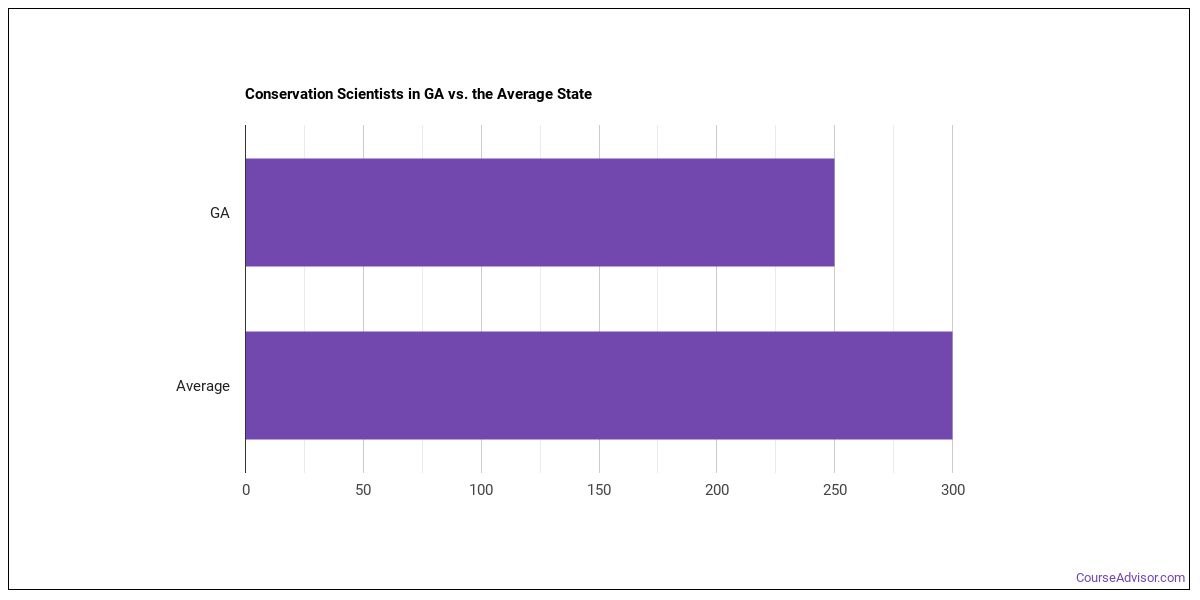
There are roughly 184,125 conservation scientists in the U.S.. In Georgia alone, around 300 people work in this role. That’s below the typical state, which employs around 390 conservation scientists.

Top Georgia Metros for Conservation Scientists
The metro areas below employ the most conservation scientists in Georgia.
| Metro Area | Number Employed | Annual Median Salary |
|---|---|---|
| Atlanta-Sandy Springs-Roswell, GA | 130 | $76,270 |
Top States for Conservation Scientists Employment
The table below shows the states where the most conservation scientists work.
| State | Number Employed |
|---|---|
| Texas | 2,070 |
| California | 1,940 |
| Pennsylvania | 1,410 |
| Colorado | 1,220 |
| Wisconsin | 1,010 |
| Washington | 940 |
| Oregon | 880 |
| New York | 750 |
| Illinois | 730 |
| Massachusetts | 730 |
| Florida | 720 |
| Virginia | 720 |
| Ohio | 700 |
| Minnesota | 690 |
| Michigan | 630 |
| Maryland | 610 |
| Iowa | 590 |
| North Carolina | 570 |
| New Jersey | 530 |
| Missouri | 520 |
Highest-Paying States for Conservation Scientists
Where conservation scientists earn the most: conservation scientists.
| State | Annual Median Salary |
|---|---|
| Oregon | $86,170 |
| California | $81,620 |
| Washington | $81,220 |
| Colorado | $80,240 |
| Nevada | $79,790 |
| North Dakota | $79,790 |
| Connecticut | $77,410 |
| Utah | $77,380 |
| Minnesota | $77,180 |
| Wyoming | $77,020 |
Skills
Top conservation scientists skills, rated on an importance scale of 0 to 5:
Knowledge Areas
Important knowledge areas for this occupation, rated on an importance scale of 0 to 5:
Abilities
Top abilities for conservation scientists, rated on an importance scale of 0 to 5:
Daily Tasks
Day-to-day, conservation scientists typically:
- Apply principles of specialized fields of science, such as agronomy, soil science, forestry, or agriculture, to achieve conservation objectives.
- Plan soil management or conservation practices, such as crop rotation, reforestation, permanent vegetation, contour plowing, or terracing, to maintain soil or conserve water.
- Monitor projects during or after construction to ensure projects conform to design specifications.
- Advise land users, such as farmers or ranchers, on plans, problems, or alternative conservation solutions.
- Implement soil or water management techniques, such as nutrient management, erosion control, buffers, or filter strips, in accordance with conservation plans.
- Compute design specifications for implementation of conservation practices, using survey or field information, technical guides or engineering manuals.
- Gather information from geographic information systems (GIS) databases or applications to formulate land use recommendations.
- Participate on work teams to plan, develop, or implement programs or policies for improving environmental habitats, wetlands, or groundwater or soil resources.
- Compute cost estimates of different conservation practices, based on needs of land users, maintenance requirements, or life expectancy of practices.
- Develop or maintain working relationships with local government staff or board members.
- Revisit land users to view implemented land use practices or plans.
- Visit areas affected by erosion problems to identify causes or determine solutions.
Work Activities
- Analyzing Data or Information
- Working with Computers
- Getting Information
- Making Decisions and Solving Problems
- Evaluating Information to Determine Compliance with Standards
- Communicating with Supervisors, Peers, or Subordinates
- Documenting/Recording Information
- Interpreting the Meaning of Information for Others
- Updating and Using Relevant Knowledge
- Organizing, Planning, and Prioritizing Work
- Processing Information
- Establishing and Maintaining Interpersonal Relationships
Tools & Technology
Software and systems commonly involved: Hot technologies: Adobe Acrobat, Autodesk AutoCAD In-demand technologies: ESRI ArcGIS software
What Major Will Prepare You For This Career?
Several college majors map to this occupation:
- Natural Resources Conservation
- Wildlife Management
- Natural Resource Management
- Forestry
- Sustainability Science
- Geography and Environmental Studies
- Ecology & Systematics Biology
- Agricultural Production
- Plant Sciences
Featured schools near , edit
Related Careers
Related occupations to conservation scientists include:
- Water Resource Specialists
- Brownfield Redevelopment Specialists and Site Managers
- Environmental Compliance Inspectors
- Agricultural Engineers
- Water/Wastewater Engineers
- Environmental Engineers
Also Known As
Agricultural Consultant, Agriculture Consultant, Aquatic Ecologist, Aquatic Habitat Restoration Technician, Botany Technician, Conservation Agent, Conservation Associate, Conservation Engineer, Conservation Policy Analyst, Conservation Science Officer, Conservation Scientist, Conservation Specialist, Conservationist, Department of Natural Resources Officer (DNR Officer), District Conservationist.
References
- U.S. Bureau of Labor Statistics, Occupational Employment and Wage Statistics — https://www.bls.gov/oes/
- O*NET Online — https://www.onetonline.org/
- BLS Employment Projections — https://www.bls.gov/emp/
- O*NET-SOC code: 19-1031.00

Course Advisor provides higher-education, college and university, degree, program, career, salary, and other helpful information to students, faculty, institutions, and other internet audiences. Presented information and data are subject to change. Inclusion on this website does not imply or represent a direct relationship with the company, school, or brand. Information, though believed correct at time of publication, may not be correct, and no warranty is provided. Contact the schools to verify any information before relying on it. Financial aid may be available for those who qualify. The displayed options may include sponsored or recommended results, not necessarily based on your preferences.
© Course Advisor – All Rights Reserved.