Computer Hardware Engineers in Tennessee
Thinking about a career as a Computer Hardware Engineers in Tennessee? Below are the key facts. Research, design, develop, or test computer or computer-related equipment for commercial, industrial, military, or scientific use. May supervise the manufacturing and installation of computer or computer-related equipment and components. Excludes “Software Developers” (15-1252) and “Web Developers” (15-1254).
What do Computer Hardware Engineers Make in Tennessee?
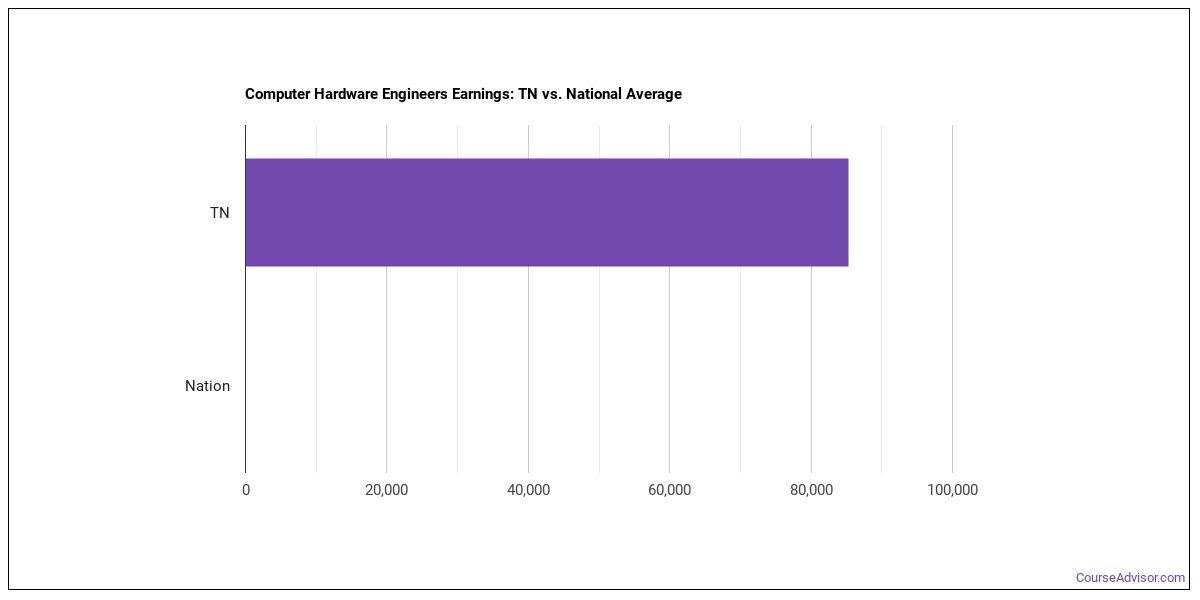
For a computer hardware engineers working in Tennessee, the median annual wage is $100,430 per year (or about $48.28/hour).Pay can range from $69,720 at the 10th percentile to $160,690 at the 90th percentile.
| Wage Statistic | Annual | Hourly |
|---|---|---|
| 10th percentile | $69,720 | $33.52 |
| 25th percentile | $71,700 | $34.47 |
| Median (50th) | $100,430 | $48.28 |
| 75th percentile | $127,030 | $61.07 |
| 90th percentile | $160,690 | $77.26 |

Location quotient — how concentrated this career is in Tennessee relative to the national average — is 0.20, indicating fewer computer hardware engineers per worker than the national average.
National Wage Comparison
Nationally, computer hardware engineers earn a median of $63,909 per year ($30.73/hour), exceeding the Tennessee median.
Employment Outlook
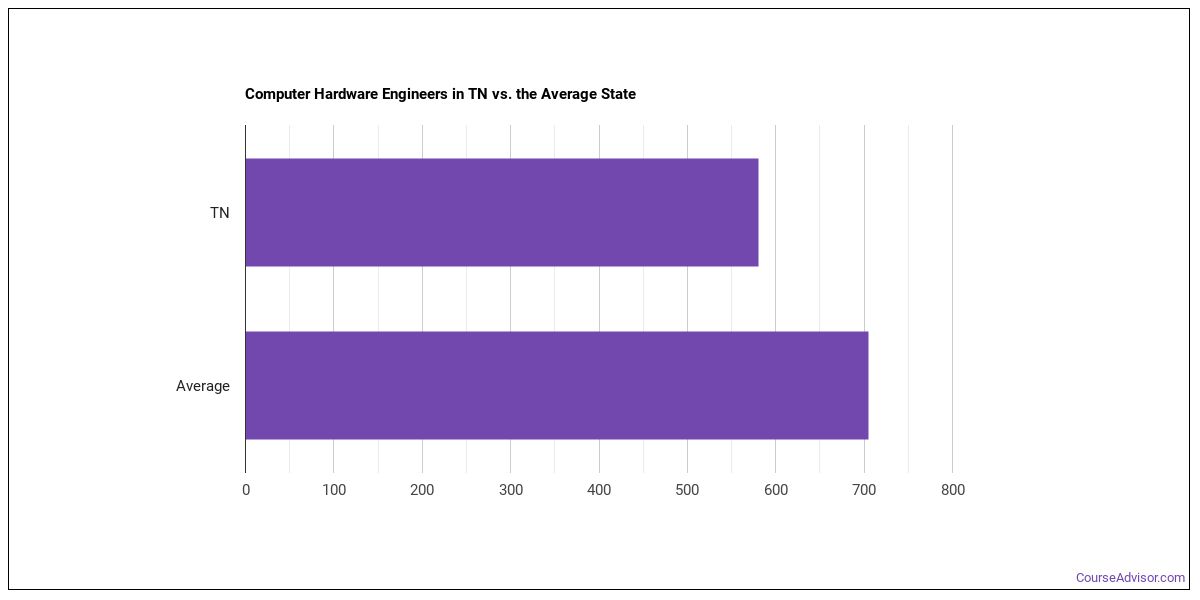
Nationally, total employment in this occupation is 370,152 computer hardware engineers nationwide. In Tennessee alone, around 320 people work in this role. That trails the typical state, which employs around 510 computer hardware engineers.

Top Tennessee Metros for Computer Hardware Engineers
The metro areas below employ the most computer hardware engineers in Tennessee.
| Metro Area | Number Employed | Annual Median Salary |
|---|---|---|
| Knoxville, TN | 90 | $71,690 |
Top States for Computer Hardware Engineers Employment
The table below shows the states where the most computer hardware engineers work.
| State | Number Employed |
|---|---|
| California | 24,200 |
| Arizona | 3,390 |
| Texas | 3,380 |
| Massachusetts | 3,350 |
| Colorado | 2,920 |
| Florida | 2,890 |
| New York | 2,500 |
| Maryland | 2,420 |
| Virginia | 1,840 |
| Illinois | 1,500 |
| Michigan | 1,440 |
| Washington | 1,370 |
| North Carolina | 1,250 |
| Pennsylvania | 940 |
| Idaho | 820 |
| Alabama | 800 |
| Ohio | 790 |
| New Jersey | 690 |
| Missouri | 580 |
| Minnesota | 560 |
Highest-Paying States for Computer Hardware Engineers
The highest-paying states for computer hardware engineers.
| State | Annual Median Salary |
|---|---|
| Connecticut | $188,540 |
| California | $179,880 |
| Washington | $174,070 |
| Massachusetts | $170,570 |
| Arizona | $163,090 |
| Colorado | $162,920 |
| Hawaii | $155,390 |
| District of Columbia | $153,630 |
| New Hampshire | $152,840 |
| New York | $141,780 |
Skills
Key computer hardware engineers skills, rated on an importance scale of 0 to 5:
Knowledge Areas
Key knowledge areas for this occupation, rated on an importance scale of 0 to 5:
Abilities
The abilities that matter most for computer hardware engineers, rated on an importance scale of 0 to 5:
Daily Tasks
Computer Hardware Engineers typically:
- Update knowledge and skills to keep up with rapid advancements in computer technology.
- Design and develop computer hardware and support peripherals, including central processing units (CPUs), support logic, microprocessors, custom integrated circuits, and printers and disk drives.
- Confer with engineering staff and consult specifications to evaluate interface between hardware and software and operational and performance requirements of overall system.
- Build, test, and modify product prototypes, using working models or theoretical models constructed with computer simulation.
- Write detailed functional specifications that document the hardware development process and support hardware introduction.
- Test and verify hardware and support peripherals to ensure that they meet specifications and requirements, by recording and analyzing test data.
- Direct technicians, engineering designers or other technical support personnel as needed.
- Provide technical support to designers, marketing and sales departments, suppliers, engineers and other team members throughout the product development and implementation process.
- Select hardware and material, assuring compliance with specifications and product requirements.
- Store, retrieve, and manipulate data for analysis of system capabilities and requirements.
- Analyze user needs and recommend appropriate hardware.
- Evaluate factors such as reporting formats required, cost constraints, and need for security restrictions to determine hardware configuration.
Work Activities
- Working with Computers
- Making Decisions and Solving Problems
- Updating and Using Relevant Knowledge
- Analyzing Data or Information
- Getting Information
- Thinking Creatively
- Processing Information
- Communicating with Supervisors, Peers, or Subordinates
- Evaluating Information to Determine Compliance with Standards
- Estimating the Quantifiable Characteristics of Products, Events, or Information
- Documenting/Recording Information
- Identifying Objects, Actions, and Events
Tools & Technology
Software and systems commonly involved: Hot technologies: Apache Subversion SVN, Autodesk AutoCAD, C In-demand technologies: C, C++
What Major Will Prepare You For This Career?
Related college programs include:
- Electrical Engineering
- Computer Engineering
- Electrical and Computer Engineering
Featured schools near , edit
Related Careers
Related occupations to computer hardware engineers include:
- Computer Systems Analysts
- Software Developers
- Software Quality Assurance Analysts and Testers
- Computer Systems Engineers/Architects
- Electrical Engineers
- Electronics Engineers, Except Computer
Also Known As
Analog Design Engineer, Analog IC Design Engineer (Analog Integrated Circuit Design Engineer), Application Specific Integrated Circuit Design Engineer (ASIC Design Engineer), Application Specific Integrated Circuit Design Verification Engineer (ASIC Design Verification Engineer), Computer Designer, Computer Engineer, Computer Hardware Designer, Computer Hardware Developer, Computer Hardware Engineer, Computer Installation Engineer, Computer Tester, Computer Vision Engineer, Design Engineer, Design Verification Engineer, Digital Design Engineer.
References
- U.S. Bureau of Labor Statistics, Occupational Employment and Wage Statistics — https://www.bls.gov/oes/
- O*NET Online — https://www.onetonline.org/
- BLS Employment Projections — https://www.bls.gov/emp/
- O*NET-SOC code: 17-2061.00

Course Advisor provides higher-education, college and university, degree, program, career, salary, and other helpful information to students, faculty, institutions, and other internet audiences. Presented information and data are subject to change. Inclusion on this website does not imply or represent a direct relationship with the company, school, or brand. Information, though believed correct at time of publication, may not be correct, and no warranty is provided. Contact the schools to verify any information before relying on it. Financial aid may be available for those who qualify. The displayed options may include sponsored or recommended results, not necessarily based on your preferences.
© Course Advisor – All Rights Reserved.