Chemical Engineers in Iowa
Want to work as a Chemical Engineers in Iowa? Below are the key facts. Design chemical plant equipment and devise processes for manufacturing chemicals and products, such as gasoline, synthetic rubber, plastics, detergents, cement, paper, and pulp, by applying principles and technology of chemistry, physics, and engineering.
What do Chemical Engineers Make in Iowa?
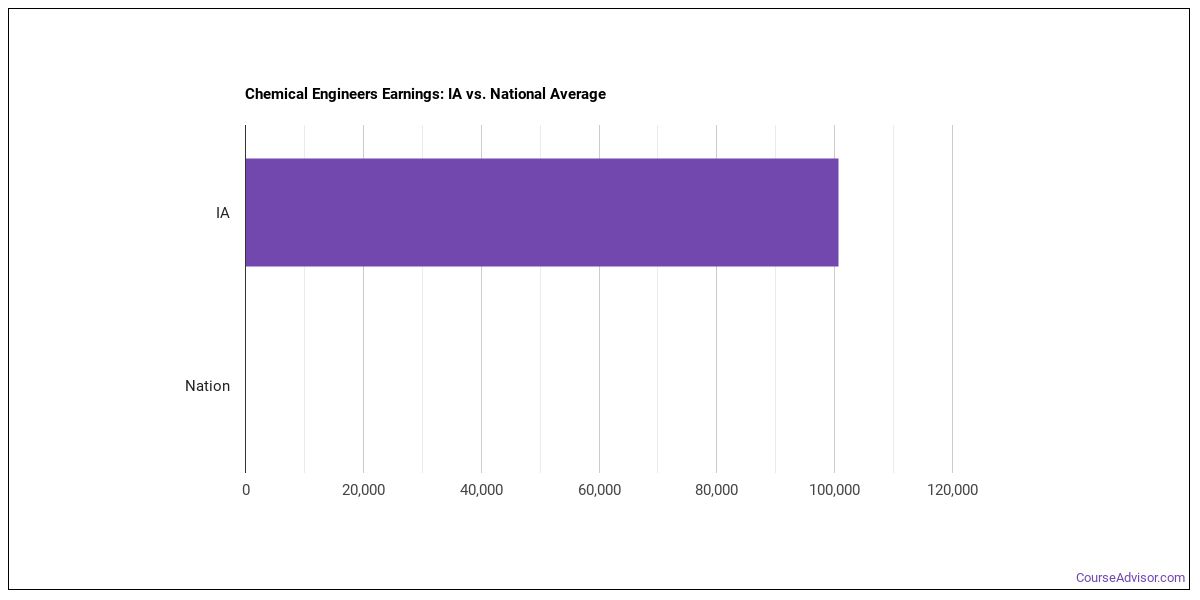
The chemical engineers working in Iowa, the typical annual salary is $101,080 per year (or roughly $48.59/hour).Earnings range from $82,700 at the 10th percentile to $126,600 at the 90th percentile.
| Wage Statistic | Annual | Hourly |
|---|---|---|
| 10th percentile | $82,700 | $39.76 |
| 25th percentile | $88,230 | $42.42 |
| Median (50th) | $101,080 | $48.59 |
| 75th percentile | $117,330 | $56.41 |
| 90th percentile | $126,600 | $60.86 |

The location quotient — a measure of how concentrated this occupation is in Iowa nationwide is 0.28, indicating fewer chemical engineers per worker than the national average.
National Wage Comparison
Nationally, chemical engineers earn a median of $130,903 per year ($62.93/hour), lower than the Iowa median.
Employment Outlook
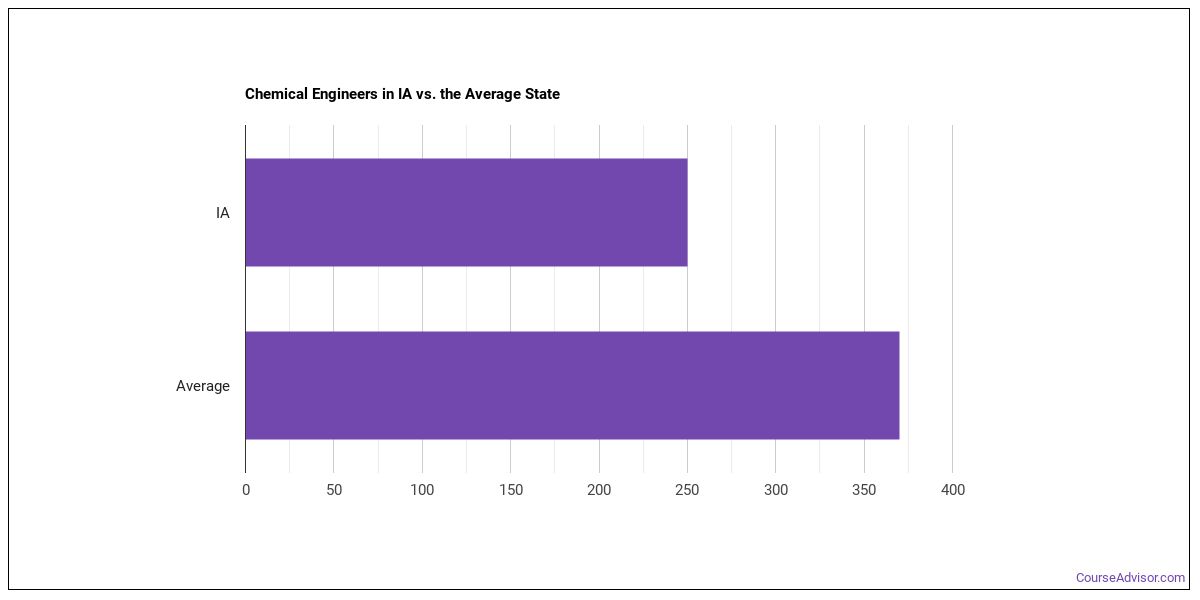
National employment for 213,738 chemical engineers nationwide. In Iowa alone, approximately 60 people work in this role. That’s below the typical state, which employs around 340 chemical engineers.

Top States for Chemical Engineers Employment
These states have the highest employment of chemical engineers work.
| State | Number Employed |
|---|---|
| Texas | 2,780 |
| California | 1,260 |
| Massachusetts | 1,140 |
| Ohio | 1,100 |
| Virginia | 1,020 |
| Pennsylvania | 970 |
| Colorado | 850 |
| Michigan | 780 |
| Louisiana | 780 |
| Washington | 600 |
| Maryland | 560 |
| New York | 560 |
| Alabama | 540 |
| Illinois | 490 |
| New Jersey | 480 |
| North Carolina | 450 |
| Tennessee | 450 |
| Missouri | 450 |
| Delaware | 390 |
| Connecticut | 380 |
Highest-Paying States for Chemical Engineers
The highest-paying states for chemical engineers.
| State | Annual Median Salary |
|---|---|
| Oklahoma | $160,990 |
| New Mexico | $147,290 |
| West Virginia | $139,730 |
| Texas | $135,160 |
| Virginia | $132,550 |
| New York | $132,480 |
| Colorado | $131,740 |
| Delaware | $131,330 |
| Louisiana | $131,180 |
| Washington | $130,830 |
Skills
Key chemical engineers skills, rated on an importance scale of 0 to 5:
Knowledge Areas
Key knowledge areas for this occupation, rated on an importance scale of 0 to 5:
Abilities
The abilities that matter most for chemical engineers, rated on an importance scale of 0 to 5:
Daily Tasks
Common tasks include:
- Develop safety procedures to be employed by workers operating equipment or working in close proximity to ongoing chemical reactions.
- Troubleshoot problems with chemical manufacturing processes.
- Monitor and analyze data from processes and experiments.
- Evaluate chemical equipment and processes to identify ways to optimize performance or to ensure compliance with safety and environmental regulations.
- Design and plan layout of equipment.
- Prepare estimate of production costs and production progress reports for management.
- Perform tests and monitor performance of processes throughout stages of production to determine degree of control over variables such as temperature, density, specific gravity, and pressure.
- Conduct research to develop new and improved chemical manufacturing processes.
- Determine most effective arrangement of operations such as mixing, crushing, heat transfer, distillation, and drying.
- Develop processes to separate components of liquids or gases or generate electrical currents, using controlled chemical processes.
- Design measurement and control systems for chemical plants based on data collected in laboratory experiments and in pilot plant operations.
- Perform laboratory studies of steps in manufacture of new products and test proposed processes in small-scale operation, such as a pilot plant.
Work Activities
- Making Decisions and Solving Problems
- Working with Computers
- Getting Information
- Analyzing Data or Information
- Communicating with Supervisors, Peers, or Subordinates
- Monitoring Processes, Materials, or Surroundings
- Processing Information
- Evaluating Information to Determine Compliance with Standards
- Identifying Objects, Actions, and Events
- Interpreting the Meaning of Information for Others
- Updating and Using Relevant Knowledge
- Documenting/Recording Information
Tools & Technology
Technologies frequently used: Hot technologies: Autodesk AutoCAD, C In-demand technologies: Autodesk AutoCAD
What Major Will Prepare You For This Career?
Several college majors map to this occupation:
- Chemical Engineering
- Polymer & Plastics Engineering
- Biochemical Engineering
- Ceramic Engineering
- Paper Science & Engineering
- Engineering Chemistry
Featured schools near , edit
Related Careers
Other careers like chemical engineers include:
- Biofuels/Biodiesel Technology and Product Development Managers
- Industrial Engineers
- Manufacturing Engineers
- Materials Engineers
- Mechanical Engineers
- Fuel Cell Engineers
Also Known As
Absorption and Adsorption Engineer, Blending Coordinator, Chemical Design Process Engineer, Chemical Engineer, Chemical Process Engineer, Chemical Research Engineer, Chemical Test Engineer, Control Systems Engineer, Controls Engineer, Development Engineer, Engineer, Engineering Scientist, Explosives Engineer, Fuel Engineer, Gas Combustion Engineer.
References
- U.S. Bureau of Labor Statistics, Occupational Employment and Wage Statistics — https://www.bls.gov/oes/
- O*NET Online — https://www.onetonline.org/
- BLS Employment Projections — https://www.bls.gov/emp/
- O*NET-SOC code: 17-2041.00

Course Advisor provides higher-education, college and university, degree, program, career, salary, and other helpful information to students, faculty, institutions, and other internet audiences. Presented information and data are subject to change. Inclusion on this website does not imply or represent a direct relationship with the company, school, or brand. Information, though believed correct at time of publication, may not be correct, and no warranty is provided. Contact the schools to verify any information before relying on it. Financial aid may be available for those who qualify. The displayed options may include sponsored or recommended results, not necessarily based on your preferences.
© Course Advisor – All Rights Reserved.