Camera Operators, Television, Video, and Film in Massachusetts
Considering working as a Camera Operators, Television, Video, and Film in Massachusetts? Below are the key facts. Operate television, video, or film camera to record images or scenes for television, video, or film productions.
What do Camera Operators, Television, Video, and Film Make in Massachusetts?
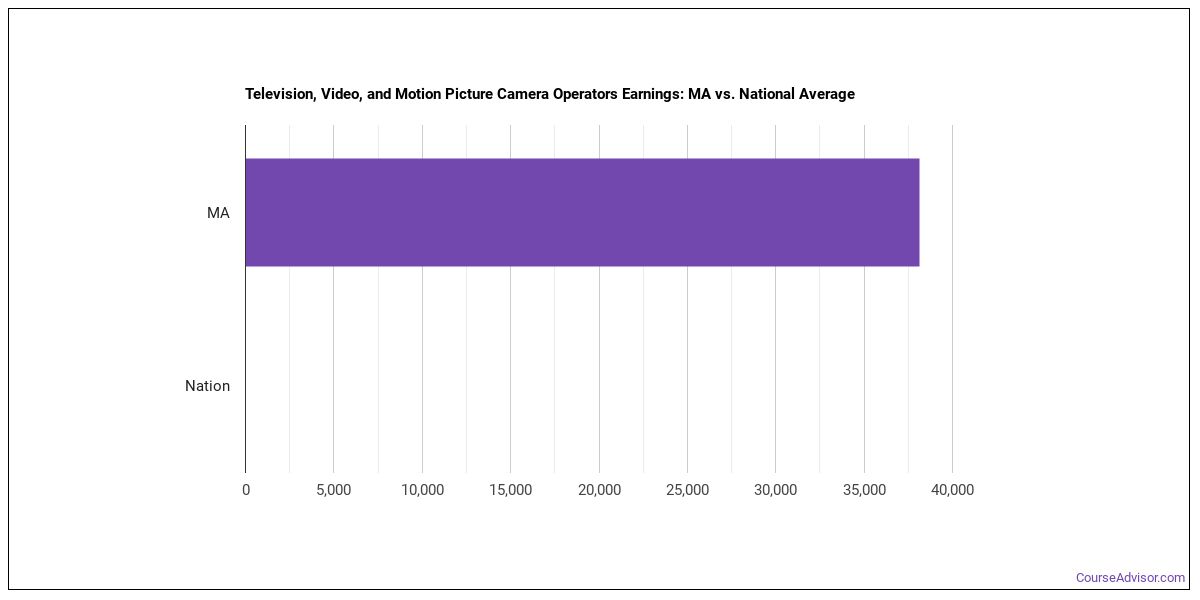
For camera operators, television, video, and film working in Massachusetts, the median annual wage is $49,670 per year (or about $23.88/hour).Earnings range from $39,680 at the 10th percentile to $98,740 at the 90th percentile.
| Wage Statistic | Annual | Hourly |
|---|---|---|
| 10th percentile | $39,680 | $19.08 |
| 25th percentile | $45,960 | $22.09 |
| Median (50th) | $49,670 | $23.88 |
| 75th percentile | $79,710 | $38.32 |
| 90th percentile | $98,740 | $47.47 |

The job concentration index in Massachusetts compared to the national average — is 0.77, meaning fewer camera operators, television, video, and film per worker than the national average.
National Wage Comparison
Nationally, camera operators, television, video, and film earn a median of $92,043 per year ($44.25/hour), lower than the Massachusetts median.
Employment Outlook
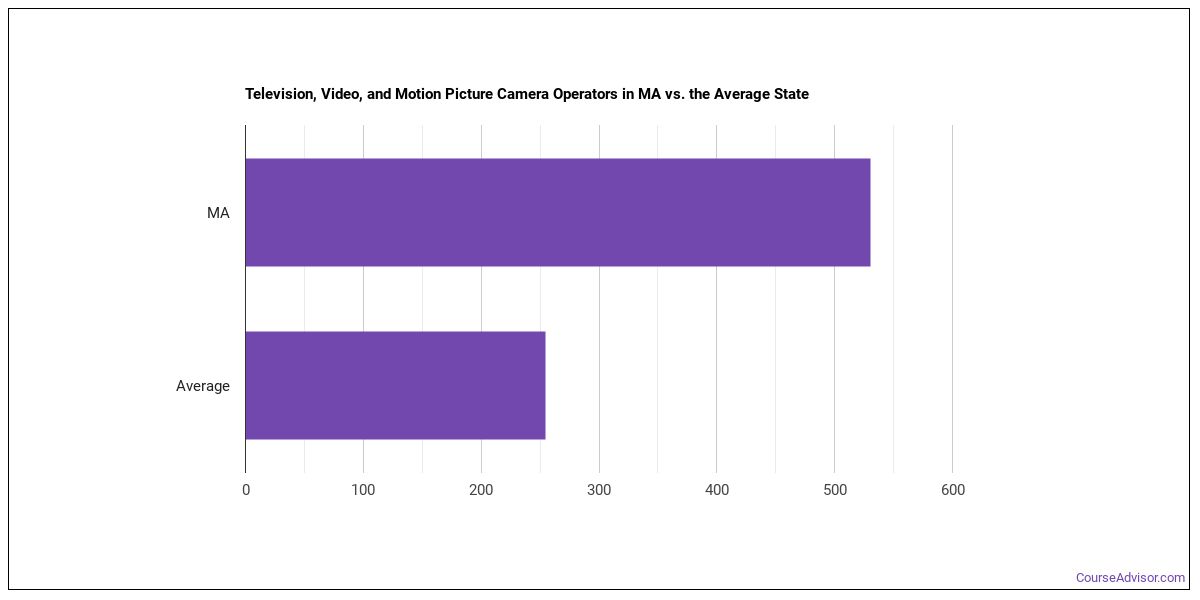
There are roughly 96,991 camera operators, television, video, and film across the United States. In Massachusetts alone, around 440 people work in this role. That’s more than the typical state, which employs around 300 camera operators, television, video, and film.

Top Massachusetts Metros for Camera Operators, Television, Video, and Film
The largest metro-area employers of camera operators, television, video, and film in Massachusetts.
| Metro Area | Number Employed | Annual Median Salary |
|---|---|---|
| Boston-Cambridge-Newton, MA-NH | 300 | $52,000 |
| Springfield, MA | 30 | $61,770 |
Top States for Camera Operators, Television, Video, and Film Employment
View the states that employ the most camera operators, television, video, and film work.
| State | Number Employed |
|---|---|
| California | 5,520 |
| New York | 3,510 |
| Florida | 1,770 |
| Texas | 1,530 |
| Illinois | 870 |
| Pennsylvania | 670 |
| Washington | 630 |
| Arizona | 630 |
| Virginia | 510 |
| Ohio | 500 |
| Michigan | 440 |
| New Jersey | 440 |
| Massachusetts | 440 |
| Tennessee | 440 |
| New Mexico | 420 |
| Nevada | 410 |
| Utah | 400 |
| Georgia | 340 |
| Wisconsin | 320 |
| District of Columbia | 310 |
Highest-Paying States for Camera Operators, Television, Video, and Film
These states pay the most for camera operators, television, video, and film.
| State | Annual Median Salary |
|---|---|
| California | $101,610 |
| District of Columbia | $100,940 |
| Oregon | $93,610 |
| New York | $89,960 |
| New Jersey | $85,560 |
| Illinois | $82,950 |
| Arizona | $74,830 |
| Colorado | $74,350 |
| Virginia | $71,760 |
| Maryland | $67,580 |
Skills
Key camera operators, television, video, and film skills, rated on an importance scale of 0 to 5:
Knowledge Areas
Important knowledge areas for this occupation, rated on an importance scale of 0 to 5:
Abilities
The abilities that matter most for camera operators, television, video, and film, rated on an importance scale of 0 to 5:
Daily Tasks
Common tasks include:
- Compose and frame each shot, applying the technical aspects of light, lenses, film, filters, and camera settings to achieve the effects sought by directors.
- Operate television or motion picture cameras to record scenes for television broadcasts, advertising, or motion pictures.
- Adjust positions and controls of cameras, printers, and related equipment to change focus, exposure, and lighting.
- Confer with directors, sound and lighting technicians, electricians, and other crew members to discuss assignments and determine filming sequences, desired effects, camera movements, and lighting requirements.
- Operate zoom lenses, changing images according to specifications and rehearsal instructions.
- Observe sets or locations for potential problems and to determine filming and lighting requirements.
- Set up and perform live shots for broadcast.
- Use cameras in any of several different camera mounts, such as stationary, track-mounted, or crane-mounted.
- Test, clean, maintain, and repair broadcast equipment, including testing microphones, to ensure proper working condition.
- Edit video for broadcast productions, including non-linear editing.
- Instruct camera operators regarding camera setups, angles, distances, movement, and variables and cues for starting and stopping filming.
- Assemble studio sets and select and arrange cameras, film stock, audio, or lighting equipment to be used during filming.
Work Activities
- Thinking Creatively
- Getting Information
- Communicating with Supervisors, Peers, or Subordinates
- Establishing and Maintaining Interpersonal Relationships
- Identifying Objects, Actions, and Events
- Making Decisions and Solving Problems
- Working with Computers
- Controlling Machines and Processes
- Updating and Using Relevant Knowledge
- Inspecting Equipment, Structures, or Materials
- Judging the Qualities of Objects, Services, or People
- Handling and Moving Objects
Tools & Technology
Software and systems commonly involved: Hot technologies: Adobe Acrobat, Adobe After Effects In-demand technologies: Adobe After Effects
What Major Will Prepare You For This Career?
Programs that train for this career include:
- Film, Video & Photographic Arts
- Audiovisual Communications
Featured schools near , edit
Related Careers
Related occupations to camera operators, television, video, and film include:
- Aerospace Engineering and Operations Technologists and Technicians
- Electrical and Electronic Engineering Technologists and Technicians
- Electro-Mechanical and Mechatronics Technologists and Technicians
- Robotics Technicians
- Calibration Technologists and Technicians
- Remote Sensing Scientists and Technologists
Also Known As
Advanced Air Mobility Operator (AAM Operator), Advanced Air Mobility Pilot (AAM Pilot), Advanced Air Mobility Technician (AAM Technician), Aerial Camera Operator, Animation Camera Operator, Camera Engineer, Camera Operator, Camera Person, Cameraman, Cinematographer, Commercial Drone Operator, Commercial Drone Pilot, Creative Specialist, Drone Camera Operator, Drone Operator.
References
- U.S. Bureau of Labor Statistics, Occupational Employment and Wage Statistics — https://www.bls.gov/oes/
- O*NET Online — https://www.onetonline.org/
- BLS Employment Projections — https://www.bls.gov/emp/
- O*NET-SOC code: 27-4031.00

Course Advisor provides higher-education, college and university, degree, program, career, salary, and other helpful information to students, faculty, institutions, and other internet audiences. Presented information and data are subject to change. Inclusion on this website does not imply or represent a direct relationship with the company, school, or brand. Information, though believed correct at time of publication, may not be correct, and no warranty is provided. Contact the schools to verify any information before relying on it. Financial aid may be available for those who qualify. The displayed options may include sponsored or recommended results, not necessarily based on your preferences.
© Course Advisor – All Rights Reserved.