Bioengineers and Biomedical Engineers in Ohio
Want to work as a Bioengineers and Biomedical Engineers in Ohio? Here’s what the data says. Apply knowledge of engineering, biology, chemistry, computer science, and biomechanical principles to the design, development, and evaluation of biological, agricultural, and health systems and products, such as artificial organs, prostheses, instrumentation, medical information systems, and health management and care delivery systems.
What do Bioengineers and Biomedical Engineers Make in Ohio?
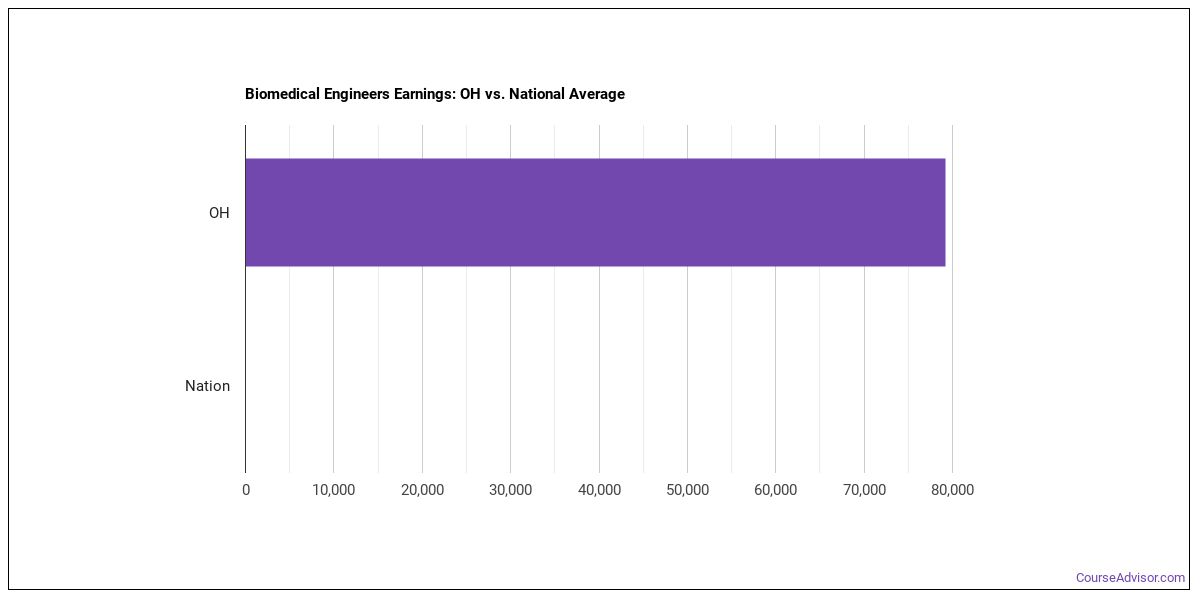
The bioengineers and biomedical engineers working in Ohio, wages run about $117,960 per year (or about $56.71/hour).Annual wages span from $79,140 at the 10th percentile to $165,570 at the 90th percentile.
| Wage Statistic | Annual | Hourly |
|---|---|---|
| 10th percentile | $79,140 | $38.05 |
| 25th percentile | $99,060 | $47.62 |
| Median (50th) | $117,960 | $56.71 |
| 75th percentile | $130,590 | $62.78 |
| 90th percentile | $165,570 | $79.60 |

The location quotient — a measure of how concentrated this occupation is in Ohio relative to the national average — is 1.88, meaning that bioengineers and biomedical engineers are more concentrated here than the national average.
National Wage Comparison
Nationally, bioengineers and biomedical engineers earn a median of $121,651 per year ($58.49/hour), below the Ohio median.
Employment Outlook
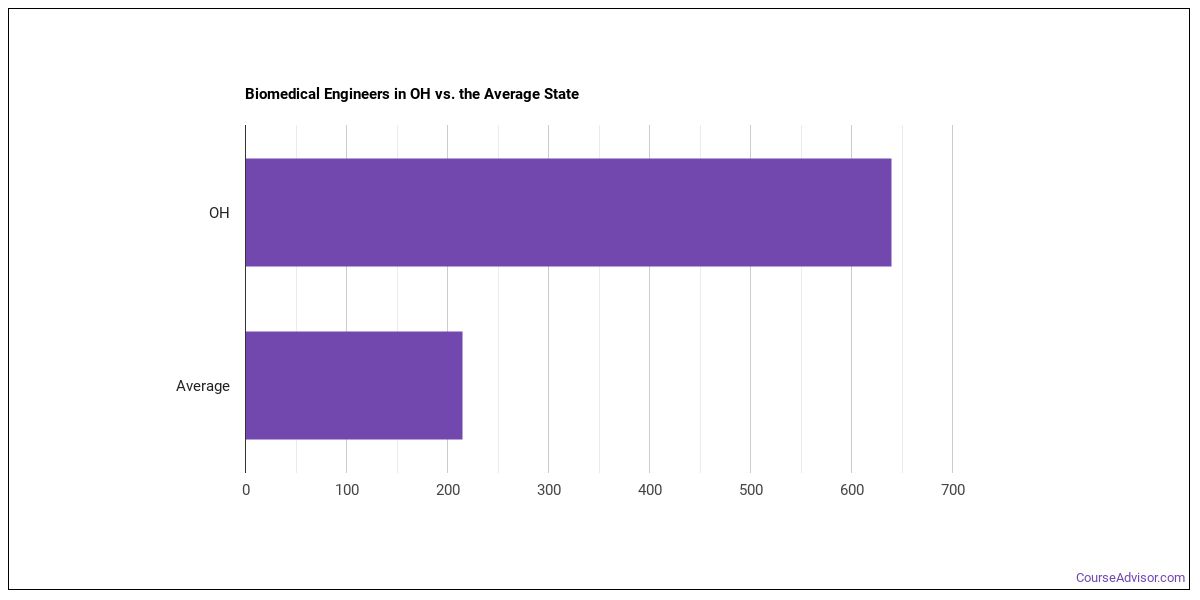
National employment for 56,066 bioengineers and biomedical engineers nationwide. In Ohio alone, about 1,470 people work in this role. That’s higher than the typical state, which employs around 400 bioengineers and biomedical engineers.

Top Ohio Metros for Bioengineers and Biomedical Engineers
The metro areas below employ the most bioengineers and biomedical engineers in Ohio.
| Metro Area | Number Employed | Annual Median Salary |
|---|---|---|
| Cincinnati, OH-KY-IN | 690 | $127,490 |
| Cleveland, OH | 280 | $100,080 |
| Columbus, OH | 220 | $128,220 |
| Dayton-Kettering-Beavercreek, OH | 90 | $109,160 |
| Akron, OH | 80 | $105,860 |
Top States for Bioengineers and Biomedical Engineers Employment
View the states that employ the most bioengineers and biomedical engineers work.
| State | Number Employed |
|---|---|
| Massachusetts | 3,920 |
| California | 2,900 |
| Texas | 1,750 |
| Ohio | 1,470 |
| Washington | 970 |
| Indiana | 970 |
| New York | 920 |
| Minnesota | 720 |
| Pennsylvania | 690 |
| Florida | 670 |
| North Carolina | 640 |
| Maryland | 540 |
| Georgia | 520 |
| Virginia | 500 |
| New Jersey | 490 |
| Colorado | 460 |
| Arizona | 410 |
| Utah | 400 |
| Michigan | 320 |
| Tennessee | 260 |
Highest-Paying States for Bioengineers and Biomedical Engineers
The highest-paying states for bioengineers and biomedical engineers.
| State | Annual Median Salary |
|---|---|
| Wisconsin | $129,440 |
| Oregon | $129,020 |
| California | $125,700 |
| Washington | $125,010 |
| Minnesota | $124,760 |
| Arizona | $121,680 |
| Ohio | $117,960 |
| Oklahoma | $117,250 |
| New York | $117,180 |
| New Mexico | $116,560 |
Skills
The most important bioengineers and biomedical engineers skills, rated on an importance scale of 0 to 5:
Knowledge Areas
Core knowledge areas for this occupation, rated on an importance scale of 0 to 5:
Abilities
The abilities that matter most for bioengineers and biomedical engineers, rated on an importance scale of 0 to 5:
Daily Tasks
Day-to-day, bioengineers and biomedical engineers typically:
- Evaluate the safety, efficiency, and effectiveness of biomedical equipment.
- Prepare technical reports, data summary documents, or research articles for scientific publication, regulatory submissions, or patent applications.
- Design or develop medical diagnostic or clinical instrumentation, equipment, or procedures, using the principles of engineering and biobehavioral sciences.
- Conduct research, along with life scientists, chemists, and medical scientists, on the engineering aspects of the biological systems of humans and animals.
- Adapt or design computer hardware or software for medical science uses.
- Maintain databases of experiment characteristics or results.
- Develop statistical models or simulations, using statistical or modeling software.
- Read current scientific or trade literature to stay abreast of scientific, industrial, or technological advances.
- Manage teams of engineers by creating schedules, tracking inventory, creating or using budgets, or overseeing contract obligations or deadlines.
- Develop models or computer simulations of human biobehavioral systems to obtain data for measuring or controlling life processes.
- Design or conduct follow-up experimentation, based on generated data, to meet established process objectives.
- Write documents describing protocols, policies, standards for use, maintenance, and repair of medical equipment.
Work Activities
- Working with Computers
- Analyzing Data or Information
- Making Decisions and Solving Problems
- Getting Information
- Processing Information
- Updating and Using Relevant Knowledge
- Thinking Creatively
- Communicating with Supervisors, Peers, or Subordinates
- Evaluating Information to Determine Compliance with Standards
- Identifying Objects, Actions, and Events
- Documenting/Recording Information
- Organizing, Planning, and Prioritizing Work
Tools & Technology
Software and systems commonly involved: Hot technologies: Adobe Illustrator, Adobe Photoshop, Autodesk AutoCAD, C, C++ In-demand technologies: Microsoft Excel
What Major Will Prepare You For This Career?
Related college programs include:
- Biomedical Engineering
- Biological Engineering
- Chemical Engineering
Featured schools near , edit
Related Careers
Related occupations to bioengineers and biomedical engineers include:
- Natural Sciences Managers
- Data Scientists
- Clinical Data Managers
- Bioinformatics Technicians
- Chemical Engineers
- Nanosystems Engineers
Also Known As
Analytical Biochemical Engineer, Biochemical Development Engineer, Biochemical Engineer, Biochemistry Chemical Engineering Analyst, Bioengineer, Bioinformatics Engineer, Biomaterials Engineer, Biomechanical Engineer, Biomedical Analytical Scientist, Biomedical Engineer, Biomedical Engineering Intern, Biomedical Engineering Research Assistant, Biomedical Engineering Technologist, Biomedical Field Service Engineer, Biomedical Scientist.
References
- U.S. Bureau of Labor Statistics, Occupational Employment and Wage Statistics — https://www.bls.gov/oes/
- O*NET Online — https://www.onetonline.org/
- BLS Employment Projections — https://www.bls.gov/emp/
- O*NET-SOC code: 17-2031.00

Course Advisor provides higher-education, college and university, degree, program, career, salary, and other helpful information to students, faculty, institutions, and other internet audiences. Presented information and data are subject to change. Inclusion on this website does not imply or represent a direct relationship with the company, school, or brand. Information, though believed correct at time of publication, may not be correct, and no warranty is provided. Contact the schools to verify any information before relying on it. Financial aid may be available for those who qualify. The displayed options may include sponsored or recommended results, not necessarily based on your preferences.
© Course Advisor – All Rights Reserved.