Atmospheric and Space Scientists in Wisconsin
Want to work as an Atmospheric and Space Scientists in Wisconsin? Here’s what the data says. Investigate atmospheric phenomena and interpret meteorological data, gathered by surface and air stations, satellites, and radar to prepare reports and forecasts for public and other uses. Includes weather analysts and forecasters whose functions require the detailed knowledge of meteorology.
What do Atmospheric and Space Scientists Make in Wisconsin?
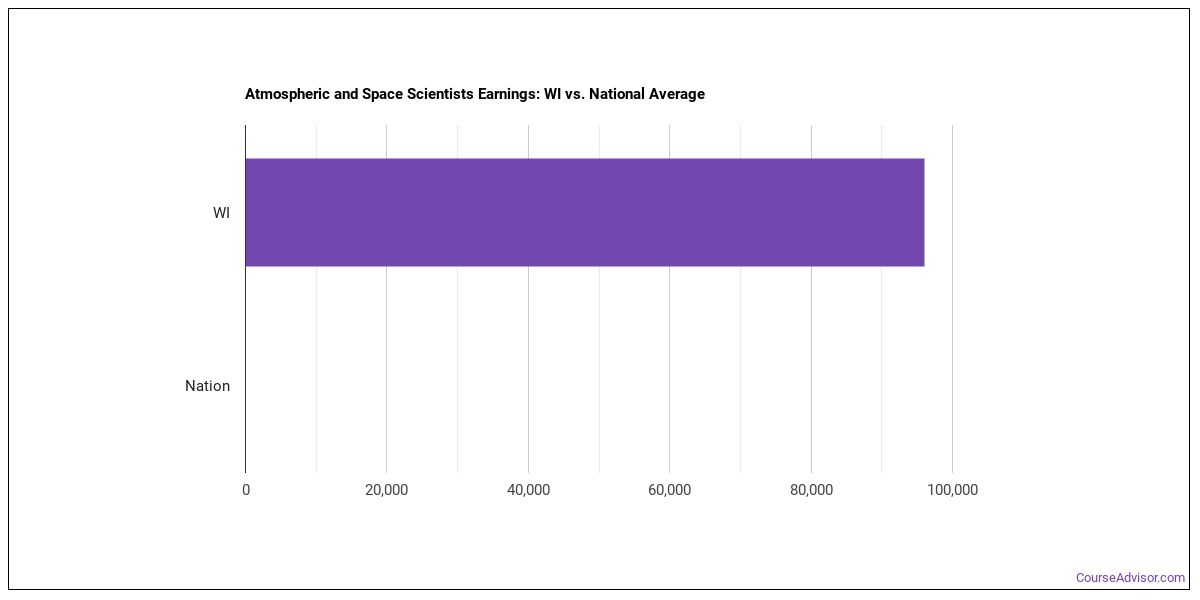
For a atmospheric and space scientists working in Wisconsin, wages run about $102,130 per year (or roughly $49.10/hour).Annual wages span from $62,690 at the 10th percentile to $165,440 at the 90th percentile.
| Wage Statistic | Annual | Hourly |
|---|---|---|
| 10th percentile | $62,690 | $30.14 |
| 25th percentile | $81,230 | $39.05 |
| Median (50th) | $102,130 | $49.10 |
| 75th percentile | $124,090 | $59.66 |
| 90th percentile | $165,440 | $79.54 |

Location quotient — how concentrated this career is in Wisconsin nationwide is 1.06.
National Wage Comparison
Nationally, atmospheric and space scientists earn a median of $77,973 per year ($37.49/hour), exceeding the Wisconsin median.
Employment Outlook
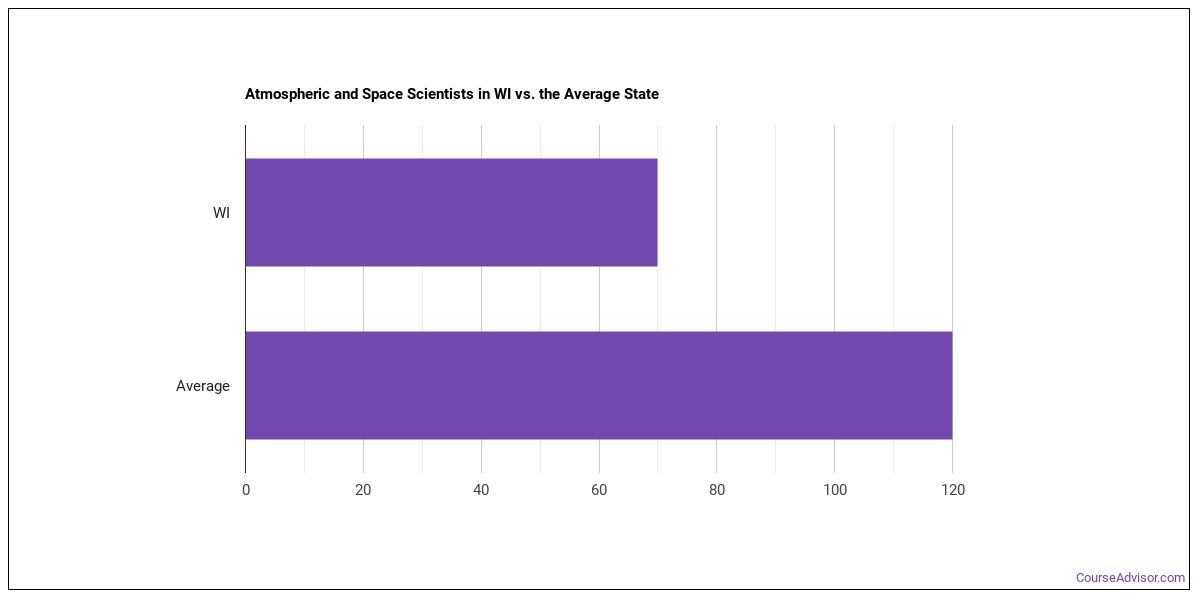
Nationally, total employment in this occupation is 55,620 atmospheric and space scientists nationwide. In Wisconsin alone, approximately 180 people work in this role. That’s higher than the typical state, which employs around 120 atmospheric and space scientists.

Top Wisconsin Metros for Atmospheric and Space Scientists
The metro areas below employ the most atmospheric and space scientists in Wisconsin.
| Metro Area | Number Employed | Annual Median Salary |
|---|---|---|
| Madison, WI | 110 | $102,130 |
Top States for Atmospheric and Space Scientists Employment
These states have the highest employment of atmospheric and space scientists work.
| State | Number Employed |
|---|---|
| Colorado | 950 |
| Maryland | 710 |
| California | 580 |
| New York | 500 |
| Florida | 440 |
| Texas | 440 |
| Illinois | 320 |
| Washington | 280 |
| Oklahoma | 280 |
| Alabama | 230 |
| Ohio | 190 |
| Alaska | 180 |
| Wisconsin | 180 |
| Georgia | 170 |
| Mississippi | 160 |
| Virginia | 150 |
| Michigan | 140 |
| North Carolina | 140 |
| Kansas | 140 |
| Missouri | 140 |
Highest-Paying States for Atmospheric and Space Scientists
These states pay the most for atmospheric and space scientists.
| State | Annual Median Salary |
|---|---|
| Hawaii | $122,180 |
| California | $117,770 |
| Idaho | $117,190 |
| Missouri | $116,480 |
| Oregon | $115,890 |
| New Mexico | $114,230 |
| Virginia | $111,920 |
| Nebraska | $110,140 |
| Tennessee | $109,800 |
| Montana | $107,240 |
Skills
Key atmospheric and space scientists skills, rated on an importance scale of 0 to 5:
Knowledge Areas
Important knowledge areas for this occupation, rated on an importance scale of 0 to 5:
Abilities
Key abilities for atmospheric and space scientists, rated on an importance scale of 0 to 5:
Daily Tasks
Atmospheric and Space Scientists typically:
- Develop or use mathematical or computer models for weather forecasting.
- Interpret data, reports, maps, photographs, or charts to predict long- or short-range weather conditions, using computer models and knowledge of climate theory, physics, and mathematics.
- Conduct meteorological research into the processes or determinants of atmospheric phenomena, weather, or climate.
- Formulate predictions by interpreting environmental data, such as meteorological, atmospheric, oceanic, paleoclimate, climate, or related information.
- Broadcast weather conditions, forecasts, or severe weather warnings to the public via television, radio, or the Internet or provide this information to the news media.
- Prepare forecasts or briefings to meet the needs of industry, business, government, or other groups.
- Gather data from sources such as surface or upper air stations, satellites, weather bureaus, or radar for use in meteorological reports or forecasts.
- Develop computer programs to collect meteorological data or to present meteorological information.
- Prepare weather reports or maps for analysis, distribution, or use in weather broadcasts, using computer graphics.
- Develop and deliver training on weather topics.
- Prepare scientific atmospheric or climate reports, articles, or texts.
- Analyze climate data sets, using techniques such as geophysical fluid dynamics, data assimilation, or numerical modeling.
Work Activities
- Working with Computers
- Analyzing Data or Information
- Getting Information
- Processing Information
- Updating and Using Relevant Knowledge
- Interpreting the Meaning of Information for Others
- Making Decisions and Solving Problems
- Communicating with People Outside the Organization
- Communicating with Supervisors, Peers, or Subordinates
- Thinking Creatively
- Organizing, Planning, and Prioritizing Work
- Identifying Objects, Actions, and Events
Tools & Technology
Technologies frequently used: Hot technologies: Adobe Photoshop, C++, Facebook In-demand technologies: Microsoft Office software
What Major Will Prepare You For This Career?
Several college majors map to this occupation:
- Atmospheric Sciences
- Climate Science
- Mathematics and Atmospheric/Oceanic Science
Featured schools near , edit
Related Careers
Careers similar to atmospheric and space scientists include:
- Geographic Information Systems Technologists and Technicians
- Statisticians
- Data Scientists
- Geodetic Surveyors
- Surveying and Mapping Technicians
- Soil and Plant Scientists
Also Known As
Aerologist, Air Analyst, Astrochemist, Atmospheric Chemist, Atmospheric Scientist, Broadcast Meteorologist, Climate Change Risk Assessor, Climatologist, Computer Meteorologist, Forecaster, General Forecaster, Hurricane Tracker, Hydrometeorological Technician (Hydrometeorological Tech), Hydrometeorologist, Marine Meteorologist.
References
- U.S. Bureau of Labor Statistics, Occupational Employment and Wage Statistics — https://www.bls.gov/oes/
- O*NET Online — https://www.onetonline.org/
- BLS Employment Projections — https://www.bls.gov/emp/
- O*NET-SOC code: 19-2021.00

Course Advisor provides higher-education, college and university, degree, program, career, salary, and other helpful information to students, faculty, institutions, and other internet audiences. Presented information and data are subject to change. Inclusion on this website does not imply or represent a direct relationship with the company, school, or brand. Information, though believed correct at time of publication, may not be correct, and no warranty is provided. Contact the schools to verify any information before relying on it. Financial aid may be available for those who qualify. The displayed options may include sponsored or recommended results, not necessarily based on your preferences.
© Course Advisor – All Rights Reserved.