Actuaries in Virginia
Thinking about a career as an Actuaries in Virginia? Here’s what you need to know. Analyze statistical data, such as mortality, accident, sickness, disability, and retirement rates and construct probability tables to forecast risk and liability for payment of future benefits. May ascertain insurance rates required and cash reserves necessary to ensure payment of future benefits.
What do Actuaries Make in Virginia?
For a actuaries working in Virginia, the typical annual salary is $135,880 per year (or about $65.33/hour).
| Wage Statistic | Annual | Hourly |
|---|---|---|
| 10th percentile | $88,050 | $42.33 |
| 25th percentile | $101,820 | $48.95 |
| Median (50th) | $135,880 | $65.33 |
| 75th percentile | $166,180 | $79.90 |
| 90th percentile | n/a | n/a |

The job concentration index in Virginia nationwide is 0.93.
National Wage Comparison
Nationally, actuaries earn a median of $69,100 per year ($33.22/hour), higher than the Virginia median.

Employment Outlook
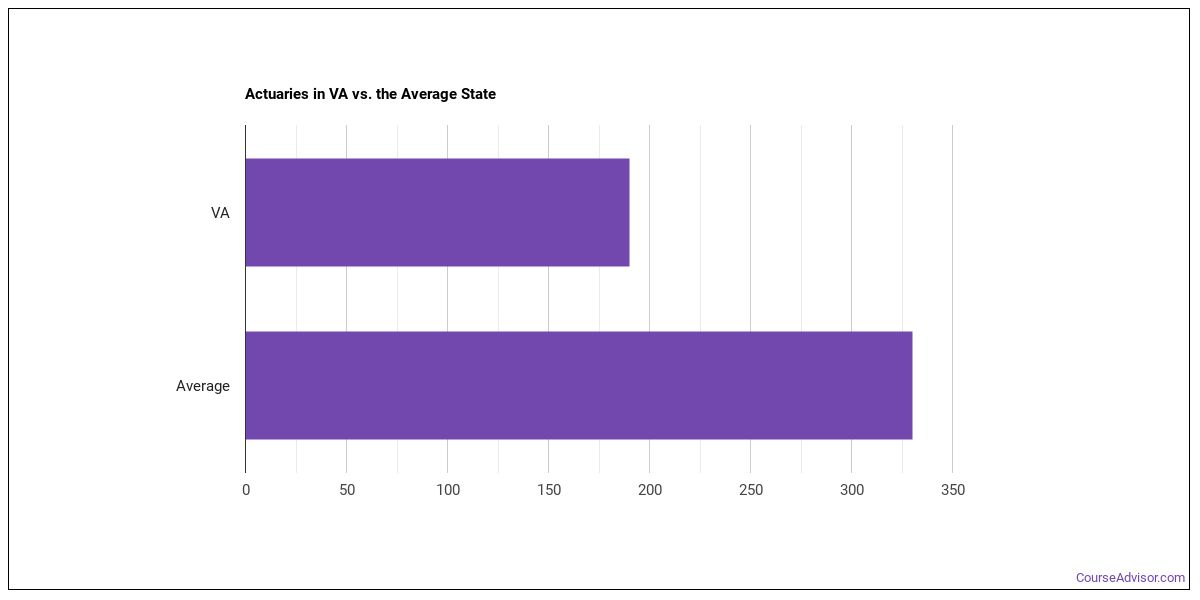
National employment for 224,851 actuaries in the U.S.. In Virginia alone, around 690 people work in this role. That puts the state above the typical state, which employs around 360 actuaries.

Top Virginia Metros for Actuaries
The metro areas below employ the most actuaries in Virginia.
| Metro Area | Number Employed | Annual Median Salary |
|---|---|---|
| Richmond, VA | 160 | $130,360 |
Top States for Actuaries Employment
View the states that employ the most actuaries work.
| State | Number Employed |
|---|---|
| New York | 3,090 |
| Illinois | 2,120 |
| Pennsylvania | 1,980 |
| Texas | 1,800 |
| Florida | 1,740 |
| Massachusetts | 1,530 |
| Ohio | 1,340 |
| California | 1,320 |
| New Jersey | 1,280 |
| Connecticut | 1,190 |
| Indiana | 1,060 |
| Wisconsin | 930 |
| Minnesota | 830 |
| Virginia | 690 |
| Iowa | 650 |
| Maryland | 610 |
| North Carolina | 600 |
| Tennessee | 450 |
| Colorado | 440 |
| Michigan | 360 |
Highest-Paying States for Actuaries
Where actuaries earn the most: actuaries.
| State | Annual Median Salary |
|---|---|
| District of Columbia | $153,340 |
| Washington | $153,260 |
| Connecticut | $148,220 |
| Alabama | $143,230 |
| New Jersey | $137,330 |
| Virginia | $135,880 |
| New York | $133,730 |
| Maine | $132,970 |
| Maryland | $132,740 |
| Nevada | $132,470 |
Skills
Key actuaries skills, rated on an importance scale of 0 to 5:
Knowledge Areas
Core knowledge areas for this occupation, rated on an importance scale of 0 to 5:
Abilities
Top abilities for actuaries, rated on an importance scale of 0 to 5:
Daily Tasks
Actuaries typically:
- Ascertain premium rates required and cash reserves and liabilities necessary to ensure payment of future benefits.
- Collaborate with programmers, underwriters, accounts, claims experts, and senior management to help companies develop plans for new lines of business or improvements to existing business.
- Analyze statistical information to estimate mortality, accident, sickness, disability, and retirement rates.
- Design, review, and help administer insurance, annuity and pension plans, determining financial soundness and calculating premiums.
- Determine, or help determine, company policy, and explain complex technical matters to company executives, government officials, shareholders, policyholders, or the public.
- Construct probability tables for events such as fires, natural disasters, and unemployment, based on analysis of statistical data and other pertinent information.
- Provide advice to clients on a contract basis, working as a consultant.
- Determine equitable basis for distributing surplus earnings under participating insurance and annuity contracts in mutual companies.
- Negotiate terms and conditions of reinsurance with other companies.
- Provide expertise to help financial institutions manage risks and maximize returns associated with investment products or credit offerings.
- Testify before public agencies on proposed legislation affecting businesses.
- Determine policy contract provisions for each type of insurance.
Work Activities
- Analyzing Data or Information
- Processing Information
- Working with Computers
- Getting Information
- Making Decisions and Solving Problems
- Communicating with Supervisors, Peers, or Subordinates
- Updating and Using Relevant Knowledge
- Evaluating Information to Determine Compliance with Standards
- Interpreting the Meaning of Information for Others
- Identifying Objects, Actions, and Events
- Providing Consultation and Advice to Others
- Communicating with People Outside the Organization
Tools & Technology
Software and systems commonly involved: Hot technologies: C++, IBM SPSS Statistics, Microsoft Access In-demand technologies: Microsoft Excel, Microsoft Office software
What Major Will Prepare You For This Career?
Related college programs include:
- Statistics
- Applied Mathematics
- Applied Statistics
- Management Sciences & Methods
- Business Administration & Management
Featured schools near , edit
Related Careers
Other careers like actuaries include:
- Financial Managers
- Investment Fund Managers
- Compensation and Benefits Managers
- Management Analysts
- Compensation, Benefits, and Job Analysis Specialists
- Accountants and Auditors
Also Known As
Actuarial Analyst, Actuarial Associate, Actuarial Consultant, Actuarial Intern, Actuarial Mathematician, Actuarial Specialist, Actuary, Annuity Analyst, Consulting Actuary, Corporate Actuary, Enrolled Actuary, Forecast Analyst, Health Actuary, Insurance Actuary, Life Actuary.
References
- U.S. Bureau of Labor Statistics, Occupational Employment and Wage Statistics — https://www.bls.gov/oes/
- O*NET Online — https://www.onetonline.org/
- BLS Employment Projections — https://www.bls.gov/emp/
- O*NET-SOC code: 15-2011.00

Course Advisor provides higher-education, college and university, degree, program, career, salary, and other helpful information to students, faculty, institutions, and other internet audiences. Presented information and data are subject to change. Inclusion on this website does not imply or represent a direct relationship with the company, school, or brand. Information, though believed correct at time of publication, may not be correct, and no warranty is provided. Contact the schools to verify any information before relying on it. Financial aid may be available for those who qualify. The displayed options may include sponsored or recommended results, not necessarily based on your preferences.
© Course Advisor – All Rights Reserved.