Veterinary Assistants and Laboratory Animal Caretakers: Career Overview
Feed, water, and examine pets and other nonfarm animals for signs of illness, disease, or injury in laboratories and animal hospitals and clinics. Clean and disinfect cages and work areas, and sterilize laboratory and surgical equipment. May provide routine postoperative care, administer medication orally or topically, or prepare samples for laboratory examination under the supervision of veterinary or laboratory animal technologists or technicians, veterinarians, or scientists.
Featured schools near , edit
What Tasks Do Veterinary Assistants and Laboratory Animal Caretakers Perform?
Typical responsibilities of veterinary assistants and laboratory animal caretakers cover:
- Hold or restrain animals during veterinary procedures.
- Monitor animals recovering from surgery and notify veterinarians of any unusual changes or symptoms.
- Fill medication prescriptions.
- Clean and maintain kennels, animal holding areas, examination or operating rooms, or animal loading or unloading facilities to control the spread of disease.
- Examine animals to detect behavioral changes or clinical symptoms that could indicate illness or injury.
- Perform routine laboratory tests or diagnostic tests, such as taking or developing x-rays.
- Assist veterinarians in examining animals to determine the nature of illnesses or injuries.
- Administer medication, immunizations, or blood plasma to animals as prescribed by veterinarians.
Key Skills and Knowledge
Top veterinary assistants and laboratory animal caretakers combine a mix of skills and domain knowledge.
Top Skills
The competencies that matter most in this role, rated on an importance scale of 0 to 5:
Top Knowledge Areas
Related Job Titles
Common job titles for this role include:
- Animal Care Provider
- Animal Care Service Worker
- Animal Care Specialist
- Animal Caregiver
- Animal Caretaker
- Animal Health Technician
- Avian Keeper
- Certified Veterinary Assistant
Job Outlook
The U.S. employs around 1,005,706 veterinary assistants and laboratory animal caretakers working in the United States today. Employment is projected to grow by +13.0% over the projection horizon.

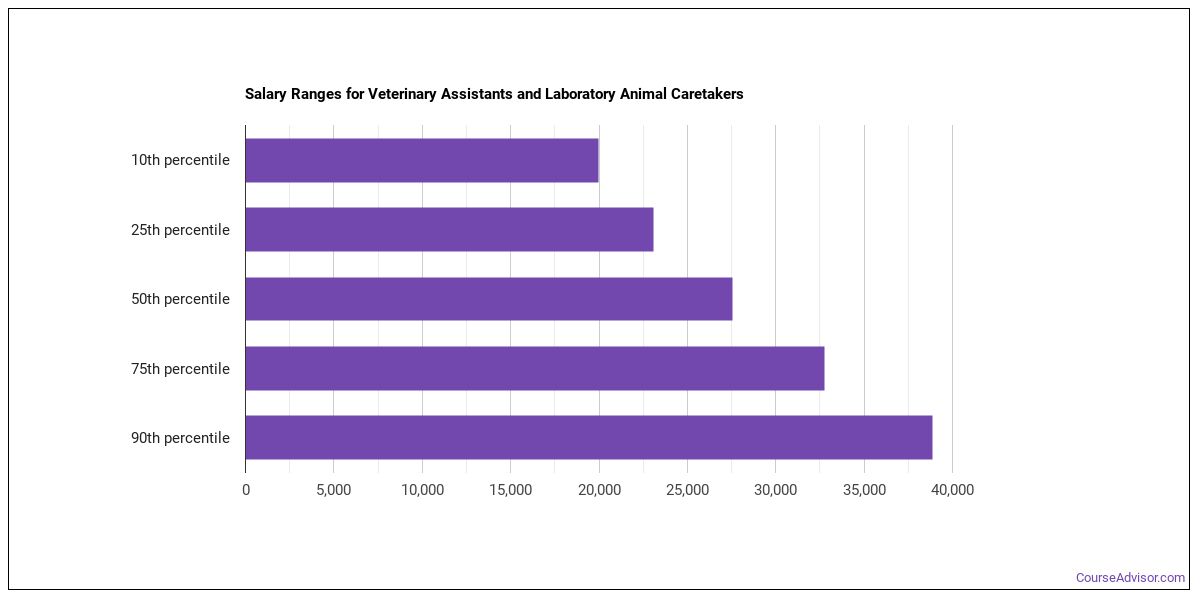
Salary for Veterinary Assistants and Laboratory Animal Caretakers
| Statistic | Value |
|---|---|
| Annual median | $48,340 |
| Hourly median | $23.24 |
| 10th percentile | $30,822 |
| 25th percentile | $39,581 |
| 75th percentile | $57,099 |
| 90th percentile | $65,858 |
Compensation varies based on experience, location, and industry.
Pay by State
| State | Annual median salary |
|---|---|
| Rhode Island | $48,050 |
| Massachusetts | $45,480 |
| California | $45,470 |
| Maine | $44,080 |
| Minnesota | $43,670 |
| Washington | $43,590 |
| District of Columbia | $43,580 |
| Maryland | $43,520 |
| New York | $43,150 |
| New Jersey | $42,910 |
| Oregon | $42,830 |
| Connecticut | $39,540 |
| Colorado | $39,480 |
| Arizona | $38,240 |
| Alaska | $37,530 |
| Illinois | $37,310 |
| Florida | $37,200 |
| Montana | $37,060 |
| North Carolina | $36,680 |
| Michigan | $36,550 |
| Virginia | $36,500 |
| Pennsylvania | $36,480 |
| Tennessee | $36,440 |
| Wyoming | $36,430 |
| North Dakota | $36,370 |
| Nevada | $36,160 |
| Vermont | $36,120 |
| Delaware | $36,060 |
| Idaho | $35,820 |
| Utah | $35,730 |
| South Carolina | $35,680 |
| New Mexico | $35,600 |
| Hawaii | $35,420 |
| Indiana | $35,270 |
| New Hampshire | $35,230 |
| Nebraska | $35,210 |
| Missouri | $35,040 |
| Wisconsin | $34,990 |
| Georgia | $34,980 |
| Ohio | $34,820 |
| South Dakota | $32,810 |
| Kansas | $32,670 |
| West Virginia | $32,630 |
| Kentucky | $32,590 |
| Iowa | $31,200 |
| Arkansas | $30,550 |
| Texas | $30,430 |
| Mississippi | $29,730 |
| Oklahoma | $29,730 |
| Alabama | $29,660 |
| Louisiana | $29,280 |
| Puerto Rico | $21,730 |
Pay by U.S. Region
Compensation for veterinary assistants and laboratory animal caretakers differ across the country. These regions lead on median pay:
| Region | Median annual wage | Share of U.S. jobs | Location quotient |
|---|---|---|---|
| Far Western US | $44,024 | 21.4% | 1.33 |
| New England | $42,104 | 4.1% | 0.99 |
| Middle Atlantic | $40,983 | 12.3% | 0.82 |
| Rocky Mountains | $38,040 | 4.6% | 1.25 |
| Great Lakes | $35,899 | 14.6% | 1.04 |
| Southeast | $35,531 | 25.6% | 1.14 |
| Plains States | $35,442 | 6.2% | 0.97 |
| Southwest | $31,930 | 10.8% | 0.88 |
Where the Jobs Cluster
| Metro area | State | Median annual wage | Employment |
|---|---|---|---|
| New Haven, CT | CT | $57,320 | 330 |
| Providence-Warwick, RI-MA | RI | $48,010 | 410 |
| Kahului-Wailuku, HI | HI | $47,460 | 50 |
| San Francisco-Oakland-Fremont, CA | CA | $47,040 | 2,410 |
| San Jose-Sunnyvale-Santa Clara, CA | CA | $46,950 | 550 |
| Barnstable Town, MA | MA | $46,920 | 80 |
| Sacramento-Roseville-Folsom, CA | CA | $46,620 | 1,590 |
| Santa Rosa-Petaluma, CA | CA | $46,280 | 320 |
Industry Breakdown
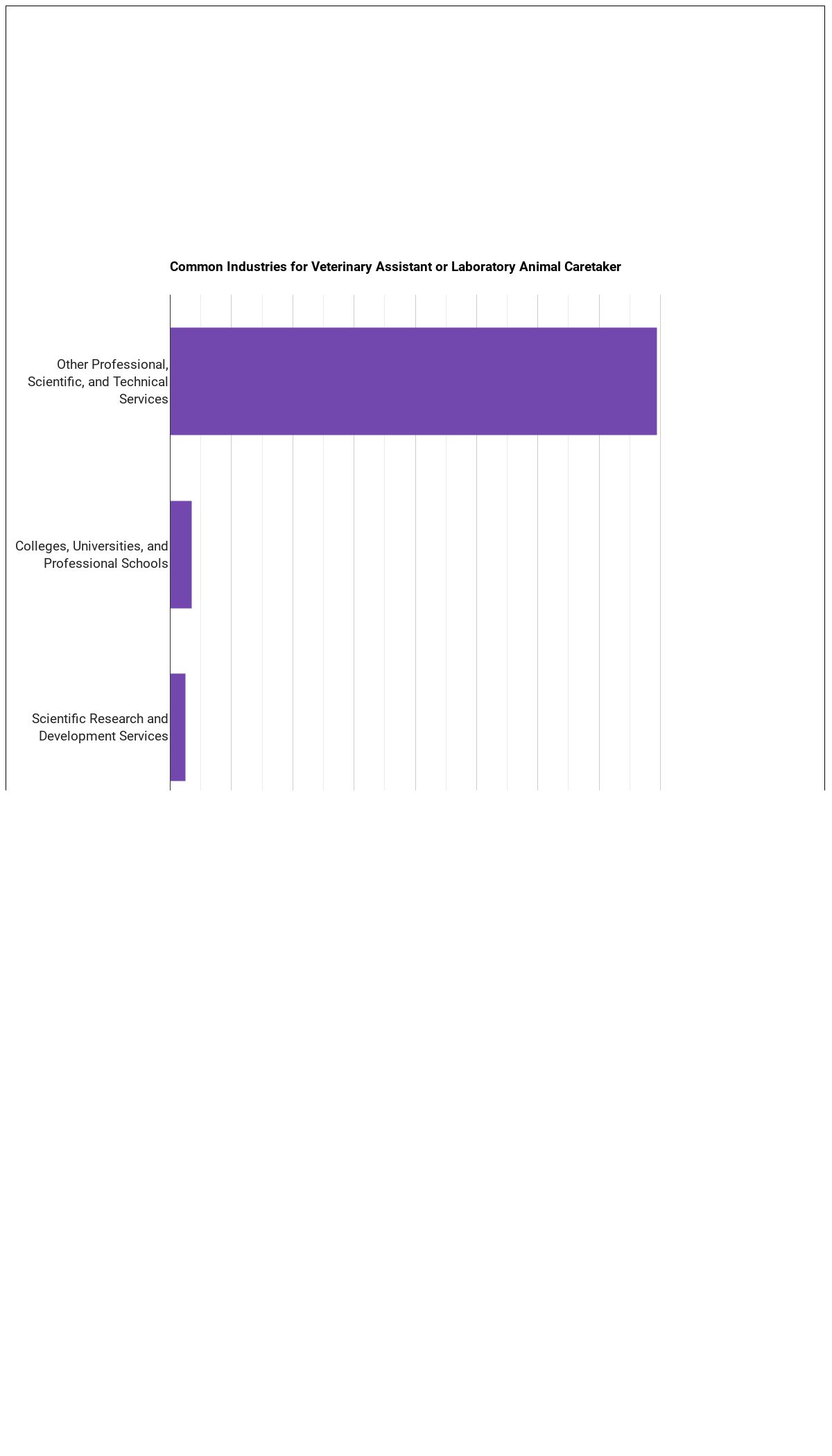
The bulk of veterinary assistants and laboratory animal caretakers work in these industries:
| Industry | Employment | Median annual wage |
|---|---|---|
| Professional, Scientific, and Technical Services | 103,290 | $37,110 |
| Educational Services | 5,090 | $47,670 |
| Other Services (except Public Administration) | 2,820 | $36,760 |
| Retail Trade | 1,740 | $41,490 |
| Health Care and Social Assistance | 330 | $48,350 |
| Administrative and Support and Waste Management and Remediation Services | 320 | $47,810 |
| Manufacturing | 70 | $47,420 |
| Arts, Entertainment, and Recreation | 70 | $42,960 |

The table below shows some of the most common industries where those employed in this career field work.
Tools and Technology
- Data base user interface and query software: Microsoft Access (hot technology)
- Spreadsheet software: Microsoft Excel (hot technology)
- Office suite software: Microsoft Office software (hot technology)
- Electronic mail software: Microsoft Outlook (hot technology)
- Presentation software: Microsoft PowerPoint (hot technology)
- Word processing software: Microsoft Word (hot technology)
What the Workplace Is Like
The work environment for veterinary assistants and laboratory animal caretakers is shaped by the following characteristics:
- Indoors, Environmentally Controlled
- Spend Time Standing
- Importance of Being Exact or Accurate
- Face-to-Face Discussions with Individuals and Within Teams
- Contact With Others
Getting Started in This Career
Entry-level veterinary assistants and laboratory animal caretakers positions require a high school diploma or equivalent as the typical entry-level education. This occupation sits in Some Preparation Needed (Job Zone 2), signaling the level of preparation typically expected.
Similar Occupations
Similar Occupations
- Pharmacists (Supplemental)
- Physician Assistants (Supplemental)
- Veterinarians (Supplemental)
- Registered Nurses (Supplemental)
- Nurse Practitioners (Supplemental)
- Emergency Medicine Physicians (Supplemental)
- Physicians, Pathologists (Supplemental)
- Allergists and Immunologists (Supplemental)
Degree Programs
Future veterinary assistants and laboratory animal caretakers often complete programs in:
Agriculture, Agriculture Operations, and Related Sciences
2 programs across 1 majors
About the Data
Data on this page comes from the following authoritative sources:
- U.S. Bureau of Labor Statistics — Occupational Employment and Wage Statistics (OEWS) for employment and wage data by state and industry.
- BLS Employment Projections for total employment and growth forecasts.
- O*NET (Occupational Information Network) for skills, knowledge, tasks, work activities, work context, technology, and education-zone data.
SOC code: 31-9096.00 (Veterinary Assistants and Laboratory Animal Caretakers).

Course Advisor provides higher-education, college and university, degree, program, career, salary, and other helpful information to students, faculty, institutions, and other internet audiences. Presented information and data are subject to change. Inclusion on this website does not imply or represent a direct relationship with the company, school, or brand. Information, though believed correct at time of publication, may not be correct, and no warranty is provided. Contact the schools to verify any information before relying on it. Financial aid may be available for those who qualify. The displayed options may include sponsored or recommended results, not necessarily based on your preferences.
© Course Advisor – All Rights Reserved.