Riggers: Job Description
Set up or repair rigging for construction projects, manufacturing plants, logging yards, ships and shipyards, or for the entertainment industry.
Featured schools near , edit
What Do Riggers Do?
The core tasks performed by riggers cover:
- Test rigging to ensure safety and reliability.
- Signal or verbally direct workers engaged in hoisting and moving loads to ensure safety of workers and materials.
- Control movement of heavy equipment through narrow openings or confined spaces, using chainfalls, gin poles, gallows frames, and other equipment.
- Tilt, dip, and turn suspended loads to maneuver over, under, or around obstacles, using multi-point suspension techniques.
- Select gear, such as cables, pulleys, and winches, according to load weights and sizes, facilities, and work schedules.
- Dismantle and store rigging equipment after use.
- Attach loads to rigging to provide support or prepare them for moving, using hand and power tools.
- Manipulate rigging lines, hoists, and pulling gear to move or support materials, such as heavy equipment, ships, or theatrical sets.
Skills and Knowledge
Top riggers draw on a mix of skills and domain knowledge.
Most Important Skills
The abilities most central to this role, rated on an importance scale of 0 to 5:
Core Knowledge
Other Riggers Job Titles
This career also goes by job titles like:
- Acrobatic Rigger
- Boat Rigger
- Certified Rigger
- Crane Rigger
- Fly Rail Operator
- Gantry Rigger
- Gear Repairer
- Grip
How Many Riggers Are There?
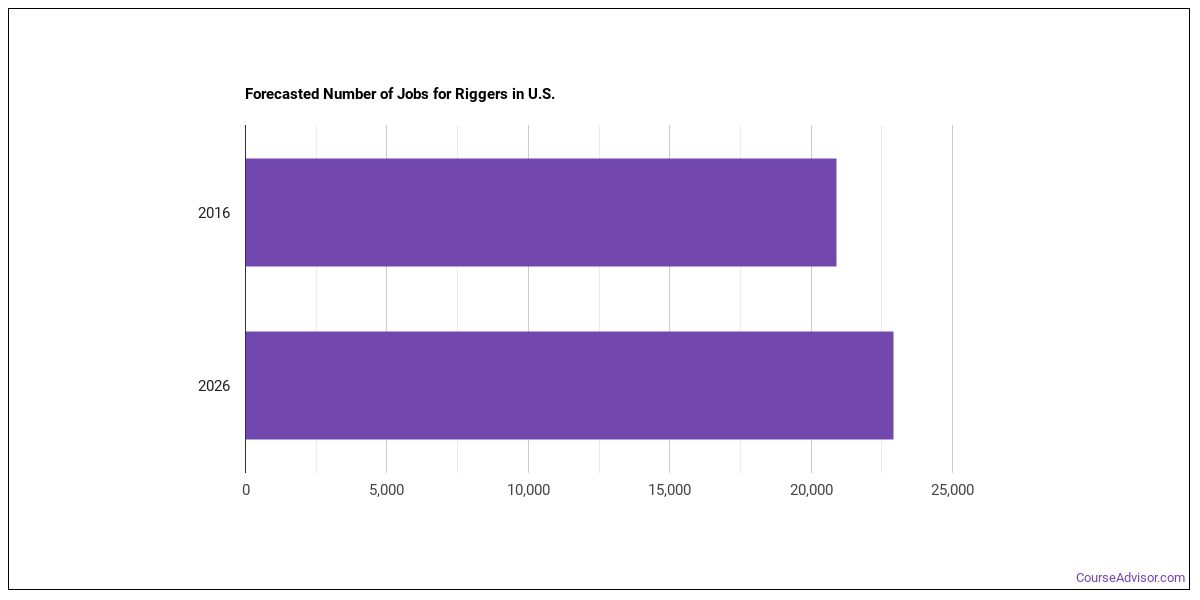
There are roughly 515,404 riggers working in the United States today. This occupation is expected to grow by +8.9% over the projection horizon.
How Much Do Riggers Make?
| Statistic | Value |
|---|---|
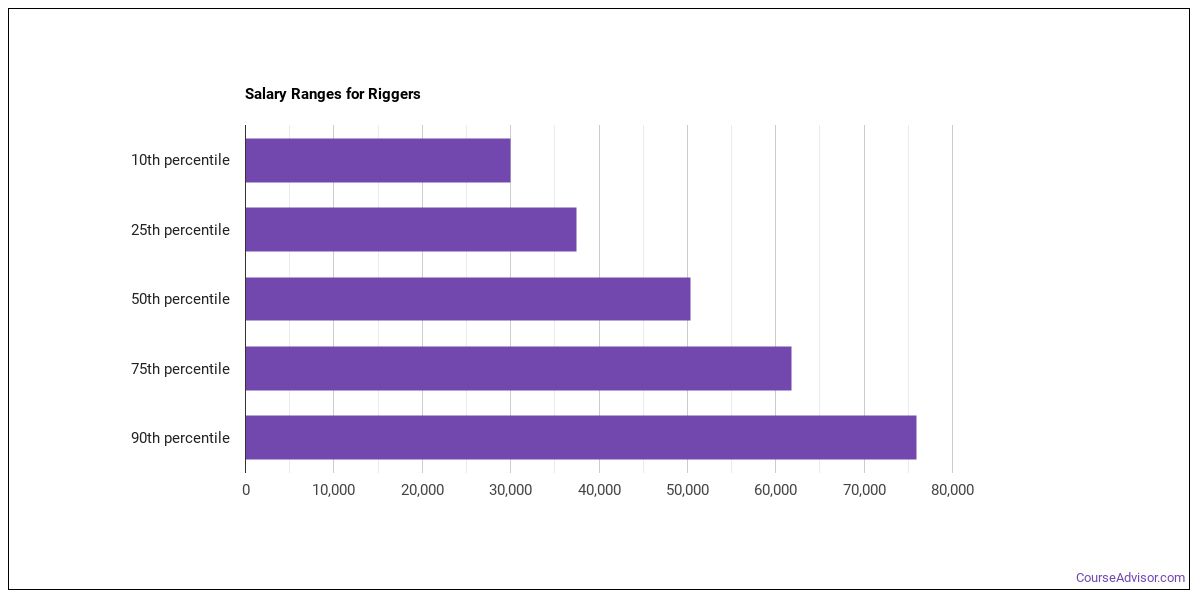
| Annual median | $35,808 |
| Hourly median | $17.22 |
| 10th percentile | $24,269 |
| 25th percentile | $30,039 |
| 75th percentile | $41,578 |
| 90th percentile | $47,347 |
Wages vary widely based on experience, location, and industry.
How Much Do Riggers Make in Different U.S. States?
| State | Annual median salary |
|---|---|
| New York | $103,230 |
| Maryland | $91,730 |
| Utah | $91,070 |
| Oregon | $89,770 |
| California | $83,320 |
| Idaho | $82,250 |
| Hawaii | $80,180 |
| Nevada | $77,960 |
| North Dakota | $76,980 |
| Washington | $75,750 |
| Missouri | $75,480 |
| Massachusetts | $74,560 |
| Colorado | $72,360 |
| South Dakota | $72,330 |
| Minnesota | $68,840 |
| New Mexico | $67,910 |
| Wisconsin | $67,500 |
| Illinois | $67,420 |
| Maine | $63,340 |
| Connecticut | $63,270 |
| West Virginia | $62,730 |
| Virginia | $62,140 |
| Iowa | $61,880 |
| Mississippi | $61,860 |
| Georgia | $61,560 |
| Pennsylvania | $60,410 |
| New Jersey | $60,050 |
| Kentucky | $59,740 |
| Nebraska | $59,530 |
| Michigan | $59,370 |
| North Carolina | $55,650 |
| Texas | $51,890 |
| Arizona | $50,340 |
| Tennessee | $50,280 |
| Florida | $49,770 |
| Wyoming | $48,880 |
| Ohio | $47,590 |
| Indiana | $47,580 |
| South Carolina | $46,280 |
| Arkansas | $46,140 |
| Oklahoma | $45,290 |
| Kansas | $43,770 |
| Alabama | $41,550 |
| Louisiana | $38,370 |
| Puerto Rico | $31,990 |
Pay by U.S. Region
Compensation for riggers differ across the country. Top regions by median wage:
| Region | Median annual wage | Share of U.S. jobs | Location quotient |
|---|---|---|---|
| Middle Atlantic | $89,374 | 7.1% | 0.58 |
| Far Western US | $81,808 | 22.9% | 1.44 |
| Rocky Mountains | $81,203 | 4.2% | 1.28 |
| Plains States | $67,683 | 4.9% | 0.79 |
| New England | $66,437 | 4.0% | 1.85 |
| Great Lakes | $58,100 | 4.9% | 0.41 |
| Southwest | $51,689 | 19.7% | 1.68 |
| Southeast | $50,928 | 32.2% | 3.42 |
Highest-Paying Metro Areas for Riggers
| Metro area | State | Median annual wage | Employment |
|---|---|---|---|
| Fargo, ND-MN | ND | $165,050 | 40 |
| Buffalo-Cheektowaga, NY | NY | $103,230 | 40 |
| New York-Newark-Jersey City, NY-NJ | NY | $103,050 | 760 |
| Boise City, ID | ID | $102,860 | 60 |
| San Francisco-Oakland-Fremont, CA | CA | $95,670 | 200 |
| Salt Lake City-Murray, UT | UT | $95,350 | 280 |
| Los Angeles-Long Beach-Anaheim, CA | CA | $94,540 | 1,800 |
| Rochester, NY | NY | $91,480 | 30 |
Top Industries Employing Riggers
The bulk of riggers are found across these industries:
| Industry | Employment | Median annual wage |
|---|---|---|
| Construction | 7,130 | $64,330 |
| Manufacturing | 3,840 | $50,280 |
| Mining, Quarrying, and Oil and Gas Extraction | 2,140 | $40,870 |
| Information | 1,760 | $101,840 |
| Transportation and Warehousing | 1,310 | $48,930 |
| Real Estate and Rental and Leasing | 1,310 | $59,040 |
| Arts, Entertainment, and Recreation | 830 | $68,450 |
| Retail Trade | 700 | $43,080 |

The table below shows some of the most common industries where those employed in this career field work.

Software Riggers Use
- Computer aided design CAD software: Autodesk AutoCAD (hot technology)
- Spreadsheet software: Microsoft Excel (hot technology)
- Electronic mail software: Microsoft Outlook (hot technology)
- Word processing software: Microsoft Word (hot technology)
Work Environment
The work environment for riggers tends to involve the following characteristics:
- Wear Common Protective or Safety Equipment such as Safety Shoes, Glasses, Gloves, Hearing Protection, Hard Hats, or Life Jackets
- Face-to-Face Discussions with Individuals and Within Teams
- Exposed to Very Hot or Cold Temperatures
- Time Pressure
- Contact With Others
Education and Training
Typical riggers positions require a high school diploma or equivalent as the typical entry-level education. The role falls in Some Preparation Needed (Job Zone 2), signaling the level of preparation typically expected.
Related Careers
Similar Occupations
- Pile Driver Operators (Supplemental)
- Operating Engineers and Other Construction Equipment Operators (Primary-Long)
- Structural Iron and Steel Workers (Primary-Long)
- Helpers–Electricians (Supplemental)
- Excavating and Loading Machine and Dragline Operators, Surface Mining (Supplemental)
- Roustabouts, Oil and Gas (Supplemental)
- Mobile Heavy Equipment Mechanics, Except Engines (Primary-Short)
- Motorboat Mechanics and Service Technicians (Supplemental)
References
Statistics shown above are sourced from the following authoritative sources:
- U.S. Bureau of Labor Statistics — Occupational Employment and Wage Statistics (OEWS) for employment and wage data by state and industry.
- BLS Employment Projections for total employment and growth forecasts.
- O*NET (Occupational Information Network) for skills, knowledge, tasks, work activities, work context, technology, and education-zone data.
SOC code: 49-9096.00 (Riggers).

Course Advisor provides higher-education, college and university, degree, program, career, salary, and other helpful information to students, faculty, institutions, and other internet audiences. Presented information and data are subject to change. Inclusion on this website does not imply or represent a direct relationship with the company, school, or brand. Information, though believed correct at time of publication, may not be correct, and no warranty is provided. Contact the schools to verify any information before relying on it. Financial aid may be available for those who qualify. The displayed options may include sponsored or recommended results, not necessarily based on your preferences.
© Course Advisor – All Rights Reserved.