Medical and Clinical Laboratory Technologists: Job Description
Perform complex medical laboratory tests for diagnosis, treatment, and prevention of disease. May train or supervise staff.
Featured schools near , edit
What Do Medical and Clinical Laboratory Technologists Take On?
The core tasks performed by medical and clinical laboratory technologists include:
- Analyze samples of biological material for chemical content or reaction.
- Analyze laboratory findings to check the accuracy of the results.
- Conduct chemical analysis of body fluids, including blood, urine, or spinal fluid, to determine presence of normal or abnormal components.
- Enter data from analysis of medical tests or clinical results into computer for storage.
- Collect and study blood samples to determine the number of cells, their morphology, or their blood group, blood type, or compatibility for transfusion purposes, using microscopic techniques.
- Set up, clean, and maintain laboratory equipment.
- Operate, calibrate, or maintain equipment used in quantitative or qualitative analysis, such as spectrophotometers, calorimeters, flame photometers, or computer-controlled analyzers.
- Establish or monitor quality assurance programs or activities to ensure the accuracy of laboratory results.
Key Skills and Knowledge
Successful medical and clinical laboratory technologists draw on a mix of skills and domain knowledge.
Top Skills
The abilities that matter most in this role, rated on an importance scale of 0 to 5:
Top Knowledge Areas
Related Job Titles
This career also goes by job titles like:
- Biochemistry Technologist
- Blood Bank Laboratory Technologist
- Blood Bank Medical Technologist
- Blood Bank Technologist
- Cath Lab Technologist (Catheterization Laboratory Technologist)
- Chemistry Technologist
- Clinical Chemist
- Clinical Laboratory Scientist (CLS)
Job Outlook
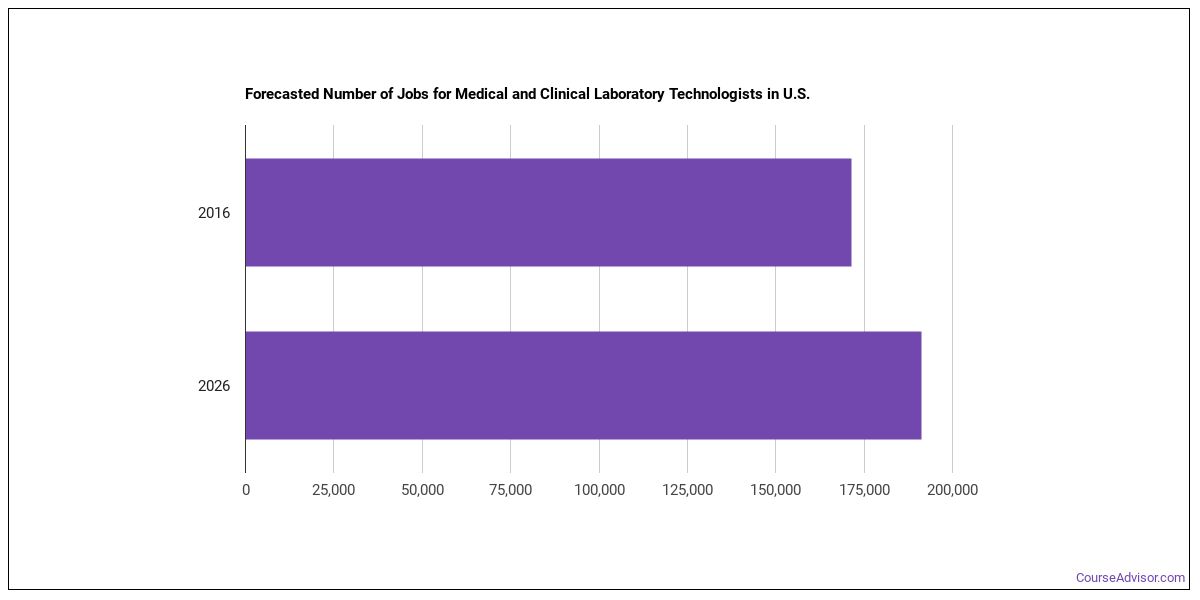
There are about 653,254 medical and clinical laboratory technologists working in the United States today. Employment is projected to grow by +3.9% over the projection horizon.
How Much Do Medical and Clinical Laboratory Technologists Make?
| Statistic | Value |
|---|---|
| Annual median | $77,339 |
| Hourly median | $37.18 |
| 10th percentile | $54,854 |
| 25th percentile | $66,096 |
| 75th percentile | $88,581 |
| 90th percentile | $99,824 |
Pay can vary substantially based on experience, location, and industry.

Software Medical and Clinical Laboratory Technologists Use
- Medical software: eClinicalWorks EHR software (hot technology)
- Medical software: MEDITECH software (hot technology)
- Spreadsheet software: Microsoft Excel (hot technology)
- Office suite software: Microsoft Office software (hot technology)
- Presentation software: Microsoft PowerPoint (hot technology)
- Project management software: Microsoft Project (hot technology)
- Word processing software: Microsoft Word (hot technology)
What the Workplace Is Like
The work environment for medical and clinical laboratory technologists reflects the following characteristics:
- Telephone Conversations
- Importance of Being Exact or Accurate
- Wear Common Protective or Safety Equipment such as Safety Shoes, Glasses, Gloves, Hearing Protection, Hard Hats, or Life Jackets
- Indoors, Environmentally Controlled
Getting Started in This Career
Entry-level medical and clinical laboratory technologists positions require a bachelor’s degree as the typical entry-level education. This occupation sits in Considerable Preparation Needed (Job Zone 4), reflecting the level of preparation typically expected.
Related Careers
Similar Occupations
- Microbiologists (Supplemental)
- Medical Scientists, Except Epidemiologists (Supplemental)
- Chemists (Supplemental)
- Biological Technicians (Primary-Long)
- Chemical Technicians (Supplemental)
- Cardiologists (Supplemental)
- Physicians, Pathologists (Supplemental)
- Radiologists (Supplemental)
Degree Programs
Aspiring medical and clinical laboratory technologists commonly pursue programs in:
Health Professions and Related Programs
5 programs across 1 majors
Biological and Biomedical Sciences
1 programs across 1 majors
References
This profile draws on the following authoritative sources:
- U.S. Bureau of Labor Statistics — Occupational Employment and Wage Statistics (OEWS) for employment and wage data by state and industry.
- BLS Employment Projections for total employment and growth forecasts.
- O*NET (Occupational Information Network) for skills, knowledge, tasks, work activities, work context, technology, and education-zone data.
SOC code: 29-2011.00 (Medical and Clinical Laboratory Technologists).

Course Advisor provides higher-education, college and university, degree, program, career, salary, and other helpful information to students, faculty, institutions, and other internet audiences. Presented information and data are subject to change. Inclusion on this website does not imply or represent a direct relationship with the company, school, or brand. Information, though believed correct at time of publication, may not be correct, and no warranty is provided. Contact the schools to verify any information before relying on it. Financial aid may be available for those who qualify. The displayed options may include sponsored or recommended results, not necessarily based on your preferences.
© Course Advisor – All Rights Reserved.