Forest and Conservation Technicians in Massachusetts
Want to work as a Forest and Conservation Technicians in Massachusetts? Below are the key facts. Provide technical assistance regarding the conservation of soil, water, forests, or related natural resources. May compile data pertaining to size, content, condition, and other characteristics of forest tracts under the direction of foresters, or train and lead forest workers in forest propagation and fire prevention and suppression. May assist conservation scientists in managing, improving, and protecting rangelands and wildlife habitats. Excludes “Conservation Scientists” (19-1031) and “Foresters” (19-1032).
What do Forest and Conservation Technicians Make in Massachusetts?
The forest and conservation technicians working in Massachusetts, the median annual wage is $53,960 per year (or about $25.94/hour).Annual wages span from $49,770 at the 10th percentile to $59,780 at the 90th percentile.
| Wage Statistic | Annual | Hourly |
|---|---|---|
| 10th percentile | $49,770 | $23.93 |
| 25th percentile | $51,710 | $24.86 |
| Median (50th) | $53,960 | $25.94 |
| 75th percentile | $53,960 | $25.94 |
| 90th percentile | $59,780 | $28.74 |

National Wage Comparison
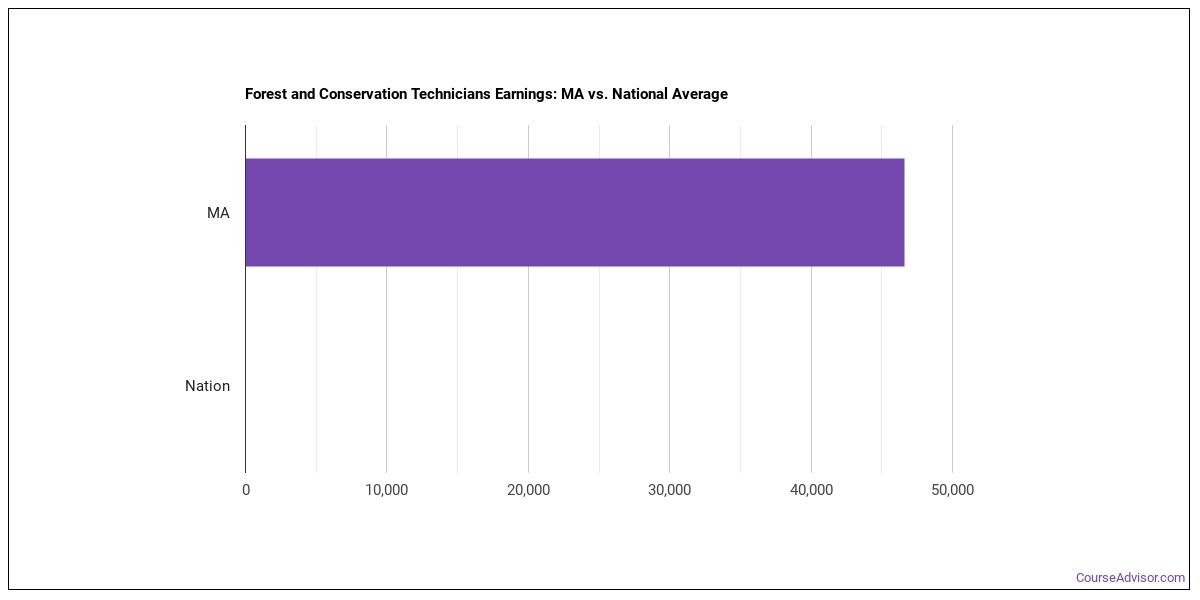
Nationally, forest and conservation technicians earn a median of $50,097 per year ($24.09/hour), higher than the Massachusetts median.
Employment Outlook
National employment for 72,716 forest and conservation technicians in the U.S..

Top Massachusetts Metros for Forest and Conservation Technicians
The metro areas below employ the most forest and conservation technicians in Massachusetts.
| Metro Area | Number Employed | Annual Median Salary |
|---|---|---|
| Worcester, MA | 70 | $50,920 |
Top States for Forest and Conservation Technicians Employment
View the states that employ the most forest and conservation technicians work.
| State | Number Employed |
|---|---|
| California | 6,440 |
| Oregon | 2,750 |
| Idaho | 2,110 |
| Montana | 1,940 |
| Arizona | 1,350 |
| Utah | 1,270 |
| Washington | 1,240 |
| Colorado | 1,230 |
| Illinois | 960 |
| Nevada | 760 |
| North Carolina | 740 |
| Minnesota | 670 |
| Wisconsin | 630 |
| Wyoming | 590 |
| Alaska | 470 |
| Iowa | 440 |
| Tennessee | 430 |
| Texas | 430 |
| Michigan | 400 |
| Pennsylvania | 380 |
Highest-Paying States for Forest and Conservation Technicians
Where forest and conservation technicians earn the most: forest and conservation technicians.
| State | Annual Median Salary |
|---|---|
| Maryland | $67,450 |
| Minnesota | $63,540 |
| California | $60,880 |
| Louisiana | $58,820 |
| Pennsylvania | $57,910 |
| New York | $56,340 |
| Oregon | $55,810 |
| Alaska | $54,810 |
| Washington | $54,310 |
| Colorado | $54,310 |
Skills
Key forest and conservation technicians skills, rated on an importance scale of 0 to 5:
Knowledge Areas
Key knowledge areas for this occupation, rated on an importance scale of 0 to 5:
Abilities
The abilities that matter most for forest and conservation technicians, rated on an importance scale of 0 to 5:
Daily Tasks
Common tasks include:
- Thin and space trees and control weeds and undergrowth, using manual tools and chemicals, or supervise workers performing these tasks.
- Train and lead forest and conservation workers in seasonal activities, such as planting tree seedlings, putting out forest fires, and maintaining recreational facilities.
- Provide information about, and enforce, regulations, such as those concerning environmental protection, resource utilization, fire safety, and accident prevention.
- Patrol park or forest areas to protect resources and prevent damage.
- Map forest tract data using digital mapping systems.
- Keep records of the amount and condition of logs taken to mills.
- Manage forest protection activities, including fire control, fire crew training, and coordination of fire detection and public education programs.
- Monitor activities of logging companies and contractors.
- Perform reforestation or forest renewal, including nursery and silviculture operations, site preparation, seeding and tree planting programs, cone collection, and tree improvement.
- Plan and supervise construction of access routes and forest roads.
- Select and mark trees for thinning or logging, drawing detailed plans that include access roads.
- Supervise forest nursery operations, timber harvesting, land use activities such as livestock grazing, and disease or insect control programs.
Work Activities
- Operating Vehicles, Mechanized Devices, or Equipment
- Making Decisions and Solving Problems
- Communicating with Supervisors, Peers, or Subordinates
- Establishing and Maintaining Interpersonal Relationships
- Identifying Objects, Actions, and Events
- Organizing, Planning, and Prioritizing Work
- Getting Information
- Inspecting Equipment, Structures, or Materials
- Updating and Using Relevant Knowledge
- Scheduling Work and Activities
- Processing Information
- Communicating with People Outside the Organization
Tools & Technology
Software and systems commonly involved: Hot technologies: ESRI ArcGIS software, Facebook In-demand technologies: ESRI ArcGIS software
What Major Will Prepare You For This Career?
Related college programs include:
- Natural Resources Conservation
- Forestry
Featured schools near , edit
Related Careers
Careers similar to forest and conservation technicians include:
- Water Resource Specialists
- Environmental Compliance Inspectors
- Agricultural Engineers
- Environmental Engineering Technologists and Technicians
- Soil and Plant Scientists
- Conservation Scientists
Also Known As
Biological Science Aide, Conservation Agent, Conservation Officer, Conservation Technician, Field Technician (Field Tech), Forest Technician, Forester Aide, Forestry Aid Technician, Forestry Aide, Forestry Aide Technician, Forestry Technician (Forestry Tech), Grazing Aide, Grazing Examiner, Natural Resources Technician, Park Technician (Park Tech).
References
- U.S. Bureau of Labor Statistics, Occupational Employment and Wage Statistics — https://www.bls.gov/oes/
- O*NET Online — https://www.onetonline.org/
- BLS Employment Projections — https://www.bls.gov/emp/
- O*NET-SOC code: 19-4071.00

Course Advisor provides higher-education, college and university, degree, program, career, salary, and other helpful information to students, faculty, institutions, and other internet audiences. Presented information and data are subject to change. Inclusion on this website does not imply or represent a direct relationship with the company, school, or brand. Information, though believed correct at time of publication, may not be correct, and no warranty is provided. Contact the schools to verify any information before relying on it. Financial aid may be available for those who qualify. The displayed options may include sponsored or recommended results, not necessarily based on your preferences.
© Course Advisor – All Rights Reserved.