Forensic Science Technicians in Montana
Thinking about a career as a Forensic Science Technicians in Montana? Below are the key facts. Collect, identify, classify, and analyze physical evidence related to criminal investigations. Perform tests on weapons or substances, such as fiber, hair, and tissue to determine significance to investigation. May testify as expert witnesses on evidence or crime laboratory techniques. May serve as specialists in area of expertise, such as ballistics, fingerprinting, handwriting, or biochemistry.
What do Forensic Science Technicians Make in Montana?
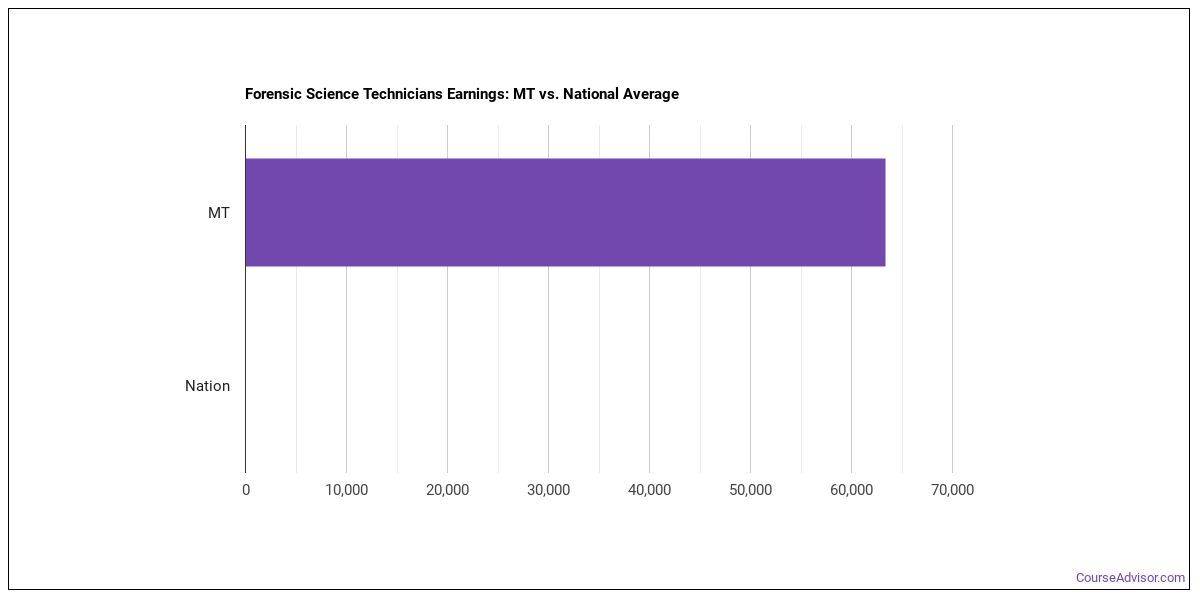
For forensic science technicians working in Montana, the typical annual salary is $78,610 per year (or roughly $37.79/hour).Annual wages span from $38,470 at the 10th percentile to $97,670 at the 90th percentile.
| Wage Statistic | Annual | Hourly |
|---|---|---|
| 10th percentile | $38,470 | $18.50 |
| 25th percentile | $57,970 | $27.87 |
| Median (50th) | $78,610 | $37.79 |
| 75th percentile | $78,610 | $37.79 |
| 90th percentile | $97,670 | $46.96 |

Location quotient — how concentrated this career is in Montana compared to the national average — is 0.94.
National Wage Comparison
Nationally, forensic science technicians earn a median of $85,117 per year ($40.92/hour), below the Montana median.
Employment Outlook
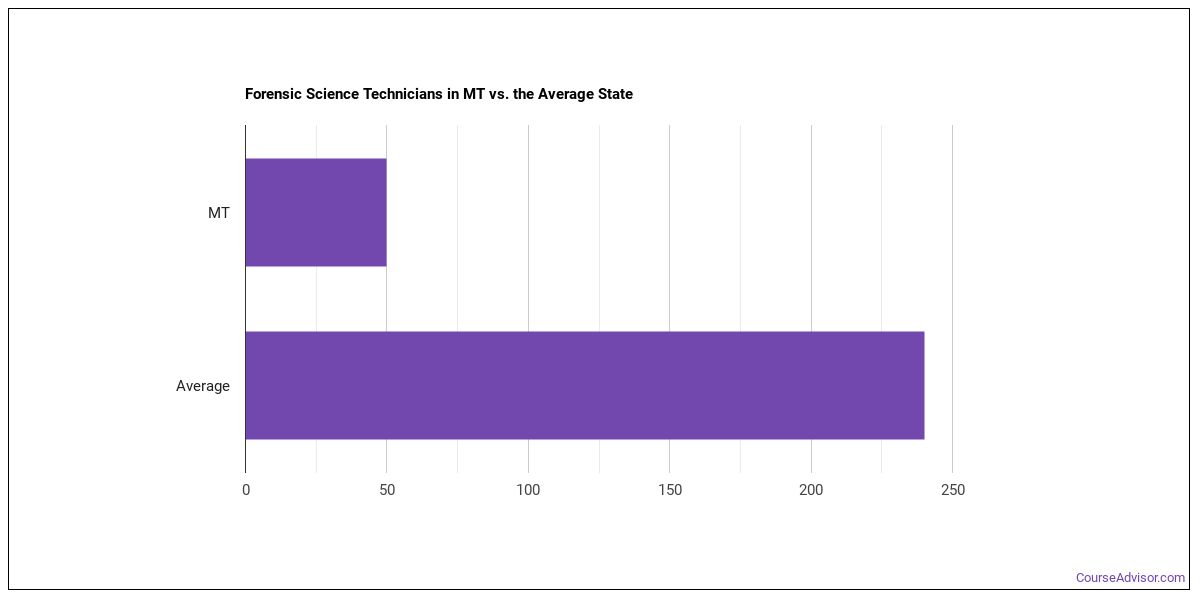
There are roughly 30,311 forensic science technicians across the United States. In Montana alone, approximately 60 people work in this role. That’s below the typical state, which employs around 210 forensic science technicians.

Top Montana Metros for Forensic Science Technicians
The metro areas below employ the most forensic science technicians in Montana.
| Metro Area | Number Employed | Annual Median Salary |
|---|---|---|
| Missoula, MT | 40 | $78,610 |
Top States for Forensic Science Technicians Employment
The table below shows the states where the most forensic science technicians work.
| State | Number Employed |
|---|---|
| California | 3,100 |
| Florida | 2,440 |
| Texas | 1,990 |
| New York | 1,120 |
| Arizona | 880 |
| Virginia | 740 |
| Michigan | 690 |
| Georgia | 540 |
| North Carolina | 520 |
| Ohio | 470 |
| Pennsylvania | 440 |
| Colorado | 430 |
| Maryland | 410 |
| Illinois | 380 |
| Washington | 340 |
| Nevada | 330 |
| Tennessee | 320 |
| Indiana | 300 |
| Wisconsin | 280 |
| Missouri | 280 |
Highest-Paying States for Forensic Science Technicians
These states pay the most for forensic science technicians.
| State | Annual Median Salary |
|---|---|
| Illinois | $117,590 |
| California | $96,850 |
| Connecticut | $84,920 |
| Montana | $78,610 |
| Maryland | $78,220 |
| New York | $78,170 |
| Oregon | $78,100 |
| Colorado | $77,800 |
| Washington | $77,650 |
| Nevada | $76,540 |
Skills
Key forensic science technicians skills, rated on an importance scale of 0 to 5:
Knowledge Areas
Important knowledge areas for this occupation, rated on an importance scale of 0 to 5:
Abilities
The abilities that matter most for forensic science technicians, rated on an importance scale of 0 to 5:
Daily Tasks
Day-to-day, forensic science technicians typically:
- Collect evidence from crime scenes, storing it in conditions that preserve its integrity.
- Keep records and prepare reports detailing findings, investigative methods, and laboratory techniques.
- Use photographic or video equipment to document evidence or crime scenes.
- Testify in court about investigative or analytical methods or findings.
- Use chemicals or other substances to examine latent fingerprint evidence and compare developed prints to those of known persons in databases.
- Measure and sketch crime scenes to document evidence.
- Visit morgues, examine scenes of crimes, or contact other sources to obtain evidence or information to be used in investigations.
- Train new technicians or other personnel on forensic science techniques.
- Operate and maintain laboratory equipment and apparatus.
- Collect impressions of dust from surfaces to obtain and identify fingerprints.
- Examine and analyze blood stain patterns at crime scenes.
- Analyze gunshot residue and bullet paths to determine how shootings occurred.
Work Activities
- Getting Information
- Documenting/Recording Information
- Interpreting the Meaning of Information for Others
- Communicating with Supervisors, Peers, or Subordinates
- Communicating with People Outside the Organization
- Updating and Using Relevant Knowledge
- Working with Computers
- Identifying Objects, Actions, and Events
- Making Decisions and Solving Problems
- Processing Information
- Performing for or Working Directly with the Public
- Evaluating Information to Determine Compliance with Standards
Tools & Technology
Technologies frequently used: Hot technologies: Adobe Photoshop, Linux In-demand technologies: Guidance Software EnCase Enterprise
What Major Will Prepare You For This Career?
Several college majors map to this occupation:
- General Biology
- Chemistry
- Security Science and Technology
- Criminal Justice & Corrections
- Anthropology
Featured schools near , edit
Related Careers
Other careers like forensic science technicians include:
- Environmental Compliance Inspectors
- Coroners
- Fraud Examiners, Investigators and Analysts
- Penetration Testers
- Digital Forensics Analysts
- Data Scientists
Also Known As
Ballistician, Ballistics Technician (Ballistics Tech), Biometric Fingerprint Technician (Biometric Fingerprint Tech), Biometric Fingerprinting Technician (Biometric Fingerprinting Tech), Biometrician, Blood Splatter Analyst, CSI (Crime Scene Investigator), Computer Forensics Technician (Computer Forensics Tech), Crime Analyst, Crime Lab Analyst (Crime Laboratory Analyst), Crime Lab Technician (Crime Laboratory Technician), Crime Scene Analyst (CSA), Crime Scene Examiner, Crime Scene Specialist, Crime Scene Technician (Crime Scene Tech).
References
- U.S. Bureau of Labor Statistics, Occupational Employment and Wage Statistics — https://www.bls.gov/oes/
- O*NET Online — https://www.onetonline.org/
- BLS Employment Projections — https://www.bls.gov/emp/
- O*NET-SOC code: 19-4092.00

Course Advisor provides higher-education, college and university, degree, program, career, salary, and other helpful information to students, faculty, institutions, and other internet audiences. Presented information and data are subject to change. Inclusion on this website does not imply or represent a direct relationship with the company, school, or brand. Information, though believed correct at time of publication, may not be correct, and no warranty is provided. Contact the schools to verify any information before relying on it. Financial aid may be available for those who qualify. The displayed options may include sponsored or recommended results, not necessarily based on your preferences.
© Course Advisor – All Rights Reserved.