Food Scientists and Technologists in Texas
Want to work as a Food Scientists and Technologists in Texas? Below are the key facts. Use chemistry, microbiology, engineering, and other sciences to study the principles underlying the processing and deterioration of foods; analyze food content to determine levels of vitamins, fat, sugar, and protein; discover new food sources; research ways to make processed foods safe, palatable, and healthful; and apply food science knowledge to determine best ways to process, package, preserve, store, and distribute food.
What do Food Scientists and Technologists Make in Texas?
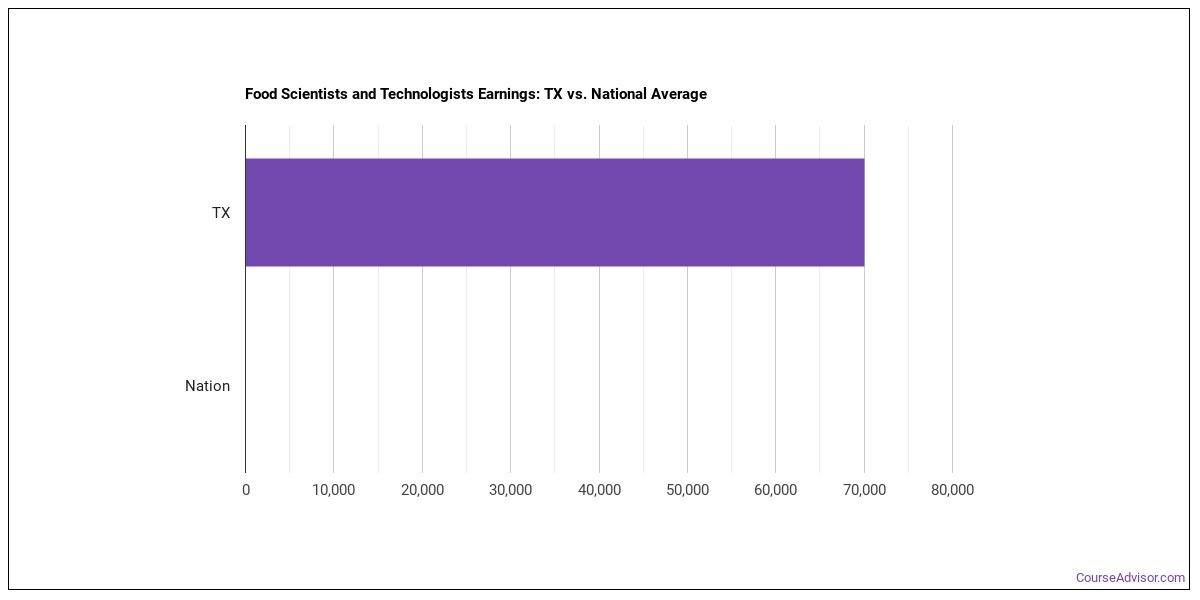
For food scientists and technologists working in Texas, wages run about $92,740 per year (or about $44.59/hour).Pay can range from $44,100 at the 10th percentile to $138,580 at the 90th percentile.
| Wage Statistic | Annual | Hourly |
|---|---|---|
| 10th percentile | $44,100 | $21.20 |
| 25th percentile | $66,330 | $31.89 |
| Median (50th) | $92,740 | $44.59 |
| 75th percentile | $117,900 | $56.68 |
| 90th percentile | $138,580 | $66.63 |

The location quotient — a measure of how concentrated this occupation is in Texas relative to the national average — is 0.60, indicating fewer food scientists and technologists per worker than the national average.
National Wage Comparison
Nationally, food scientists and technologists earn a median of $55,930 per year ($26.89/hour), above the Texas median.
Employment Outlook
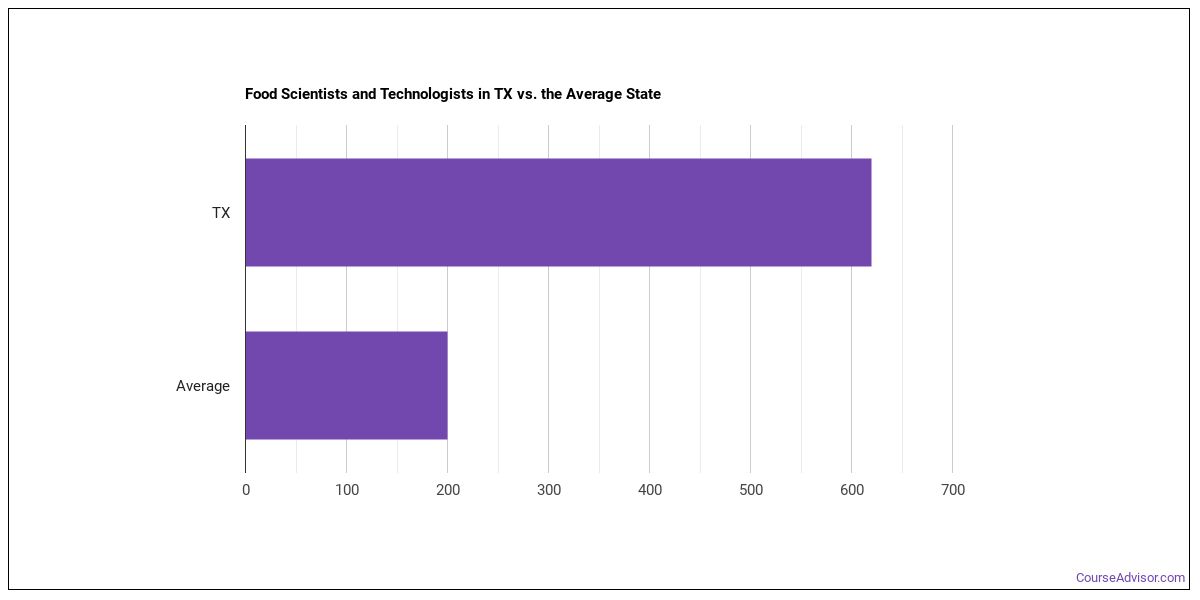
There are roughly 79,590 food scientists and technologists nationwide. In Texas alone, about 780 people work in this role. That puts the state above the typical state, which employs around 280 food scientists and technologists.

Top Texas Metros for Food Scientists and Technologists
These are the Texas metros with the most food scientists and technologists in Texas.
| Metro Area | Number Employed | Annual Median Salary |
|---|---|---|
| Dallas-Fort Worth-Arlington, TX | 390 | $101,070 |
| Houston-Pasadena-The Woodlands, TX | 70 | $92,160 |
| Austin-Round Rock-San Marcos, TX | 50 | $103,810 |
| San Antonio-New Braunfels, TX | 50 | $94,900 |
Top States for Food Scientists and Technologists Employment
These states have the highest employment of food scientists and technologists work.
| State | Number Employed |
|---|---|
| California | 2,350 |
| New Jersey | 880 |
| New York | 880 |
| Texas | 780 |
| Illinois | 720 |
| Georgia | 680 |
| Missouri | 610 |
| Wisconsin | 510 |
| Michigan | 430 |
| Pennsylvania | 430 |
| Iowa | 410 |
| Washington | 310 |
| Ohio | 310 |
| Colorado | 310 |
| Kansas | 310 |
| Maryland | 290 |
| Oregon | 280 |
| Indiana | 210 |
| Nebraska | 210 |
| North Carolina | 180 |
Highest-Paying States for Food Scientists and Technologists
Where food scientists and technologists earn the most: food scientists and technologists.
| State | Annual Median Salary |
|---|---|
| New Jersey | $102,630 |
| District of Columbia | $102,500 |
| Missouri | $101,570 |
| Alabama | $99,170 |
| Massachusetts | $99,140 |
| Washington | $96,020 |
| New York | $95,710 |
| Minnesota | $94,360 |
| Florida | $92,760 |
| Texas | $92,740 |
Skills
The most important food scientists and technologists skills, rated on an importance scale of 0 to 5:
Knowledge Areas
Key knowledge areas for this occupation, rated on an importance scale of 0 to 5:
Abilities
Top abilities for food scientists and technologists, rated on an importance scale of 0 to 5:
Daily Tasks
Food Scientists and Technologists typically:
- Inspect food processing areas to ensure compliance with government regulations and standards for sanitation, safety, quality, and waste management.
- Check raw ingredients for maturity or stability for processing, and finished products for safety, quality, and nutritional value.
- Study methods to improve aspects of foods, such as chemical composition, flavor, color, texture, nutritional value, and convenience.
- Develop food standards and production specifications, safety and sanitary regulations, and waste management and water supply specifications.
- Stay up to date on new regulations and current events regarding food science by reviewing scientific literature.
- Study the structure and composition of food or the changes foods undergo in storage and processing.
- Confer with process engineers, plant operators, flavor experts, and packaging and marketing specialists to resolve problems in product development.
- Test new products for flavor, texture, color, nutritional content, and adherence to government and industry standards.
- Develop new food items for production, based on consumer feedback.
- Develop new or improved ways of preserving, processing, packaging, storing, and delivering foods, using knowledge of chemistry, microbiology, and other sciences.
- Evaluate food processing and storage operations and assist in the development of quality assurance programs for such operations.
- Demonstrate products to clients.
Work Activities
- Documenting/Recording Information
- Getting Information
- Evaluating Information to Determine Compliance with Standards
- Communicating with Supervisors, Peers, or Subordinates
- Making Decisions and Solving Problems
- Identifying Objects, Actions, and Events
- Thinking Creatively
- Analyzing Data or Information
- Organizing, Planning, and Prioritizing Work
- Processing Information
- Updating and Using Relevant Knowledge
- Monitoring Processes, Materials, or Surroundings
Tools & Technology
Software and systems commonly involved: Hot technologies: HubSpot software, Hypertext markup language HTML In-demand technologies: Microsoft Excel
What Major Will Prepare You For This Career?
Several college majors map to this occupation:
- General Agriculture
- Food Science Technology
- International Agriculture
- Culinary Arts
Featured schools near , edit
Related Careers
Related occupations to food scientists and technologists include:
- Biofuels Production Managers
- Biofuels/Biodiesel Technology and Product Development Managers
- Agricultural Engineers
- Chemical Engineers
- Health and Safety Engineers, Except Mining Safety Engineers and Inspectors
- Industrial Engineers
Also Known As
Applications Scientist, Corporate Food Scientist, Crop Advisor, Dairy Bacteriologist, Enologist, Fermentation Scientist, Flavorist, Food Engineer, Food Preservation Scientist, Food Processing Scientist, Food Safety Auditor, Food Safety Regulatory Manager, Food Safety Scientist, Food Scientist, Food Technologist.
References
- U.S. Bureau of Labor Statistics, Occupational Employment and Wage Statistics — https://www.bls.gov/oes/
- O*NET Online — https://www.onetonline.org/
- BLS Employment Projections — https://www.bls.gov/emp/
- O*NET-SOC code: 19-1012.00

Course Advisor provides higher-education, college and university, degree, program, career, salary, and other helpful information to students, faculty, institutions, and other internet audiences. Presented information and data are subject to change. Inclusion on this website does not imply or represent a direct relationship with the company, school, or brand. Information, though believed correct at time of publication, may not be correct, and no warranty is provided. Contact the schools to verify any information before relying on it. Financial aid may be available for those who qualify. The displayed options may include sponsored or recommended results, not necessarily based on your preferences.
© Course Advisor – All Rights Reserved.