Fashion Designers: Job Description
Design clothing and accessories. Create original designs or adapt fashion trends.
Featured schools near , edit
What Do Fashion Designers Do?
The day-to-day responsibilities of fashion designers include:
- Sketch rough and detailed drawings of apparel or accessories, and write specifications such as color schemes, construction, material types, and accessory requirements.
- Examine sample garments on and off models, modifying designs to achieve desired effects.
- Confer with sales and management executives or with clients to discuss design ideas.
- Select materials and production techniques to be used for products.
- Provide sample garments to agents and sales representatives, and arrange for showings of sample garments at sales meetings or fashion shows.
- Direct and coordinate workers involved in drawing and cutting patterns and constructing samples or finished garments.
- Identify target markets for designs, looking at factors such as age, gender, and socioeconomic status.
- Collaborate with other designers to coordinate special products and designs.
Key Skills and Knowledge
Top fashion designers draw on a mix of skills and domain knowledge.
Top Skills
The competencies most central to this role, rated on an importance scale of 0 to 5:
Top Knowledge Areas
Other Fashion Designers Job Titles
Common job titles for this role include:
- Accessories Designer
- Apparel Accessories Specialist
- Apparel Designer
- Apparel Product Developer
- Apparel Technical Designer
- Apparel and Accessories Designer
- Athletic Shoe Designer
- Clothes Designer
How Many Fashion Designers Are There?
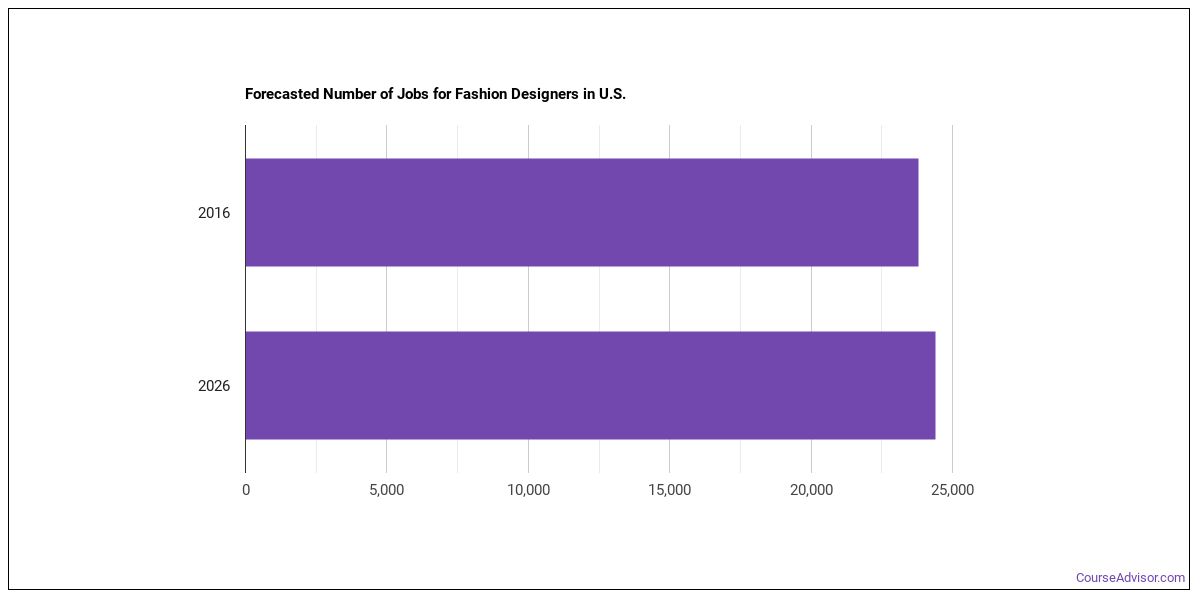
There are roughly 267,361 fashion designers working in the United States today. Employment is projected to decline by -2.9% over the projection horizon.
How Much Do Fashion Designers Make?
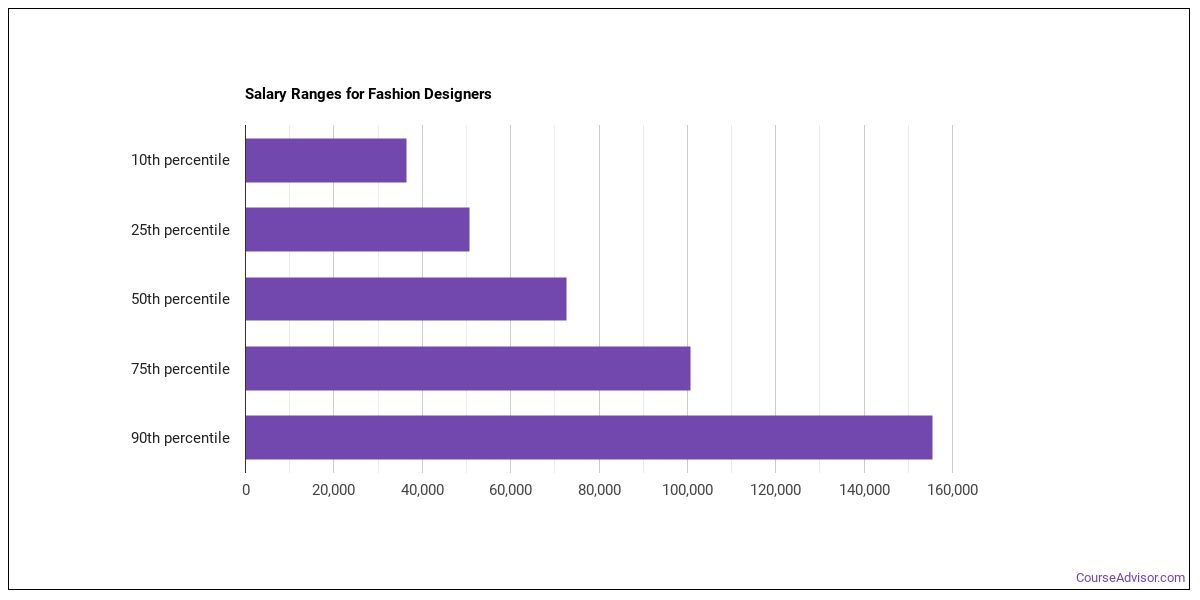
| Statistic | Value |
|---|---|
| Annual median | $53,057 |
| Hourly median | $25.51 |
| 10th percentile | $29,705 |
| 25th percentile | $41,381 |
| 75th percentile | $64,733 |
| 90th percentile | $76,409 |
Compensation varies based on experience, location, and industry.
Fashion Designers Salary by State
| State | Annual median salary |
|---|---|
| Tennessee | $142,500 |
| Oregon | $125,310 |
| Massachusetts | $99,340 |
| New York | $96,420 |
| New Hampshire | $88,230 |
| Virginia | $85,870 |
| Colorado | $85,680 |
| New Jersey | $84,020 |
| Missouri | $81,700 |
| Pennsylvania | $78,950 |
| Washington | $77,990 |
| Connecticut | $77,020 |
| North Carolina | $74,830 |
| Georgia | $73,070 |
| Ohio | $58,790 |
| Utah | $58,490 |
| Kansas | $54,400 |
| Indiana | $52,430 |
| Kentucky | $48,000 |
| Florida | $43,920 |
| Arizona | $43,200 |
| Minnesota | $40,040 |
| Wisconsin | $37,790 |
Where Fashion Designers Earn the Most
Pay for fashion designers vary by region. These regions lead on median pay:
| Region | Median annual wage | Share of U.S. jobs | Location quotient |
|---|---|---|---|
| New England | $96,985 | 3.4% | 1.11 |
| Middle Atlantic | $95,150 | 34.9% | 4.72 |
| Rocky Mountains | $68,086 | 2.5% | 1.08 |
| Plains States | $54,847 | 3.8% | 0.95 |
| Great Lakes | $46,824 | 1.7% | 0.21 |
| Southeast | $46,383 | 8.7% | 0.57 |
| Far Western US | $25,731 | 35.6% | 2.51 |
| Southwest | $2,487 | 9.3% | 0.92 |
Top Metro Areas
| Metro area | State | Median annual wage | Employment |
|---|---|---|---|
| Santa Maria-Santa Barbara, CA | CA | $100,230 | 90 |
| Boston-Cambridge-Newton, MA-NH | MA | $100,170 | 570 |
| New York-Newark-Jersey City, NY-NJ | NY | $96,620 | 6,350 |
| Washington-Arlington-Alexandria, DC-VA-MD-WV | DC | $95,730 | 50 |
| Denver-Aurora-Centennial, CO | CO | $85,680 | 120 |
| St. Louis, MO-IL | MO | $81,770 | 190 |
| Atlanta-Sandy Springs-Roswell, GA | GA | $79,750 | 40 |
| Pittsburgh, PA | PA | $78,950 | 80 |
Industry Breakdown
The largest employers of fashion designers are concentrated in the following sectors:
| Industry | Employment | Median annual wage |
|---|---|---|
| Wholesale Trade | 5,930 | $81,030 |
| Retail Trade | 4,540 | $40,040 |
| Management of Companies and Enterprises | 4,490 | $100,670 |
| Manufacturing | 2,360 | $76,080 |
| Professional, Scientific, and Technical Services | 1,410 | n/a |
| Information | 1,130 | $93,990 |
| Arts, Entertainment, and Recreation | 620 | $54,350 |
| Administrative and Support and Waste Management and Remediation Services | 200 | $85,550 |
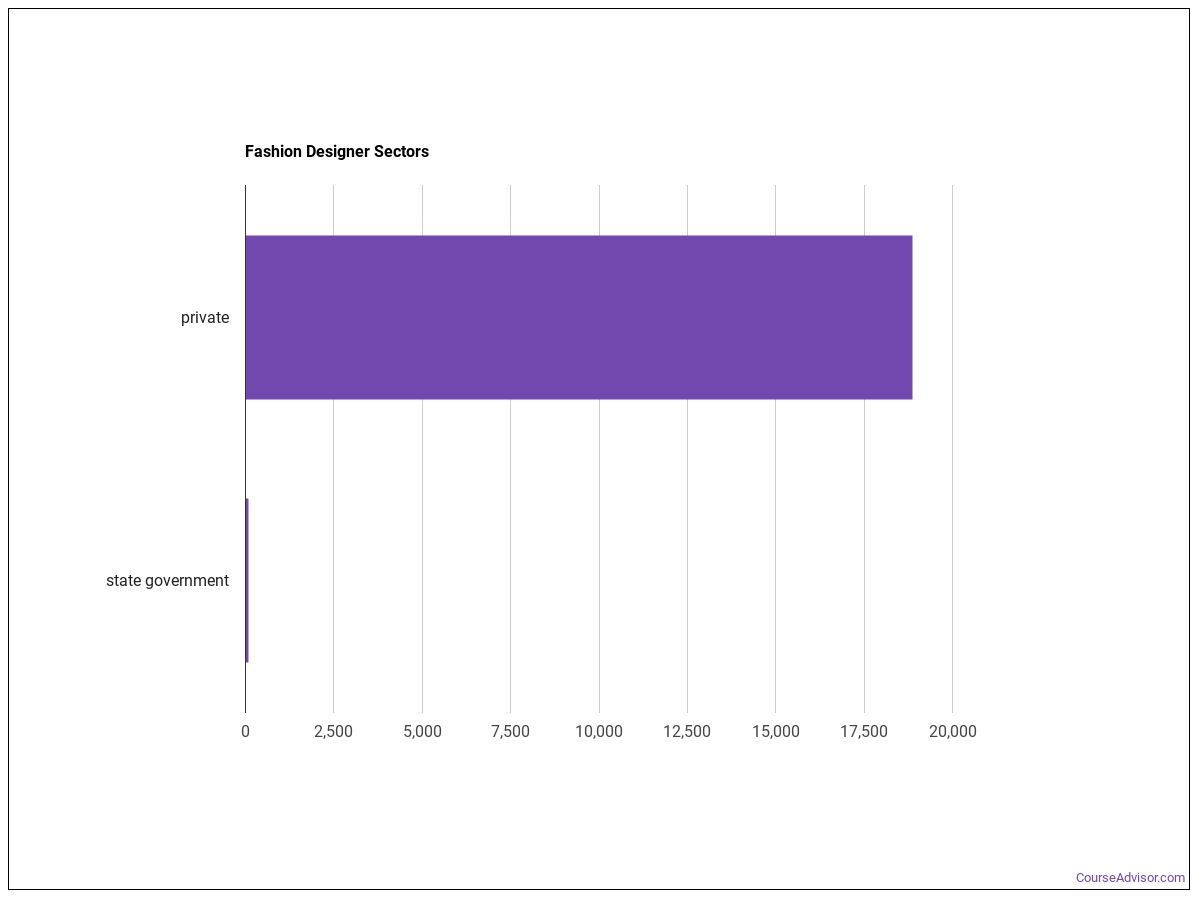
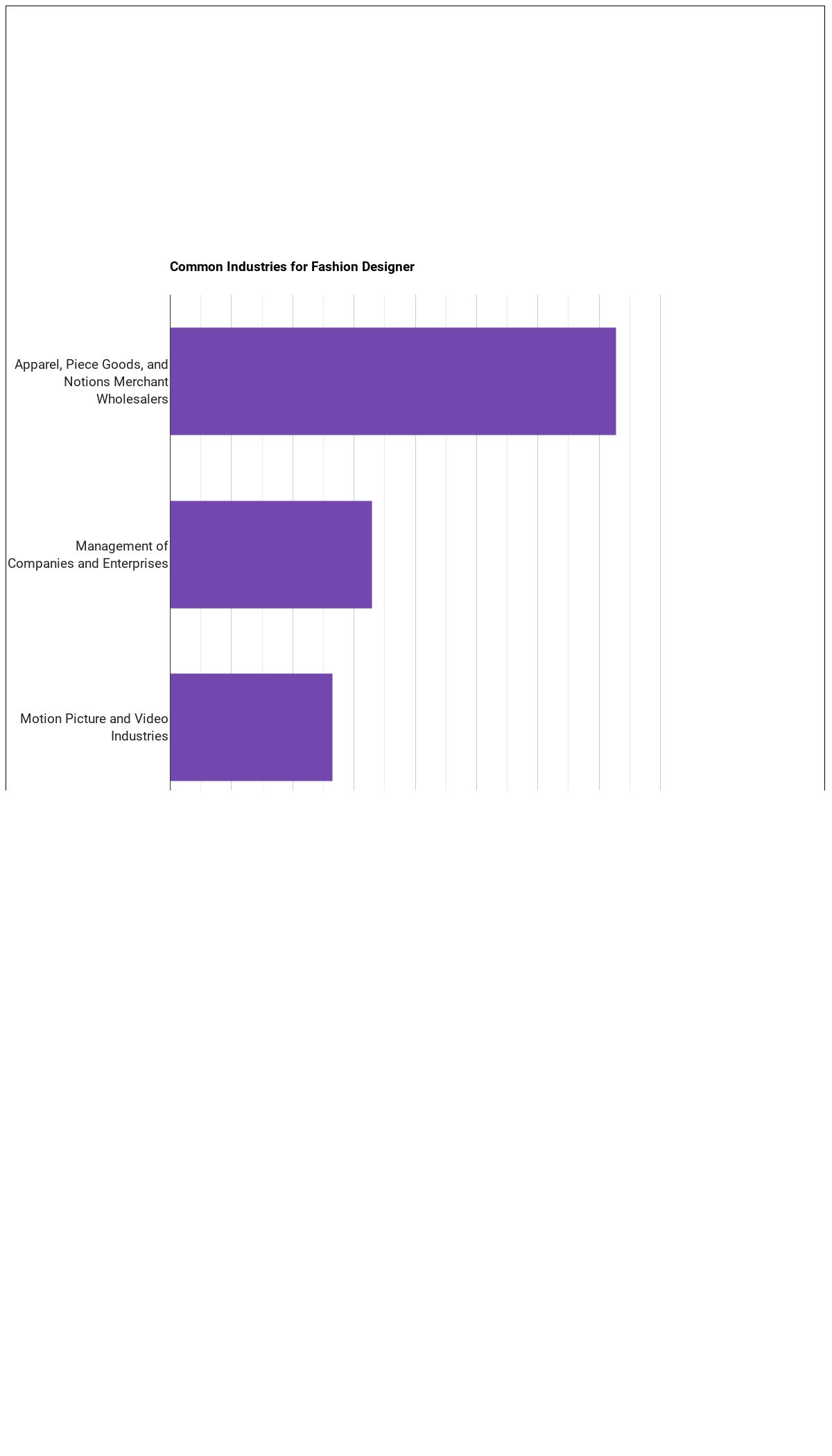
Fashion Designers work in the following industries:
Tools and Technology
- Document management software: Adobe Acrobat (hot technology)
- Graphics or photo imaging software: Adobe Creative Cloud software (hot technology)
- Graphics or photo imaging software: Adobe Illustrator (hot technology)
- Desktop publishing software: Adobe InDesign (hot technology)
- Graphics or photo imaging software: Adobe Photoshop (hot technology)
- Computer aided design CAD software: Autodesk Revit (hot technology)
- Web platform development software: JavaScript (hot technology)
- Spreadsheet software: Microsoft Excel (hot technology)
- Office suite software: Microsoft Office software (hot technology)
- Electronic mail software: Microsoft Outlook (hot technology)
- Presentation software: Microsoft PowerPoint (hot technology)
- Word processing software: Microsoft Word (hot technology)
The Day-to-Day Environment
The on-the-job environment of fashion designers is shaped by the following characteristics:
- Time Pressure
- Spend Time Sitting
- Contact With Others
- Face-to-Face Discussions with Individuals and Within Teams
Getting Started in This Career
Most fashion designers positions require a bachelor’s degree as the typical entry-level education. This career aligns with Medium Preparation Needed (Job Zone 3), reflecting the level of preparation typically expected.
Other Careers to Consider
Similar Occupations
- Art Directors (Supplemental)
- Craft Artists (Primary-Short)
- Fine Artists, Including Painters, Sculptors, and Illustrators (Supplemental)
- Commercial and Industrial Designers (Primary-Short)
- Floral Designers (Supplemental)
- Graphic Designers (Primary-Short)
- Interior Designers (Primary-Long)
- Merchandise Displayers and Window Trimmers (Primary-Long)
Where to Study
Aspiring fashion designers often complete programs in:
Family and Consumer Sciences/Human Sciences
3 programs across 1 majors
Visual and Performing Arts
2 programs across 2 majors
Sources
Data on this page comes from the following authoritative sources:
- U.S. Bureau of Labor Statistics — Occupational Employment and Wage Statistics (OEWS) for employment and wage data by state and industry.
- BLS Employment Projections for total employment and growth forecasts.
- O*NET (Occupational Information Network) for skills, knowledge, tasks, work activities, work context, technology, and education-zone data.
SOC code: 27-1022.00 (Fashion Designers).

Course Advisor provides higher-education, college and university, degree, program, career, salary, and other helpful information to students, faculty, institutions, and other internet audiences. Presented information and data are subject to change. Inclusion on this website does not imply or represent a direct relationship with the company, school, or brand. Information, though believed correct at time of publication, may not be correct, and no warranty is provided. Contact the schools to verify any information before relying on it. Financial aid may be available for those who qualify. The displayed options may include sponsored or recommended results, not necessarily based on your preferences.
© Course Advisor – All Rights Reserved.