Detectives and Criminal Investigators: Career Overview
Conduct investigations related to suspected violations of federal, state, or local laws to prevent or solve crimes.
Featured schools near , edit
What Tasks Do Detectives and Criminal Investigators Perform?
The day-to-day responsibilities of detectives and criminal investigators include:
- Check victims for signs of life, such as breathing and pulse.
- Obtain facts or statements from complainants, witnesses, and accused persons and record interviews, using recording device.
- Secure deceased body and obtain evidence from it, preventing bystanders from tampering with it prior to medical examiner's arrival.
- Record progress of investigation, maintain informational files on suspects, and submit reports to commanding officer or magistrate to authorize warrants.
- Prepare reports that detail investigation findings.
- Prepare charges or responses to charges, or information for court cases, according to formalized procedures.
- Preserve, process, and analyze items of evidence obtained from crime scenes and suspects, placing them in proper containers and destroying evidence no longer needed.
- Obtain summary of incident from officer in charge at crime scene, taking care to avoid disturbing evidence.
Key Skills and Knowledge
Successful detectives and criminal investigators draw on a mix of skills and domain knowledge.
Most Important Skills
These are the skills most important for this role, rated on an importance scale of 0 to 5:
Core Knowledge
Related Job Titles
Common job titles for this role include:
- Air Marshal
- Burglary Investigator
- CIA Agent (Central Intelligence Agency Agent)
- Child Support Agent
- Child Support Investigator
- Child Support Officer
- City Detective
- Counter Intelligence Agent
Employment and Demand
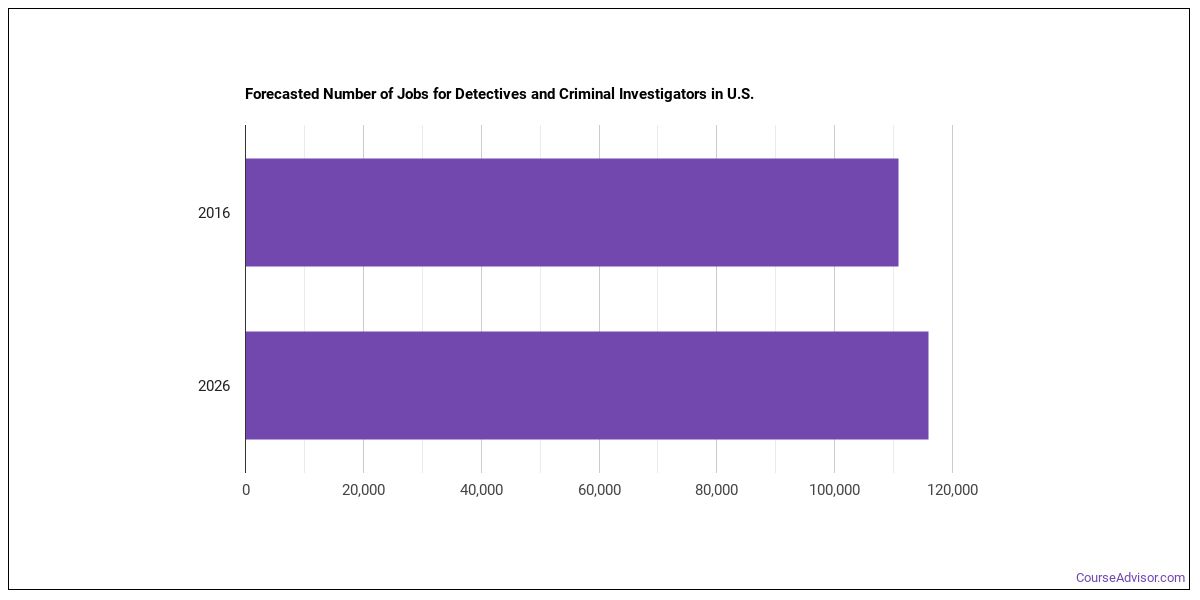
There are about 410,420 detectives and criminal investigators working in the United States today. Demand is forecast to grow by +14.5% over the projection horizon.
Detectives and Criminal Investigators Pay
| Statistic | Value |
|---|---|
| Annual median | $64,492 |
| Hourly median | $31.01 |
| 10th percentile | $37,179 |
| 25th percentile | $50,836 |
| 75th percentile | $78,148 |
| 90th percentile | $91,805 |
Wages vary widely based on experience, location, and industry.

Pay by State
| State | Annual median salary |
|---|---|
| Maryland | $125,630 |
| California | $122,140 |
| Alaska | $121,140 |
| Washington | $116,450 |
| New Jersey | $113,830 |
| Hawaii | $112,100 |
| Massachusetts | $111,460 |
| Virginia | $110,220 |
| Oregon | $107,450 |
| Vermont | $104,330 |
| New York | $103,340 |
| Arizona | $103,270 |
| Colorado | $102,910 |
| Nebraska | $99,090 |
| Pennsylvania | $98,740 |
| Montana | $95,640 |
| Nevada | $95,590 |
| Connecticut | $95,420 |
| Wisconsin | $92,910 |
| Michigan | $92,560 |
| West Virginia | $90,690 |
| New Hampshire | $90,050 |
| Texas | $89,860 |
| Illinois | $89,740 |
| Rhode Island | $88,780 |
| Delaware | $88,350 |
| New Mexico | $86,840 |
| North Dakota | $84,580 |
| Minnesota | $82,330 |
| Maine | $80,750 |
| Wyoming | $80,250 |
| Missouri | $78,670 |
| Florida | $78,290 |
| Ohio | $77,940 |
| Idaho | $77,460 |
| Kentucky | $77,440 |
| Oklahoma | $77,440 |
| Iowa | $77,440 |
| South Dakota | $77,440 |
| Indiana | $74,600 |
| Utah | $74,530 |
| Tennessee | $72,800 |
| Kansas | $68,180 |
| Puerto Rico | $66,840 |
| Alabama | $66,020 |
| Georgia | $64,990 |
| South Carolina | $63,060 |
| North Carolina | $62,480 |
| Louisiana | $59,500 |
| Mississippi | $56,310 |
| Arkansas | $53,460 |
Where Detectives and Criminal Investigators Earn the Most
Compensation for detectives and criminal investigators differ across the country. Top regions by median wage:
| Region | Median annual wage | Share of U.S. jobs | Location quotient |
|---|---|---|---|
| Far Western US | $119,744 | 14.0% | 0.86 |
| Middle Atlantic | $105,564 | 15.5% | 1.13 |
| New England | $97,494 | 3.4% | 0.79 |
| Rocky Mountains | $93,204 | 3.5% | 0.92 |
| Southwest | $91,672 | 24.5% | 1.97 |
| Great Lakes | $86,404 | 9.2% | 0.64 |
| Plains States | $79,153 | 5.2% | 0.82 |
| Southeast | $73,501 | 24.2% | 1.01 |
Where the Jobs Cluster
| Metro area | State | Median annual wage | Employment |
|---|---|---|---|
| Hagerstown-Martinsburg, MD-WV | MD | $157,270 | 40 |
| San Jose-Sunnyvale-Santa Clara, CA | CA | $156,890 | 260 |
| Brunswick-St. Simons, GA | GA | $155,110 | 220 |
| Washington-Arlington-Alexandria, DC-VA-MD-WV | DC | $153,340 | 4,760 |
| Oxnard-Thousand Oaks-Ventura, CA | CA | $143,250 | 70 |
| Salinas, CA | CA | $129,880 | 40 |
| Santa Maria-Santa Barbara, CA | CA | $129,370 | 40 |
| Los Angeles-Long Beach-Anaheim, CA | CA | $127,980 | 3,070 |
Which Industries Hire Detectives and Criminal Investigators
The largest employers of detectives and criminal investigators are found across these industries:
| Industry | Employment | Median annual wage |
|---|---|---|
| Transportation and Warehousing | 440 | $115,070 |
| Educational Services | 280 | $82,990 |
| Health Care and Social Assistance | 60 | $85,650 |
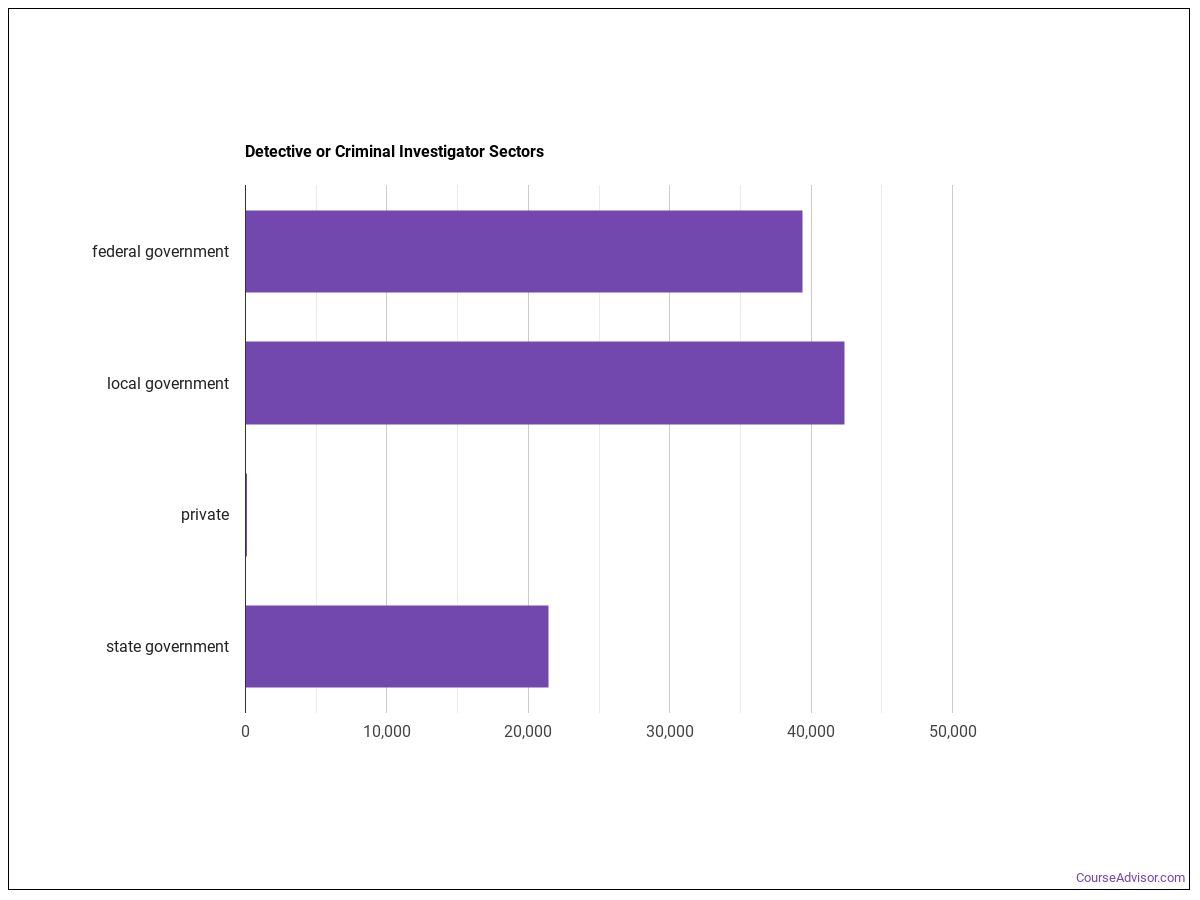
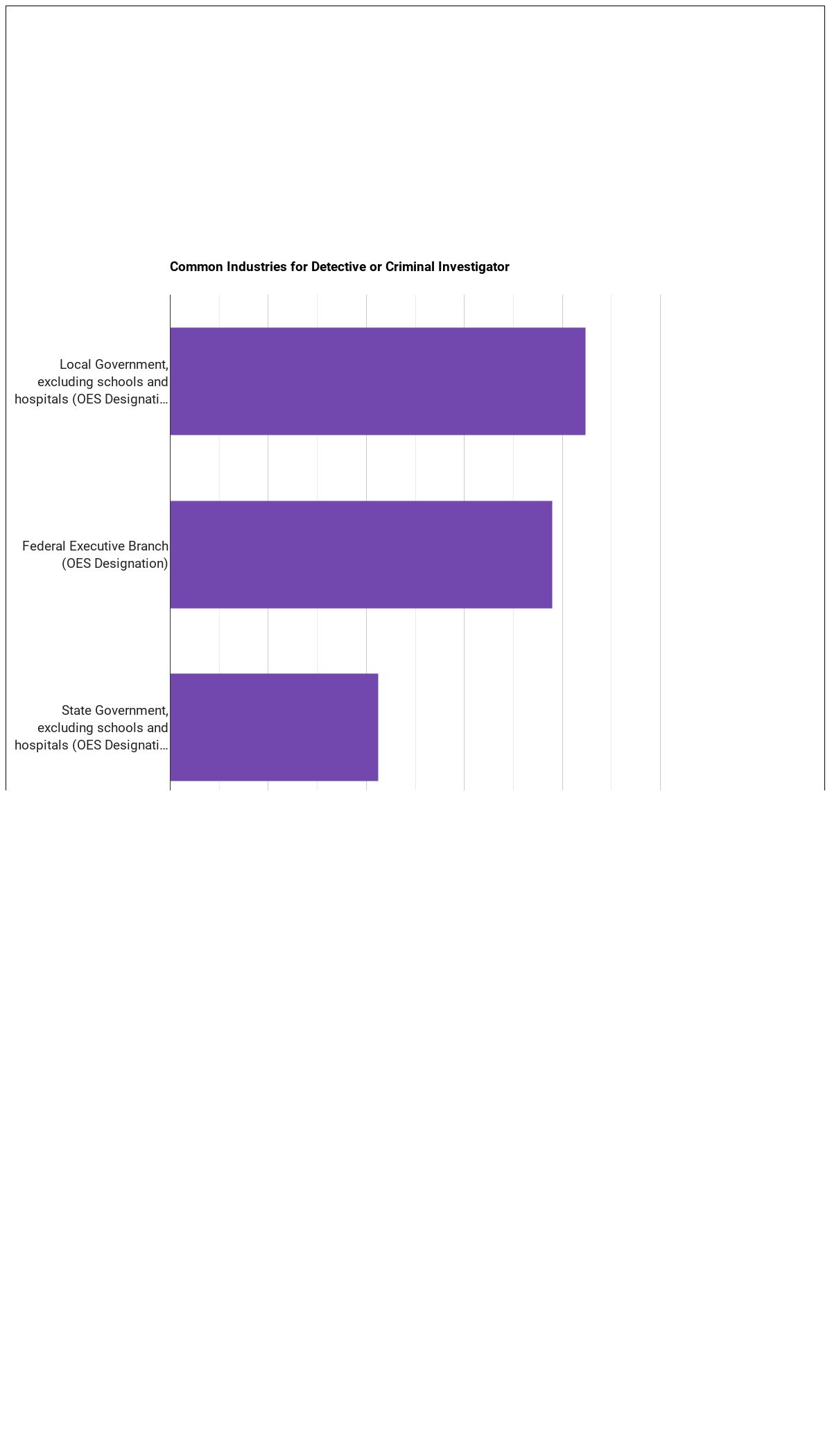
The table below shows some of the most common industries where those employed in this career field work.
Software Detectives and Criminal Investigators Use
- Graphics or photo imaging software: Adobe Photoshop (hot technology)
- Operating system software: Linux (hot technology)
- Data base user interface and query software: Microsoft Access (hot technology)
- Spreadsheet software: Microsoft Excel (hot technology)
- Office suite software: Microsoft Office software (hot technology)
- Electronic mail software: Microsoft Outlook (hot technology)
- Presentation software: Microsoft PowerPoint (hot technology)
- Process mapping and design software: Microsoft Visio (hot technology)
- Word processing software: Microsoft Word (hot technology)
- Analytical or scientific software: SAS (hot technology)
- Data base user interface and query software: Structured query language SQL (hot technology)
Work Environment
Daily working conditions for detectives and criminal investigators reflects the following characteristics:
- Telephone Conversations
- Deal With External Customers or the Public in General
- Face-to-Face Discussions with Individuals and Within Teams
- Contact With Others
Getting Started in This Career
Typical detectives and criminal investigators positions require a high school diploma or equivalent as the typical entry-level education. This career aligns with Medium Preparation Needed (Job Zone 3), indicating the level of preparation typically expected.
Other Careers to Consider
Similar Occupations
- Compliance Officers (Supplemental)
- Coroners (Primary-Long)
- Fraud Examiners, Investigators and Analysts (Primary-Long)
- Forensic Science Technicians (Primary-Long)
- Probation Officers and Correctional Treatment Specialists (Primary-Long)
- Lawyers (Supplemental)
- Judicial Law Clerks (Supplemental)
- Administrative Law Judges, Adjudicators, and Hearing Officers (Supplemental)
Degree Programs
Students preparing for detectives and criminal investigators commonly pursue programs in:
Homeland Security, Law Enforcement, Firefighting and Related Protective Services
12 programs across 2 majors
Natural Resources and Conservation
1 programs across 1 majors
Military Technologies and Applied Sciences
1 programs across 1 majors
References
Data on this page comes from the following authoritative sources:
- U.S. Bureau of Labor Statistics — Occupational Employment and Wage Statistics (OEWS) for employment and wage data by state and industry.
- BLS Employment Projections for total employment and growth forecasts.
- O*NET (Occupational Information Network) for skills, knowledge, tasks, work activities, work context, technology, and education-zone data.
SOC code: 33-3021.00 (Detectives and Criminal Investigators).

Course Advisor provides higher-education, college and university, degree, program, career, salary, and other helpful information to students, faculty, institutions, and other internet audiences. Presented information and data are subject to change. Inclusion on this website does not imply or represent a direct relationship with the company, school, or brand. Information, though believed correct at time of publication, may not be correct, and no warranty is provided. Contact the schools to verify any information before relying on it. Financial aid may be available for those who qualify. The displayed options may include sponsored or recommended results, not necessarily based on your preferences.
© Course Advisor – All Rights Reserved.