Biochemists and Biophysicists in Colorado
Want to work as a Biochemists and Biophysicists in Colorado? Here’s what the data says. Study the chemical composition or physical principles of living cells and organisms, their electrical and mechanical energy, and related phenomena. May conduct research to further understanding of the complex chemical combinations and reactions involved in metabolism, reproduction, growth, and heredity. May determine the effects of foods, drugs, serums, hormones, and other substances on tissues and vital processes of living organisms.
What do Biochemists and Biophysicists Make in Colorado?
State-level wage data is not available for this occupation in Colorado. See national-level wages below.
National Wage Comparison
Nationally, biochemists and biophysicists earn a median of $107,979 per year ($51.91/hour).
Employment Outlook
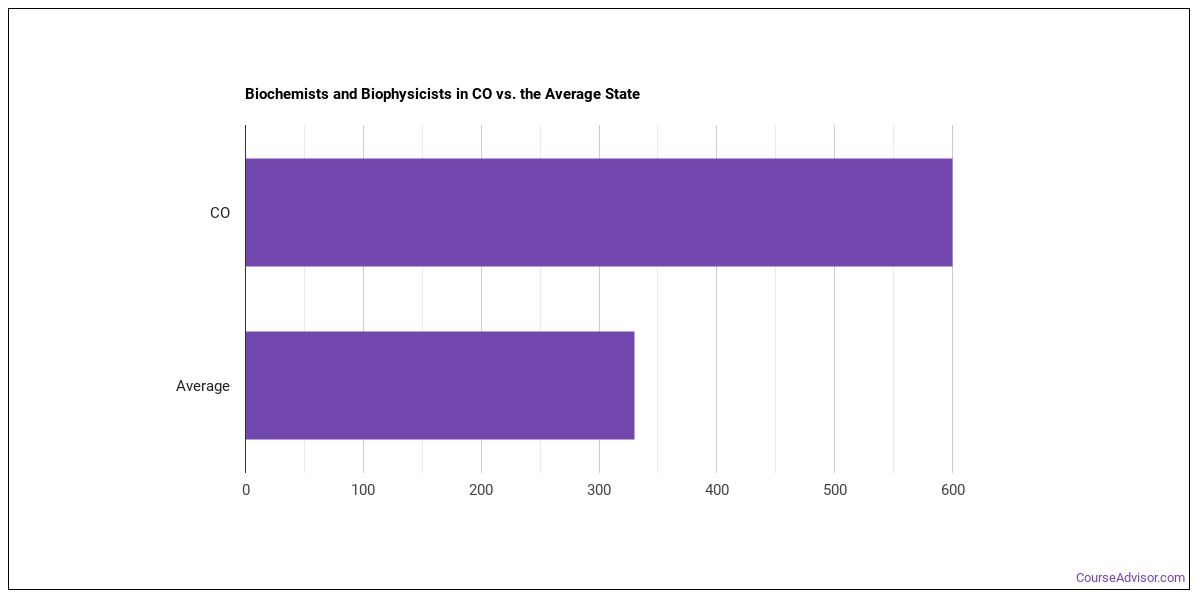
National employment for 92,228 biochemists and biophysicists across the United States. In Colorado alone, approximately 930 people work in this role. That’s more than the typical state, which employs around 340 biochemists and biophysicists.

Top Colorado Metros for Biochemists and Biophysicists
The metro areas below employ the most biochemists and biophysicists in Colorado.
| Metro Area | Number Employed | Annual Median Salary |
|---|---|---|
| Denver-Aurora-Centennial, CO | 450 | n/a |
| Boulder, CO | 360 | $126,800 |
| Fort Collins-Loveland, CO | 60 | $79,920 |
Top States for Biochemists and Biophysicists Employment
These states have the highest employment of biochemists and biophysicists work.
| State | Number Employed |
|---|---|
| Massachusetts | 13,530 |
| California | 4,190 |
| Pennsylvania | 2,530 |
| New Jersey | 2,180 |
| New York | 1,660 |
| Indiana | 1,350 |
| Michigan | 980 |
| Colorado | 930 |
| Maryland | 760 |
| Texas | 710 |
| Washington | 530 |
| Florida | 510 |
| North Carolina | 510 |
| Delaware | 470 |
| Ohio | 410 |
| Utah | 370 |
| Maine | 350 |
| Missouri | 340 |
| Connecticut | 240 |
| Minnesota | 230 |
Highest-Paying States for Biochemists and Biophysicists
Where biochemists and biophysicists earn the most: biochemists and biophysicists.
| State | Annual Median Salary |
|---|---|
| Florida | $148,880 |
| Arkansas | $143,490 |
| California | $130,240 |
| Massachusetts | $127,520 |
| Pennsylvania | $112,850 |
| Virginia | $109,230 |
| Washington | $107,730 |
| New Hampshire | $103,980 |
| New Jersey | $103,360 |
| Wisconsin | $102,380 |
Skills
The most important biochemists and biophysicists skills, rated on an importance scale of 0 to 5:
Knowledge Areas
Key knowledge areas for this occupation, rated on an importance scale of 0 to 5:
Abilities
The abilities that matter most for biochemists and biophysicists, rated on an importance scale of 0 to 5:
Daily Tasks
Day-to-day, biochemists and biophysicists typically:
- Share research findings by writing scientific articles or by making presentations at scientific conferences.
- Teach or advise undergraduate or graduate students or supervise their research.
- Study physical principles of living cells or organisms and their electrical or mechanical energy, applying methods and knowledge of mathematics, physics, chemistry, or biology.
- Manage laboratory teams or monitor the quality of a team's work.
- Develop new methods to study the mechanisms of biological processes.
- Write grant proposals to obtain funding for research.
- Design or perform experiments with equipment, such as lasers, accelerators, or mass spectrometers.
- Determine the three-dimensional structure of biological macromolecules.
- Design or build laboratory equipment needed for special research projects.
- Prepare reports or recommendations, based upon research outcomes.
- Study spatial configurations of submicroscopic molecules, such as proteins, using x-rays or electron microscopes.
- Study the chemistry of living processes, such as cell development, breathing and digestion, or living energy changes, such as growth, aging, or death.
Work Activities
- Analyzing Data or Information
- Thinking Creatively
- Documenting/Recording Information
- Updating and Using Relevant Knowledge
- Processing Information
- Making Decisions and Solving Problems
- Getting Information
- Working with Computers
- Identifying Objects, Actions, and Events
- Interpreting the Meaning of Information for Others
- Monitoring Processes, Materials, or Surroundings
- Communicating with Supervisors, Peers, or Subordinates
Tools & Technology
Technologies frequently used: Hot technologies: Adobe Photoshop, Extensible markup language XML In-demand technologies: Electronic lab notebook software
What Major Will Prepare You For This Career?
Several college majors map to this occupation:
- Biochemistry & Biophysics
- Cell Biology & Anatomical Sciences
- Physiology & Pathology Sciences
- Pharmacy/Pharmaceutical Sciences
Featured schools near , edit
Related Careers
Other careers like biochemists and biophysicists include:
- Data Scientists
- Bioengineers and Biomedical Engineers
- Nanosystems Engineers
- Nanotechnology Engineering Technologists and Technicians
- Animal Scientists
- Microbiologists
Also Known As
Analytical Research Chemist, Biochemist, Biochemistry Scientist, Biological Chemist, Biophysicist, Biophysics Researcher, Chemist, Chemistry Scientist, Clinical Biochemist, Clinical Laboratory Scientist, Clinical Researcher, Forensic Toxicologist, Formulation Scientist, Molecular Biologist, Pharmaceutical Scientist.
References
- U.S. Bureau of Labor Statistics, Occupational Employment and Wage Statistics — https://www.bls.gov/oes/
- O*NET Online — https://www.onetonline.org/
- BLS Employment Projections — https://www.bls.gov/emp/
- O*NET-SOC code: 19-1021.00

Course Advisor provides higher-education, college and university, degree, program, career, salary, and other helpful information to students, faculty, institutions, and other internet audiences. Presented information and data are subject to change. Inclusion on this website does not imply or represent a direct relationship with the company, school, or brand. Information, though believed correct at time of publication, may not be correct, and no warranty is provided. Contact the schools to verify any information before relying on it. Financial aid may be available for those who qualify. The displayed options may include sponsored or recommended results, not necessarily based on your preferences.
© Course Advisor – All Rights Reserved.