Registered Nursing at University of Arkansas at Little Rock
If you plan to study registered nursing, take a look at what University of Arkansas at Little Rock has to offer and decide if the program is a good match for you. Get started with the following essential facts.UA Little Rock is located in Little Rock, Arkansas and has a total student population of 8,899.
Want to know more about the career opportunities in this field? Check out the Careers in Registered Nursing section at the bottom of this page.
UA Little Rock Registered Nursing Degrees Available
- Associate’s Degree in Registered Nursing
- Bachelor’s Degree in Registered Nursing
Online Classes Are Available at UA Little Rock
Don't have the time or the flexibility in your schedule to take traditional classes? Online courses may be the perfect solution for you. They allow independent learners to study when and where they want to while offering the rigor of in-person classes.
Are you one of the many who prefer to take online classes? UA Little Rock offers distance education options for registered nursing at the following degree levels:
- Bachelor’s Degree
UA Little Rock Registered Nursing Rankings
The registered nursing major at UA Little Rock is not ranked on College Factual’s Best Colleges and Universities for Registered Nursing. This could be for a number of reasons, such as not having enough data on the major or school to make an accurate assessment of its quality.
Registered Nursing Student Demographics at UA Little Rock
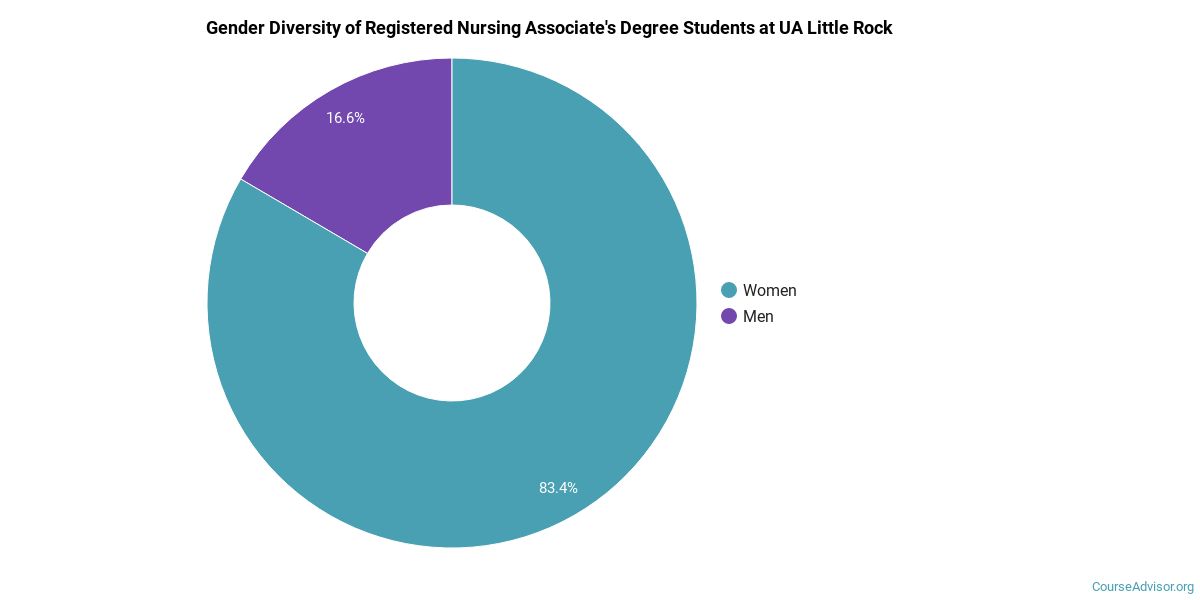
Take a look at the following statistics related to the make-up of the registered nursing majors at University of Arkansas at Little Rock.
UA Little Rock Registered Nursing Associate’s Program
UA Little Rock does a better job with serving racial-ethnic minorities than the typical school does. Its associate's program in registered nursing graduates 7% more racial-ethnic minorities than the nationwide average.*
The following table and chart show the race/ethnicity for students who recently graduated from University of Arkansas at Little Rock with a associate's in registered nursing.

| Race/Ethnicity | Number of Students |
|---|---|
| Asian | 5 |
| Black or African American | 51 |
| Hispanic or Latino | 4 |
| White | 79 |
| International Students | 5 |
| Other Races/Ethnicities | 20 |
UA Little Rock Registered Nursing Bachelor’s Program

About 61% of those who receive a bachelor's degree in registered nursing at UA Little Rock are white. This is above average for this degree on the nationwide level.
The following table and chart show the race/ethnicity for students who recently graduated from University of Arkansas at Little Rock with a bachelor's in registered nursing.

| Race/Ethnicity | Number of Students |
|---|---|
| Asian | 2 |
| Black or African American | 39 |
| Hispanic or Latino | 3 |
| White | 93 |
| International Students | 2 |
| Other Races/Ethnicities | 14 |
Related Majors
Careers That Registered Nursing Grads May Go Into
A degree in registered nursing can lead to the following careers. Since job numbers and average salaries can vary by geographic location, we have only included the numbers for AR, the home state for University of Arkansas at Little Rock.
| Occupation | Jobs in AR | Average Salary in AR |
|---|---|---|
| Registered Nurses | 25,380 | $60,780 |
| Nursing Instructors and Professors | 650 | $54,920 |
References
*The racial-ethnic minorities count is calculated by taking the total number of students and subtracting white students, international students, and students whose race/ethnicity was unknown. This number is then divided by the total number of students at the school to obtain the racial-ethnic minorities percentage.
- College Factual
- National Center for Education Statistics
- O*NET Online
- Image Credit: By Ualrcomm under License
More about our data sources and methodologies.

Course Advisor provides higher-education, college and university, degree, program, career, salary, and other helpful information to students, faculty, institutions, and other internet audiences. Presented information and data are subject to change. Inclusion on this website does not imply or represent a direct relationship with the company, school, or brand. Information, though believed correct at time of publication, may not be correct, and no warranty is provided. Contact the schools to verify any information before relying on it. Financial aid may be available for those who qualify. The displayed options may include sponsored or recommended results, not necessarily based on your preferences.
© Course Advisor – All Rights Reserved.