Trinity College Science & Tech Programs
Trinity College is a private not-for-profit institution located in Hartford, CT. A Mid-Sized City provides tranquility and safety near the excitement of urban amenities.
Featured schools near , edit
Trinity College Rankings
Trinity College is featured in these rankings for science & tech programs at the bachelors level:
| Ranking | Rank | Among |
|---|---|---|
| Overall Quality | #7 of 41 | State — Connecticut |
| Overall Quality | #39 of 254 | Region — New England |
| Overall Quality | #342 of 4,630 | Nationwide |
Where Is Trinity College?
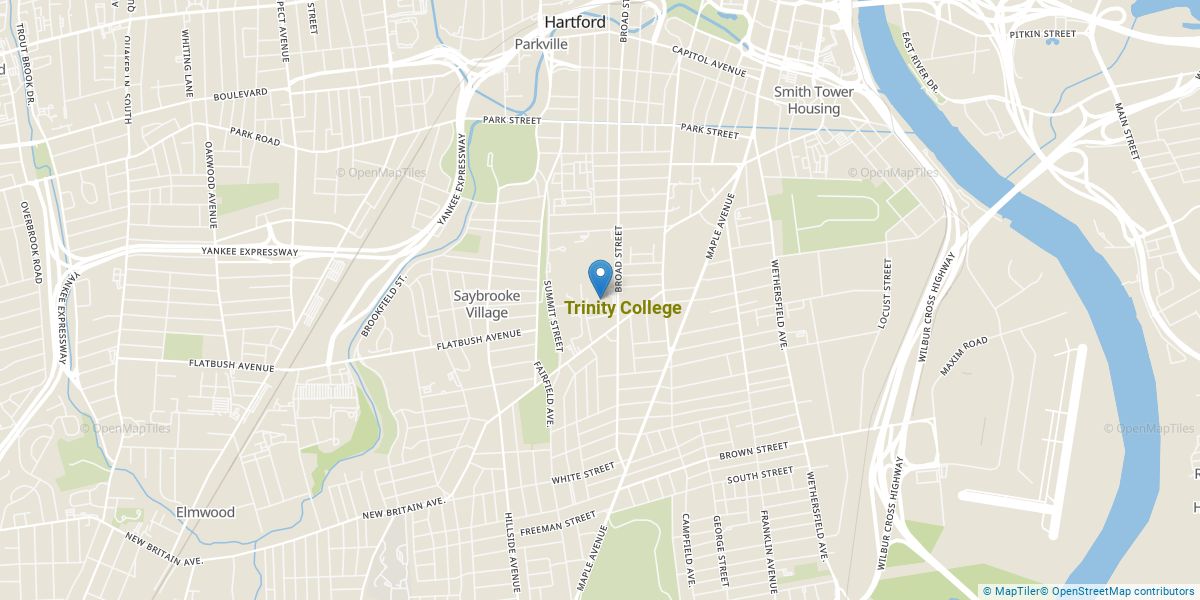
Contact information for Trinity College can be found below.
| Contact Details | |
|---|---|
| Address: | 300 Summit St, Hartford, CT 06106-3100 |
| Phone: | 8602972000 |
| Website: | www.trincoll.edu/ |
| Admissions: | www.trincoll.edu/Admissions/ |
| Financial Aid: | www.trincoll.edu/Admissions/finaid |
How Do I Get Into Trinity College?
You can apply to Trinity College online at: https://www.trincoll.edu/admissions/undergraduate-admissions/application-process/
Trinity College is classified as Very Selective (20-30%) for admissions.
Admission Requirements for Trinity College
This is what Trinity College looks for in applicants:
| Requirement | Status |
|---|---|
| Secondary School Record | Required |
| Secondary School GPA | Considered but not required |
| Recommendations | Required |
| Admission Test Scores (SAT/ACT) | Considered but not required |
How Hard Is It To Get Into Trinity College?
Trinity College admits 29%, which makes it moderately selective. Ensure you meet all application requirements and prepare the application in full.
Of those admitted, 25% choose to enroll — a typical enrollment-to-admission yield.
Average Test Scores
7% of admitted students submitted SAT scores and 3% submitted ACT scores.
When looking at the 25th through the 75th percentile of admitted students at Trinity College, SAT Evidence-Based Reading and Writing scores ranged between 658 and 740. Math scores were between 640 and 730.
Selectivity by Gender
Acceptance rates at Trinity College vary modestly across gender.
| Gender | Applicants | Admitted | Acceptance Rate |
|---|---|---|---|
| Men | 3,401 | 939 | 28% |
| Women | 4,055 | 1,242 | 31% |
Can I Afford Trinity College?
The average net price after aid at Trinity College is $35,009. Your actual cost will depend on your family’s circumstances since net price varies by income group.
Tuition & Fees
| Category | Cost |
|---|---|
| In-State Tuition | $67,650 |
| In-State Fees | $3,120 |
| Out-of-State Tuition | $67,650 |
| Out-of-State Fees | $3,120 |
| Total In-State Tuition & Fees | $70,770 |
| Total Out-of-State Tuition & Fees | $70,770 |
Financial Aid
When including loans, work-study, and grants, 26% of students at Trinity College receive some form of financial aid (577 students).
About 69% of students at Trinity College receive grant or scholarship aid, averaging $56,677 per student.
14% of students receive federal Pell Grants, averaging $5,887.
Student Loan Debt
38% of Trinity College undergraduates take out federal student loans, averaging $6,036 per year.
Trinity College Undergraduate Student Diversity
There are 50 students enrolled at Trinity College. Trinity College is classified as a 1,000 - 4,999 institution by enrollment size. Its Carnegie Classification is Baccalaureate Colleges: Arts & Sciences Focus.
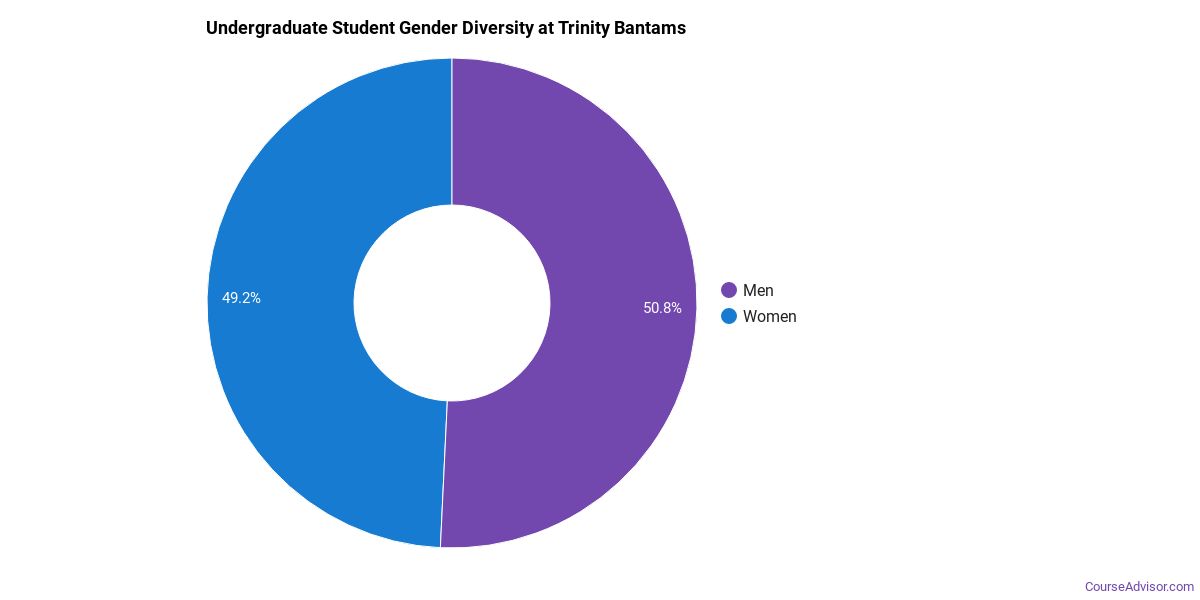
Gender Diversity
Of the 2,193 undergraduate students at Trinity College, approximately 47% are male and 53% are female.
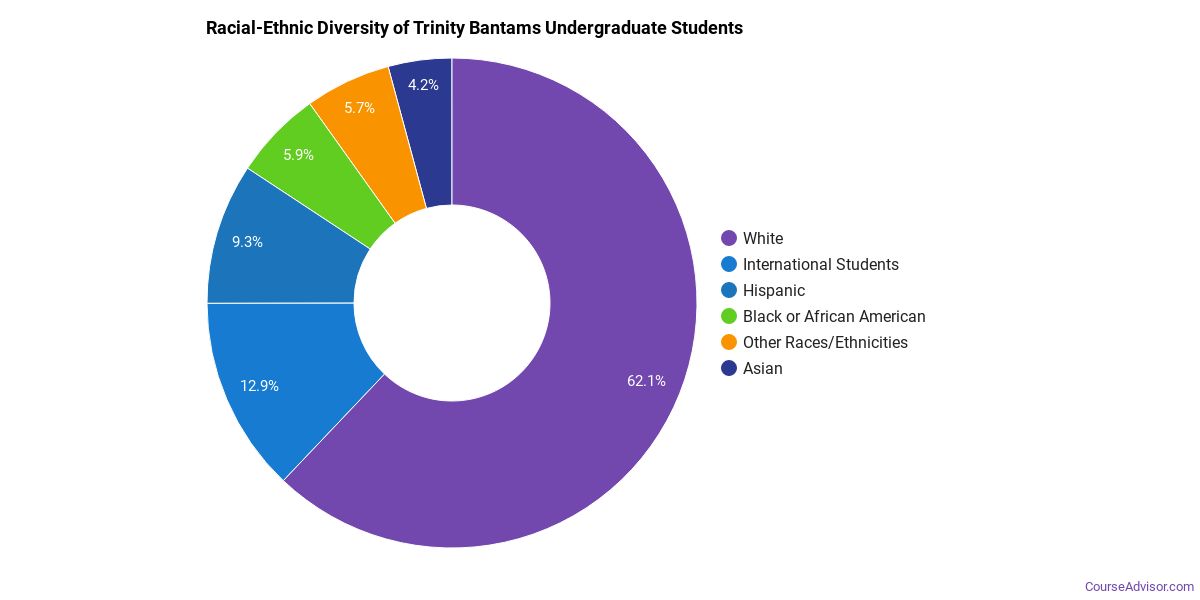
Racial-Ethnic Diversity
The racial-ethnic breakdown of Trinity College undergraduate students is as follows.
| Race/Ethnicity | Number of Students |
|---|---|
| Asian | 94 |
| Black or African American | 129 |
| Hispanic | 219 |
| White | 1,254 |
| American Indian/Alaska Native | 2 |
| Two or More Races | 96 |
| Non-Resident | 293 |
Geographic Diversity
The top 5 home states of first-time undergraduate students at Trinity College break down as follows.

| State | First-Time UG Students |
|---|---|
| Massachusetts | 132 |
| Connecticut | 82 |
| New York | 64 |
| New Jersey | 31 |
| California | 29 |
Additionally, approximately 13.4% of undergraduate students are non-resident from outside the United States.
Trinity College Graduate Student Diversity
39 of Trinity College’s students are in graduate programs. The highest graduate-level award offered is Master’s degree.
Gender Diversity (Graduate)
Among graduate students at Trinity College, approximately 56% are male and 44% are female.

Racial-Ethnic Diversity (Graduate)
The racial-ethnic breakdown of Trinity College graduate students is as follows.

| Race/Ethnicity | Number of Students |
|---|---|
| Asian | 1 |
| Black or African American | 2 |
| Hispanic | 3 |
| White | 25 |
| Two or More Races | 1 |
| Non-Resident | 5 |
Online Learning at Trinity College
Trinity College provides remote learning paths for students who need flexibility.
Distance education is available at the undergraduate and graduate levels.
Science & Tech Programs at Trinity College
Below are the science & tech programs are offered at Trinity College, with the number of degrees awarded at each level in the most recent reporting year.
| Program | Bachelor’s | Master’s | Doctorate | Total |
|---|---|---|---|---|
| City/Urban, Community, and Regional Planning | — | — | — | 1 |
Academic Programs at Trinity College
Trinity College offers 19 distinct academic programs.
The highest level of award offered is Master’s degree.
Institutional Profile
Trinity College has an open admission policy: No. Credit transfer:
- AP credits: Yes
- Dual enrollment credits: Yes
- Life experience credits: Implied no
References
More about our data sources and methodologies.

Course Advisor provides higher-education, college and university, degree, program, career, salary, and other helpful information to students, faculty, institutions, and other internet audiences. Presented information and data are subject to change. Inclusion on this website does not imply or represent a direct relationship with the company, school, or brand. Information, though believed correct at time of publication, may not be correct, and no warranty is provided. Contact the schools to verify any information before relying on it. Financial aid may be available for those who qualify. The displayed options may include sponsored or recommended results, not necessarily based on your preferences.
© Course Advisor – All Rights Reserved.