PiBerry Institute Overview
Located in Homestead, Florida, PiBerry Institute is a private for-profit institution. Homestead is a good match for students who enjoy the safety and convenience of the suburbs.
What Is PiBerry Institute Known For?
- PiBerry Institute has an impressive student to faculty ratio of 10 to 1.
- Although it may not be available for every major, the undergraduate certificate is the highest award a student can attain at PiBerry Institute.
Where Is PiBerry Institute?

Contact details for PiBerry Institute are given below.
| Contact Details | |
|---|---|
| Address: | 30356 Old Dixie Hwy, Homestead, FL 33033-3215 |
| Phone: | 305-245-2581 |
| Website: | www.piberry.edu |
Can I Afford PiBerry Institute?
Student Loan Debt
It's not uncommon for college students to take out loans to pay for school. In fact, almost 66% of students nationwide depend at least partially on loans. At PiBerry Institute, approximately 77% of students took out student loans averaging $5,792 a year. That adds up to $23,168 over four years for those students.
Explore Best Ranked Schools for You
PiBerry Institute Undergraduate Student Diversity
Racial-Ethnic Diversity
The racial-ethnic breakdown of PiBerry Institute students is as follows.
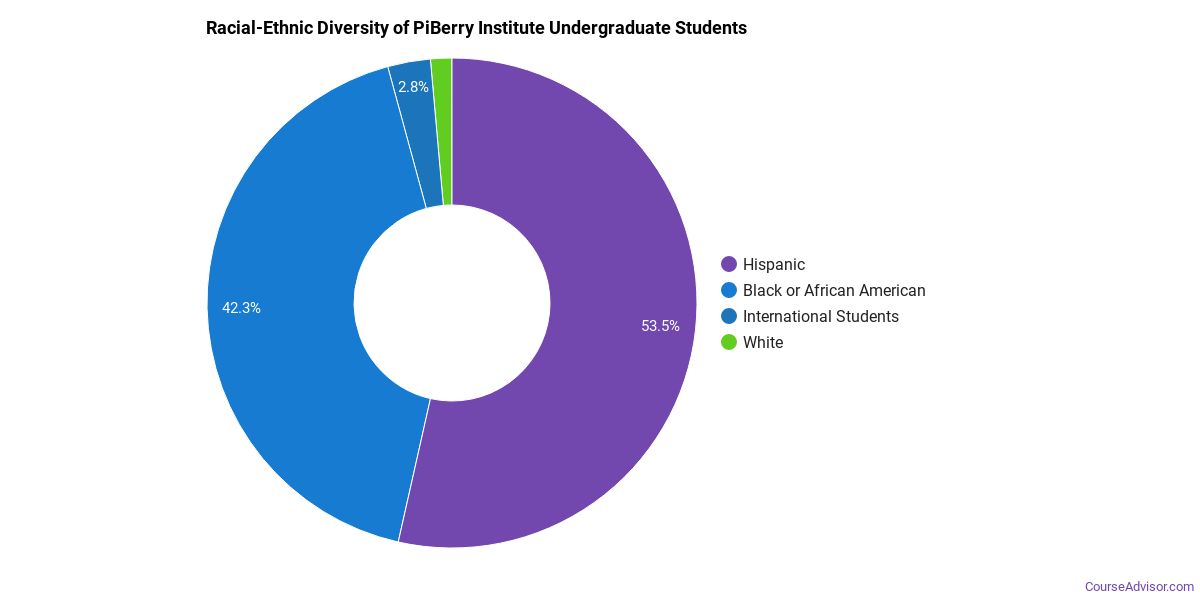
| Race/Ethnicity | Number of Grads |
|---|---|
| Asian | 0 |
| Black or African American | 10 |
| Hispanic or Latino | 9 |
| White | 0 |
| International Students | 0 |
| Other Races/Ethnicities | 0 |
PiBerry Institute Undergraduate Concentrations
The table below shows the number of awards for each concentration.
| Major | Basic Certificate | Undergraduate Certificate | TOTAL |
|---|---|---|---|
| Health Aids/Attendants/Orderlies | 90 | 0 | 90 |
| Practical Nursing & Nursing Assistants | 23 | 13 | 36 |
| Health & Medical Administrative Services | 0 | 16 | 16 |
| TOTAL | 113 | 29 | 142 |
References
*The racial-ethnic minorities count is calculated by taking the total number of students and subtracting white students, international students, and students whose race/ethnicity was unknown. This number is then divided by the total number of students at the school to obtain the racial-ethnic minorities percentage.
More about our data sources and methodologies.

Course Advisor provides higher-education, college and university, degree, program, career, salary, and other helpful information to students, faculty, institutions, and other internet audiences. Presented information and data are subject to change. Inclusion on this website does not imply or represent a direct relationship with the company, school, or brand. Information, though believed correct at time of publication, may not be correct, and no warranty is provided. Contact the schools to verify any information before relying on it. Financial aid may be available for those who qualify. The displayed options may include sponsored or recommended results, not necessarily based on your preferences.
© Course Advisor – All Rights Reserved.