Probation Officers and Correctional Treatment Specialists in Arkansas
Thinking about a career as a Probation Officers and Correctional Treatment Specialists in Arkansas? Here’s what you need to know. Provide social services to assist in rehabilitation of law offenders in custody or on probation or parole. Make recommendations for actions involving formulation of rehabilitation plan and treatment of offender, including conditional release and education and employment stipulations.
What do Probation Officers and Correctional Treatment Specialists Make in Arkansas?
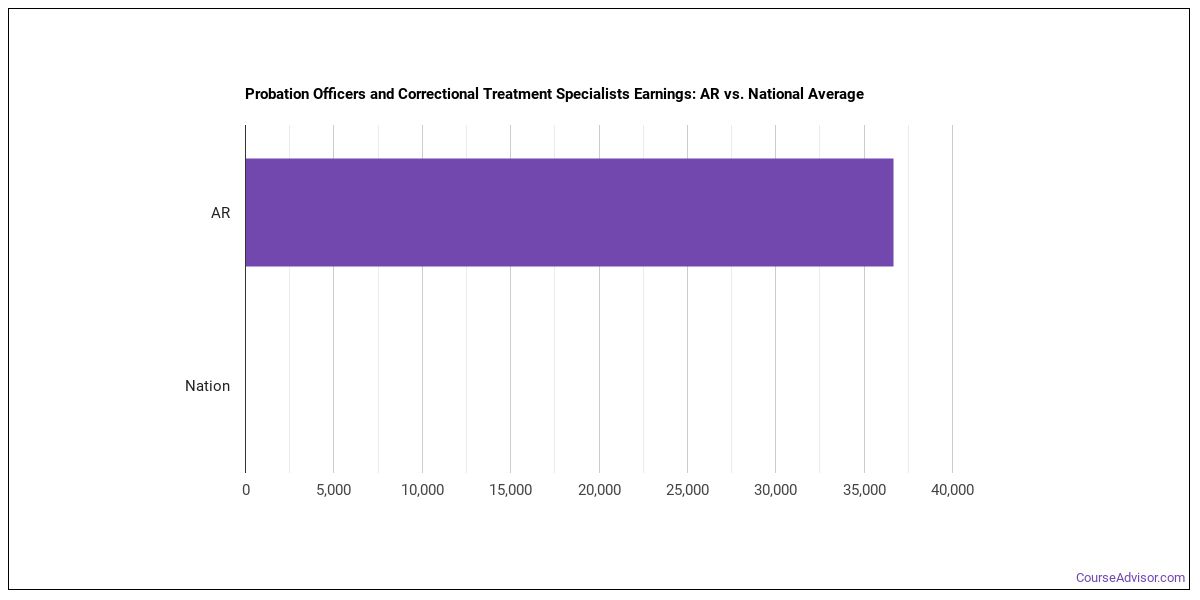
For a probation officers and correctional treatment specialists working in Arkansas, wages run about $48,970 per year (or roughly $23.54/hour).Pay can range from $39,680 at the 10th percentile to $59,220 at the 90th percentile.
| Wage Statistic | Annual | Hourly |
|---|---|---|
| 10th percentile | $39,680 | $19.08 |
| 25th percentile | $44,100 | $21.20 |
| Median (50th) | $48,970 | $23.54 |
| 75th percentile | $54,380 | $26.14 |
| 90th percentile | $59,220 | $28.47 |

Location quotient — how concentrated this career is in Arkansas compared to the national average — is 1.03.
National Wage Comparison
Nationally, probation officers and correctional treatment specialists earn a median of $40,804 per year ($19.62/hour), above the Arkansas median.
Employment Outlook
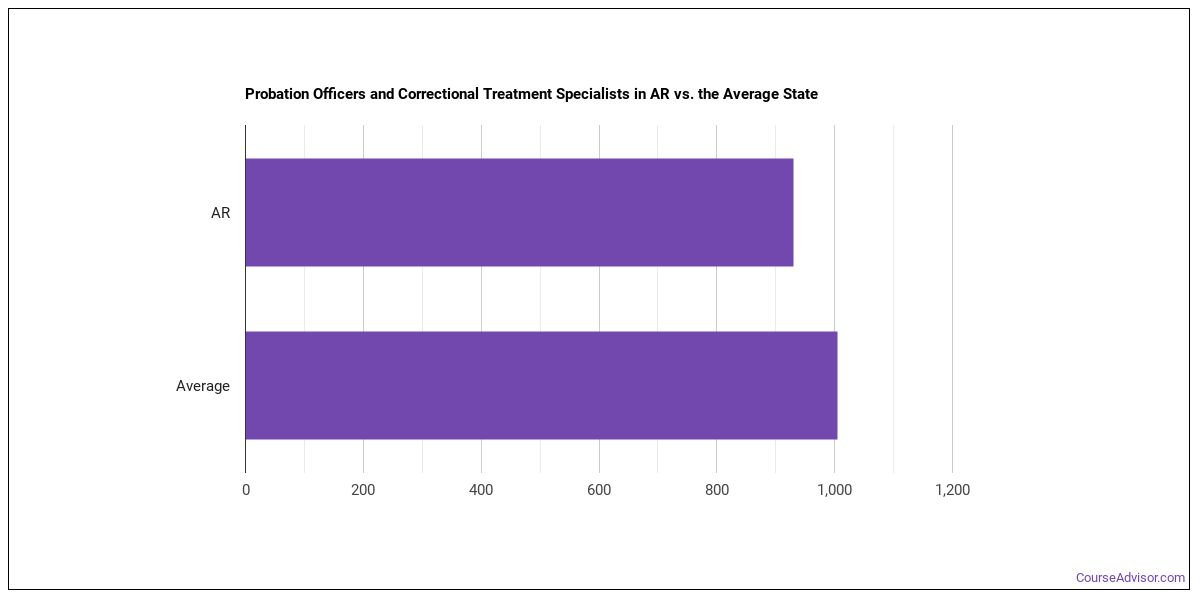
Nationally, total employment in this occupation is 35,217 probation officers and correctional treatment specialists nationwide. In Arkansas alone, approximately 750 people work in this role. That trails the typical state, which employs around 1,230 probation officers and correctional treatment specialists.

Top Arkansas Metros for Probation Officers and Correctional Treatment Specialists
These are the Arkansas metros with the most probation officers and correctional treatment specialists in Arkansas.
| Metro Area | Number Employed | Annual Median Salary |
|---|---|---|
| Little Rock-North Little Rock-Conway, AR | 460 | $52,160 |
| Fayetteville-Springdale-Rogers, AR | 40 | $44,540 |
| Fort Smith, AR-OK | 40 | $38,310 |
Top States for Probation Officers and Correctional Treatment Specialists Employment
The table below shows the states where the most probation officers and correctional treatment specialists work.
| State | Number Employed |
|---|---|
| California | 12,950 |
| Texas | 7,490 |
| New York | 4,420 |
| Florida | 4,360 |
| Pennsylvania | 4,240 |
| North Carolina | 3,160 |
| Ohio | 3,150 |
| New Jersey | 2,880 |
| Virginia | 2,830 |
| Illinois | 2,540 |
| Georgia | 2,460 |
| Tennessee | 2,350 |
| Colorado | 2,280 |
| Michigan | 2,220 |
| Missouri | 2,160 |
| Washington | 2,120 |
| Minnesota | 1,910 |
| Indiana | 1,830 |
| Maryland | 1,680 |
| Oregon | 1,290 |
Highest-Paying States for Probation Officers and Correctional Treatment Specialists
The highest-paying states for probation officers and correctional treatment specialists.
| State | Annual Median Salary |
|---|---|
| California | $107,050 |
| Connecticut | $94,600 |
| Massachusetts | $90,700 |
| Oregon | $82,970 |
| New York | $80,060 |
| Washington | $79,800 |
| Minnesota | $79,510 |
| Michigan | $79,230 |
| Iowa | $78,640 |
| New Jersey | $77,810 |
Skills
The most important probation officers and correctional treatment specialists skills, rated on an importance scale of 0 to 5:
Knowledge Areas
Core knowledge areas for this occupation, rated on an importance scale of 0 to 5:
Abilities
The abilities that matter most for probation officers and correctional treatment specialists, rated on an importance scale of 0 to 5:
Daily Tasks
Probation Officers and Correctional Treatment Specialists typically:
- Prepare and maintain case folder for each assigned inmate or offender.
- Gather information about offenders' backgrounds by talking to offenders, their families and friends, and other people who have relevant information.
- Interview probationers and parolees regularly to evaluate their progress in accomplishing goals and maintaining the terms specified in their probation contracts and rehabilitation plans.
- Discuss with offenders how such issues as drug and alcohol abuse and anger management problems might have played roles in their criminal behavior.
- Supervise people on community-based sentences, such as electronically monitored home detention, and provide field supervision of probationers by conducting curfew checks or visits to home, work, or school.
- Investigate alleged parole violations, using interviews, surveillance, and search and seizure.
- Recommend remedial action or initiate court action in response to noncompliance with terms of probation or parole.
- Arrange for medical, mental health, or substance abuse treatment services according to individual needs or court orders.
- Develop liaisons and networks with other parole officers, community agencies, correctional institutions, psychiatric facilities, and aftercare agencies to plan for helping offenders with life adjustments.
- Administer drug and alcohol tests, including random drug screens of offenders, to verify compliance with substance abuse treatment programs.
- Inform offenders or inmates of requirements of conditional release, such as office visits, restitution payments, or educational and employment stipulations.
- Participate in decisions about whether cases should go before courts and which court should hear them.
Work Activities
- Getting Information
- Documenting/Recording Information
- Communicating with Supervisors, Peers, or Subordinates
- Evaluating Information to Determine Compliance with Standards
- Organizing, Planning, and Prioritizing Work
- Making Decisions and Solving Problems
- Identifying Objects, Actions, and Events
- Working with Computers
- Establishing and Maintaining Interpersonal Relationships
- Updating and Using Relevant Knowledge
- Communicating with People Outside the Organization
- Scheduling Work and Activities
Tools & Technology
Common tools and software used in this occupation include: Hot technologies: Facebook In-demand technologies: Microsoft Excel
What Major Will Prepare You For This Career?
Several college majors map to this occupation:
- Social Work
Featured schools near , edit
Related Careers
Careers similar to probation officers and correctional treatment specialists include:
- Social and Community Service Managers
- Clinical and Counseling Psychologists
- Substance Abuse and Behavioral Disorder Counselors
- Educational, Guidance, and Career Counselors and Advisors
- Marriage and Family Therapists
- Mental Health Counselors
Also Known As
Adult Probation Officer, Adult Probation and Parole Officer, Attendance Officer, Community Corrections Specialist, Community Supervision Officer, Correctional Case Manager, Correctional Casework Specialist, Correctional Counselor, Correctional Officer, Correctional Probation Officer, Correctional Probation Specialist, Correctional Specialist, Correctional Treatment Case Manager, Correctional Treatment Specialist, Correctional Treatment Specialist Case Manager.
References
- U.S. Bureau of Labor Statistics, Occupational Employment and Wage Statistics — https://www.bls.gov/oes/
- O*NET Online — https://www.onetonline.org/
- BLS Employment Projections — https://www.bls.gov/emp/
- O*NET-SOC code: 21-1092.00

Course Advisor provides higher-education, college and university, degree, program, career, salary, and other helpful information to students, faculty, institutions, and other internet audiences. Presented information and data are subject to change. Inclusion on this website does not imply or represent a direct relationship with the company, school, or brand. Information, though believed correct at time of publication, may not be correct, and no warranty is provided. Contact the schools to verify any information before relying on it. Financial aid may be available for those who qualify. The displayed options may include sponsored or recommended results, not necessarily based on your preferences.
© Course Advisor – All Rights Reserved.