Museum Technicians and Conservators in Arkansas
Considering working as a Museum Technicians and Conservators in Arkansas? Here’s what the data says. Restore, maintain, or prepare objects in museum collections for storage, research, or exhibit. May work with specimens such as fossils, skeletal parts, or botanicals; or artifacts, textiles, or art. May identify and record objects or install and arrange them in exhibits. Includes book or document conservators.
What do Museum Technicians and Conservators Make in Arkansas?
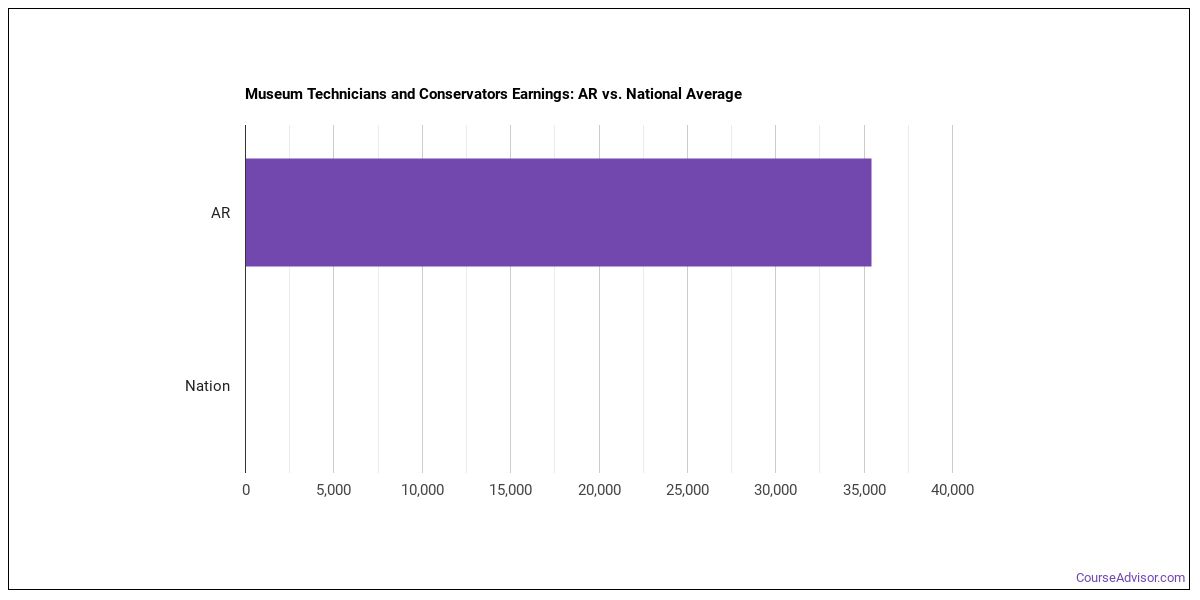
For museum technicians and conservators working in Arkansas, the typical annual salary is $43,810 per year (or roughly $21.06/hour).Annual wages span from $29,800 at the 10th percentile to $60,290 at the 90th percentile.
| Wage Statistic | Annual | Hourly |
|---|---|---|
| 10th percentile | $29,800 | $14.33 |
| 25th percentile | $36,400 | $17.50 |
| Median (50th) | $43,810 | $21.06 |
| 75th percentile | $49,750 | $23.92 |
| 90th percentile | $60,290 | $28.99 |

The location quotient — a measure of how concentrated this occupation is in Arkansas compared to the national average — is 0.74, indicating fewer museum technicians and conservators per worker than the national average.
National Wage Comparison
Nationally, museum technicians and conservators earn a median of $96,273 per year ($46.29/hour), below the Arkansas median.
Employment Outlook
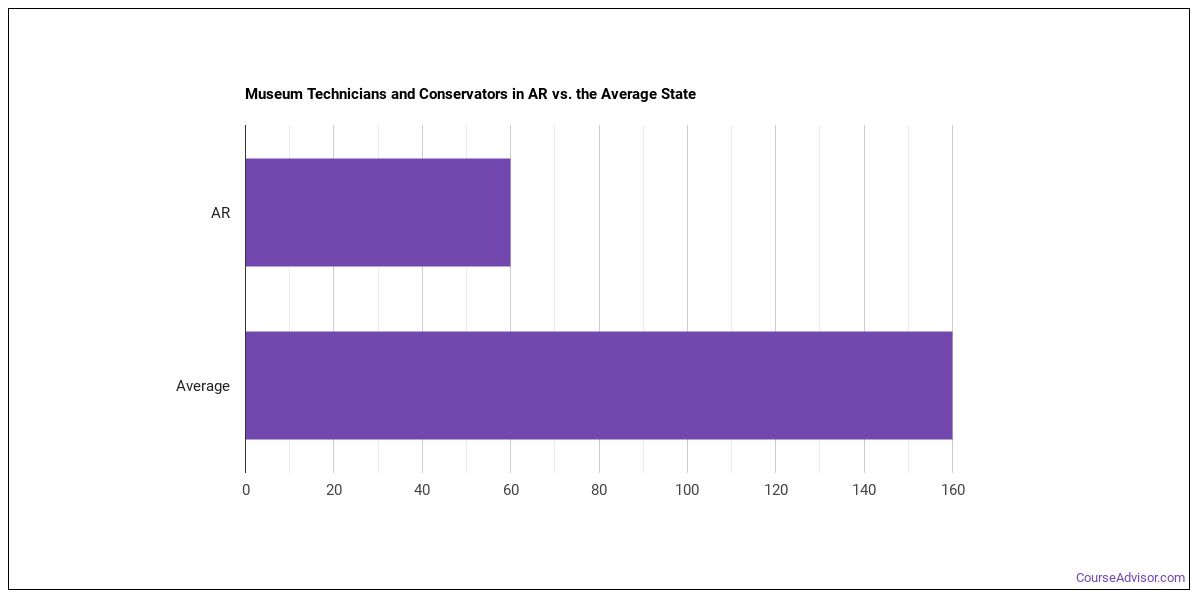
National employment for 663,035 museum technicians and conservators in the U.S.. In Arkansas alone, about 80 people work in this role. That’s below the typical state, which employs around 160 museum technicians and conservators.

Top Arkansas Metros for Museum Technicians and Conservators
These are the Arkansas metros with the most museum technicians and conservators in Arkansas.
| Metro Area | Number Employed | Annual Median Salary |
|---|---|---|
| Fayetteville-Springdale-Rogers, AR | 40 | $46,030 |
Top States for Museum Technicians and Conservators Employment
These states have the highest employment of museum technicians and conservators work.
| State | Number Employed |
|---|---|
| California | 1,790 |
| New York | 1,060 |
| Missouri | 1,000 |
| Texas | 780 |
| North Carolina | 740 |
| Illinois | 570 |
| District of Columbia | 520 |
| Pennsylvania | 470 |
| Maryland | 420 |
| Virginia | 360 |
| Ohio | 330 |
| Massachusetts | 290 |
| Washington | 270 |
| Tennessee | 270 |
| Michigan | 250 |
| Minnesota | 230 |
| Connecticut | 210 |
| Louisiana | 210 |
| Indiana | 190 |
| Wisconsin | 190 |
Highest-Paying States for Museum Technicians and Conservators
Where museum technicians and conservators earn the most: museum technicians and conservators.
| State | Annual Median Salary |
|---|---|
| District of Columbia | $74,300 |
| Maryland | $72,950 |
| Connecticut | $66,070 |
| New York | $64,680 |
| Alaska | $63,490 |
| Massachusetts | $59,130 |
| California | $58,960 |
| Washington | $58,470 |
| Rhode Island | $54,230 |
| Colorado | $51,780 |
Skills
Key museum technicians and conservators skills, rated on an importance scale of 0 to 5:
Knowledge Areas
Core knowledge areas for this occupation, rated on an importance scale of 0 to 5:
Abilities
Top abilities for museum technicians and conservators, rated on an importance scale of 0 to 5:
Daily Tasks
Common tasks include:
- Install, arrange, assemble, and prepare artifacts for exhibition, ensuring the artifacts' safety, reporting their status and condition, and identifying and correcting any problems with the set up.
- Repair, restore, and reassemble artifacts, designing and fabricating missing or broken parts, to restore them to their original appearance and prevent deterioration.
- Clean objects, such as paper, textiles, wood, metal, glass, rock, pottery, and furniture, using cleansers, solvents, soap solutions, and polishes.
- Photograph objects for documentation.
- Determine whether objects need repair and choose the safest and most effective method of repair.
- Prepare artifacts for storage and shipping.
- Enter information about museum collections into computer databases.
- Recommend preservation procedures, such as control of temperature and humidity, to curatorial and building staff.
- Notify superior when restoration of artifacts requires outside experts.
- Supervise and work with volunteers.
- Perform on-site field work which may involve interviewing people, inspecting and identifying artifacts, note-taking, viewing sites and collections, and repainting exhibition spaces.
- Lead tours and teach educational courses to students and the general public.
Work Activities
- Identifying Objects, Actions, and Events
- Getting Information
- Handling and Moving Objects
- Monitoring Processes, Materials, or Surroundings
- Making Decisions and Solving Problems
- Communicating with Supervisors, Peers, or Subordinates
- Establishing and Maintaining Interpersonal Relationships
- Performing General Physical Activities
- Thinking Creatively
- Documenting/Recording Information
- Updating and Using Relevant Knowledge
- Organizing, Planning, and Prioritizing Work
Tools & Technology
Common tools and software used in this occupation include: Hot technologies: Adobe Acrobat, Adobe Creative Cloud software
What Major Will Prepare You For This Career?
Programs that train for this career include:
- Fine & Studio Arts
- Museum Studies
- History
Featured schools near , edit
Related Careers
Other careers like museum technicians and conservators include:
- Civil Engineering Technologists and Technicians
- Conservation Scientists
- Historians
- Chemical Technicians
- Geological Technicians, Except Hydrologic Technicians
- Forest and Conservation Technicians
Also Known As
Archaeological Technician, Armorer Technician, Art Conservator, Art Handler, Art Objects Repairer, Art Preparator, Artifacts Conservator, Ceramic Restorer, Conservation Specialist, Conservation Technician, Conservation Worker, Conservator, Conservator Technician, Document Restorer, Ethnographic Materials Conservator.
References
- U.S. Bureau of Labor Statistics, Occupational Employment and Wage Statistics — https://www.bls.gov/oes/
- O*NET Online — https://www.onetonline.org/
- BLS Employment Projections — https://www.bls.gov/emp/
- O*NET-SOC code: 25-4013.00

Course Advisor provides higher-education, college and university, degree, program, career, salary, and other helpful information to students, faculty, institutions, and other internet audiences. Presented information and data are subject to change. Inclusion on this website does not imply or represent a direct relationship with the company, school, or brand. Information, though believed correct at time of publication, may not be correct, and no warranty is provided. Contact the schools to verify any information before relying on it. Financial aid may be available for those who qualify. The displayed options may include sponsored or recommended results, not necessarily based on your preferences.
© Course Advisor – All Rights Reserved.