Food Science Technicians: Career Overview
Work with food scientists or technologists to perform standardized qualitative and quantitative tests to determine physical or chemical properties of food or beverage products. Includes technicians who assist in research and development of production technology, quality control, packaging, processing, and use of foods.
Featured schools near , edit
The Daily Work of Food Science Technicians Perform?
Typical responsibilities of food science technicians cover:
- Taste or smell foods or beverages to ensure that flavors meet specifications or to select samples with specific characteristics.
- Measure, test, or weigh bottles, cans, or other containers to ensure that hardness, strength, or dimensions meet specifications.
- Maintain records of testing results or other documents as required by state or other governing agencies.
- Monitor and control temperature of products.
- Analyze test results to classify products or compare results with standard tables.
- Record or compile test results or prepare graphs, charts, or reports.
- Perform regular maintenance of laboratory equipment by inspecting, calibrating, cleaning, or sterilizing.
- Examine chemical or biological samples to identify cell structures or to locate bacteria or extraneous material, using a microscope.
Skills and Knowledge
Top food science technicians draw on a mix of skills and domain knowledge.
Most Important Skills
The competencies that matter most in this role, rated on an importance scale of 0 to 5:
Knowledge Areas
Types of Food Science Technicians Jobs
This career also goes by job titles like:
- Beer Brewer
- Biotechnician
- Bottle House QC Technician (Bottle House Quality Control Technician)
- Butter Fat Tester
- Central Laboratory Technician (CLT)
- Cheese Tester
- Cream Tester
- Dairy Laboratory Technician (Dairy Lab Tech)
Employment and Demand
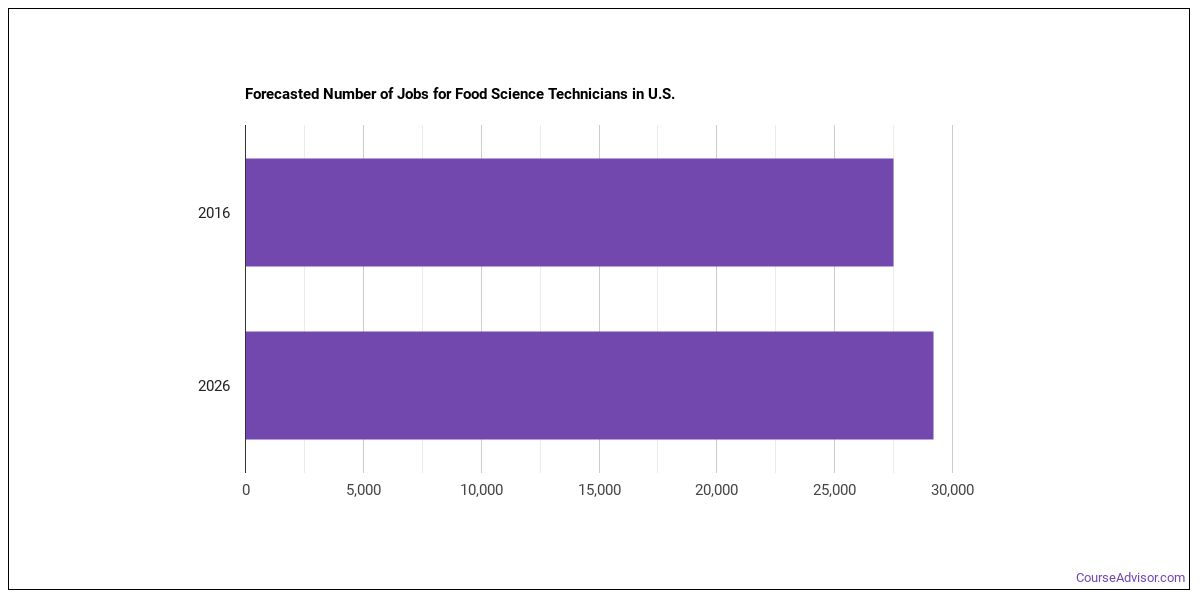
There are roughly 126,017 food science technicians working in the United States today. Demand is forecast to grow by +7.3% over the projection horizon.
Food Science Technicians Pay
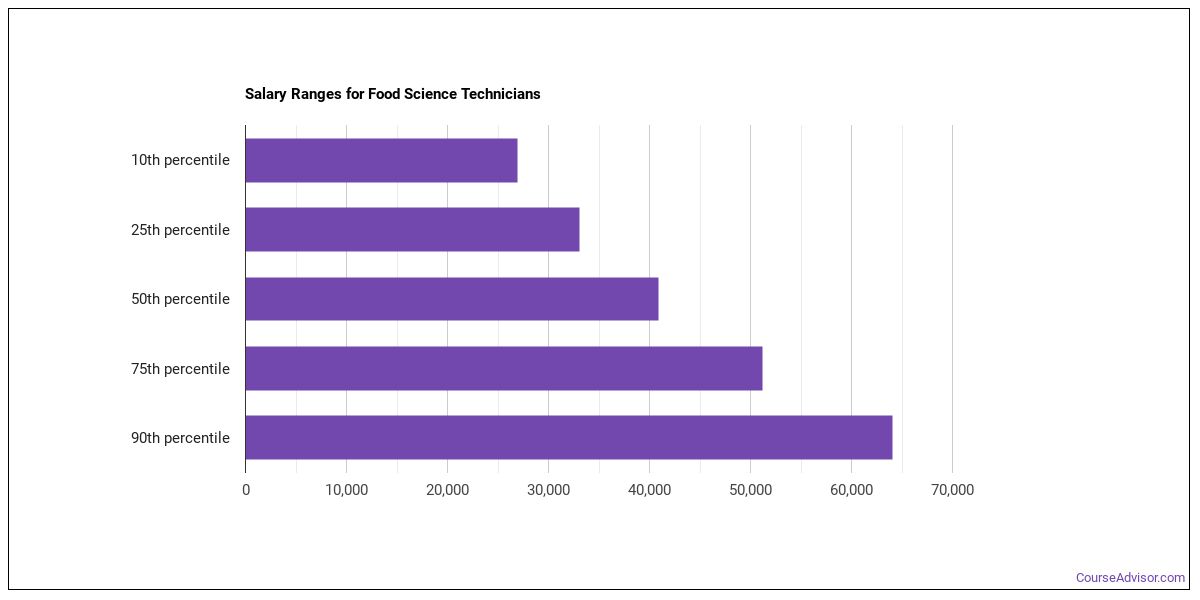
| Statistic | Value |
|---|---|
| Annual median | $100,898 |
| Hourly median | $48.51 |
| 10th percentile | $66,770 |
| 25th percentile | $83,834 |
| 75th percentile | $117,962 |
| 90th percentile | $135,026 |
Wages vary widely based on experience, location, and industry.
Pay by State
| State | Annual median salary |
|---|---|
| Mississippi | $64,600 |
| Illinois | $63,730 |
| Colorado | $59,450 |
| Virginia | $59,110 |
| Massachusetts | $57,400 |
| Missouri | $55,830 |
| Michigan | $53,480 |
| Tennessee | $52,710 |
| New York | $52,530 |
| Kentucky | $52,410 |
| New Jersey | $52,390 |
| Maryland | $51,690 |
| California | $50,960 |
| Minnesota | $50,380 |
| Wisconsin | $50,080 |
| Vermont | $49,970 |
| Pennsylvania | $49,050 |
| Oregon | $48,840 |
| Utah | $48,790 |
| Connecticut | $48,580 |
| Indiana | $48,060 |
| Iowa | $47,610 |
| Washington | $47,420 |
| Florida | $46,980 |
| Ohio | $46,830 |
| Nebraska | $46,450 |
| Arkansas | $46,400 |
| Texas | $46,170 |
| South Dakota | $46,000 |
| Idaho | $45,230 |
| North Carolina | $44,720 |
| New Mexico | $43,990 |
| Georgia | $41,840 |
| South Carolina | $39,300 |
| Kansas | $35,810 |
| Puerto Rico | $34,320 |
Top-Paying U.S. Regions
Pay for food science technicians differ across the country. The following regions pay the most:
| Region | Median annual wage | Share of U.S. jobs | Location quotient |
|---|---|---|---|
| New England | $55,651 | 1.2% | 0.63 |
| Great Lakes | $52,083 | 13.4% | 1.25 |
| Middle Atlantic | $51,475 | 15.9% | 1.13 |
| Far Western US | $50,468 | 35.4% | 2.40 |
| Rocky Mountains | $50,267 | 4.3% | 2.54 |
| Plains States | $49,345 | 10.0% | 1.81 |
| Southeast | $47,941 | 11.5% | 0.76 |
| Southwest | $45,930 | 7.9% | 0.84 |
Highest-Paying Metro Areas for Food Science Technicians
| Metro area | State | Median annual wage | Employment |
|---|---|---|---|
| Washington-Arlington-Alexandria, DC-VA-MD-WV | DC | $104,600 | 190 |
| Fort Collins-Loveland, CO | CO | $77,530 | 50 |
| Virginia Beach-Chesapeake-Norfolk, VA-NC | VA | $76,690 | 40 |
| Jacksonville, FL | FL | $76,320 | 40 |
| Houston-Pasadena-The Woodlands, TX | TX | $65,220 | 90 |
| Syracuse, NY | NY | $64,830 | 30 |
| Chicago-Naperville-Elgin, IL-IN | IL | $64,760 | 320 |
| Louisville/Jefferson County, KY-IN | KY | $63,710 | 50 |
Which Industries Hire Food Science Technicians
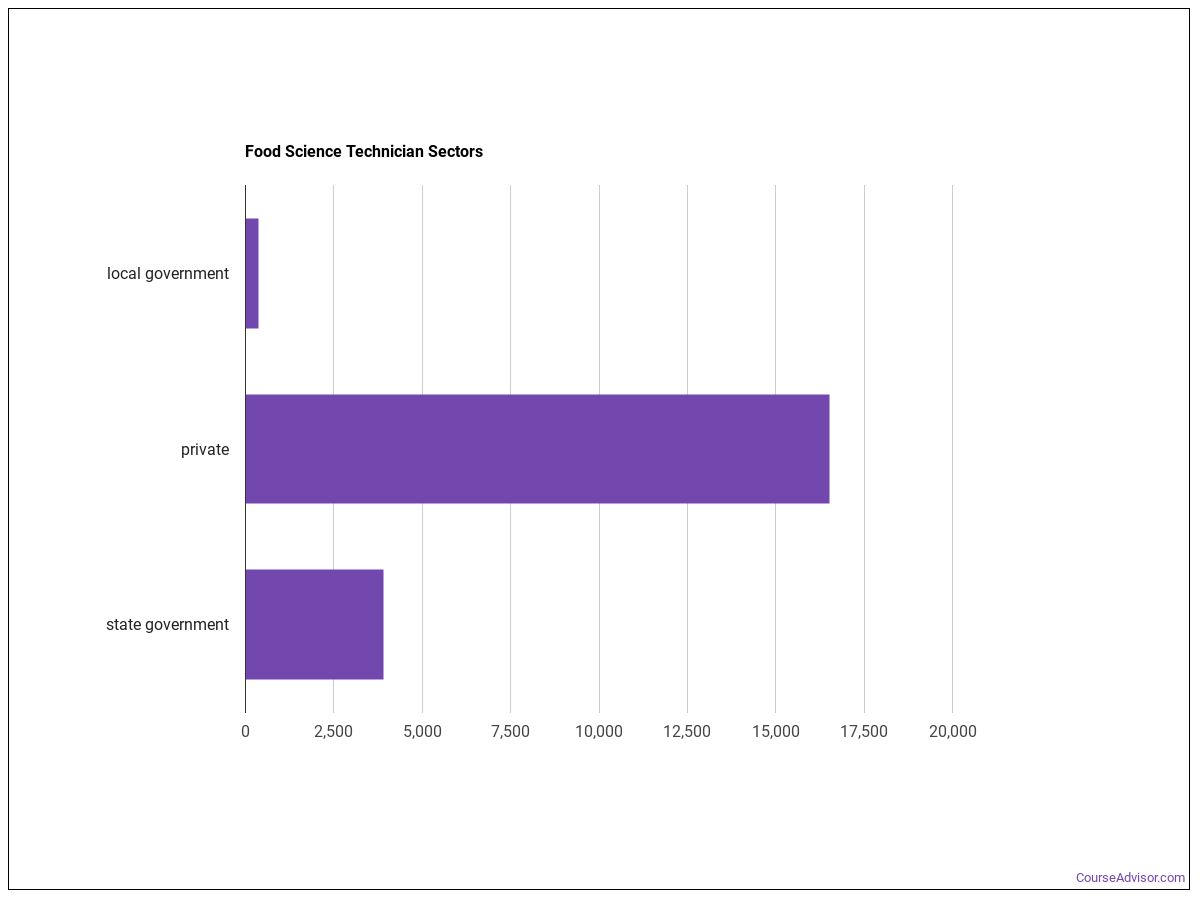
The bulk of food science technicians are concentrated in the following sectors:
| Industry | Employment | Median annual wage |
|---|---|---|
| Manufacturing | 10,450 | $49,130 |
| Professional, Scientific, and Technical Services | 1,130 | $49,890 |
| Wholesale Trade | 630 | $50,920 |
| Educational Services | 610 | $49,370 |
| Management of Companies and Enterprises | 500 | $62,460 |
| Agriculture, Forestry, Fishing and Hunting | 140 | $40,180 |
| Transportation and Warehousing | 90 | $50,560 |
| Retail Trade | 60 | $55,170 |
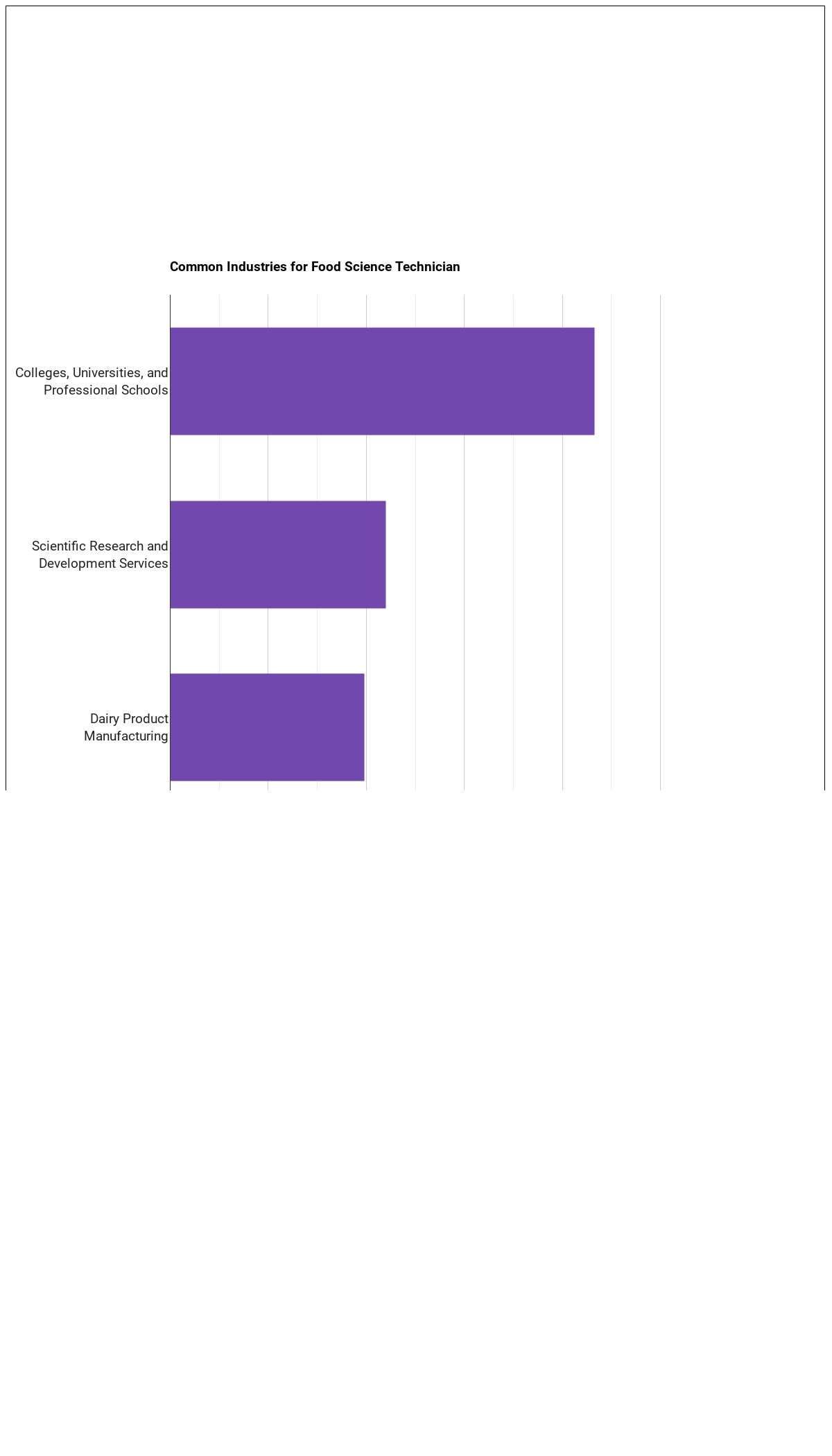
Food Science Technicians work in the following industries:
Software Food Science Technicians Use
- Operating system software: Linux (hot technology)
- Data base user interface and query software: Microsoft Access (hot technology)
- Spreadsheet software: Microsoft Excel (hot technology)
- Office suite software: Microsoft Office software (hot technology)
- Electronic mail software: Microsoft Outlook (hot technology)
- Presentation software: Microsoft PowerPoint (hot technology)
- Data base user interface and query software: Microsoft SQL Server (hot technology)
- Process mapping and design software: Microsoft Visio (hot technology)
- Word processing software: Microsoft Word (hot technology)
- Enterprise resource planning ERP software: SAP software (hot technology)
- Analytical or scientific software: SAS (hot technology)
The Day-to-Day Environment
The on-the-job environment of food science technicians is shaped by the following characteristics:
- Face-to-Face Discussions with Individuals and Within Teams
- Indoors, Environmentally Controlled
- Wear Common Protective or Safety Equipment such as Safety Shoes, Glasses, Gloves, Hearing Protection, Hard Hats, or Life Jackets
- Work With or Contribute to a Work Group or Team
Getting Started in This Career
Typical food science technicians positions require a bachelor’s degree as the typical entry-level education. The role falls in Medium Preparation Needed (Job Zone 3), indicating the level of preparation typically expected.
Related Careers
Similar Occupations
- Quality Control Systems Managers (Primary-Long)
- Industrial Engineering Technologists and Technicians (Primary-Long)
- Calibration Technologists and Technicians (Primary-Long)
- Animal Scientists (Supplemental)
- Food Scientists and Technologists (Primary-Short)
- Microbiologists (Supplemental)
- Chemists (Supplemental)
- Agricultural Technicians (Primary-Short)
Degree Programs
Future food science technicians typically earn programs in:
Agriculture, Agriculture Operations, and Related Sciences
6 programs across 2 majors
Biological and Biomedical Sciences
3 programs across 3 majors
Physical Sciences
1 programs across 1 majors
About the Data
Statistics shown above are sourced from the following authoritative sources:
- U.S. Bureau of Labor Statistics — Occupational Employment and Wage Statistics (OEWS) for employment and wage data by state and industry.
- BLS Employment Projections for total employment and growth forecasts.
- O*NET (Occupational Information Network) for skills, knowledge, tasks, work activities, work context, technology, and education-zone data.
SOC code: 19-4013.00 (Food Science Technicians).

Course Advisor provides higher-education, college and university, degree, program, career, salary, and other helpful information to students, faculty, institutions, and other internet audiences. Presented information and data are subject to change. Inclusion on this website does not imply or represent a direct relationship with the company, school, or brand. Information, though believed correct at time of publication, may not be correct, and no warranty is provided. Contact the schools to verify any information before relying on it. Financial aid may be available for those who qualify. The displayed options may include sponsored or recommended results, not necessarily based on your preferences.
© Course Advisor – All Rights Reserved.