Financial Quantitative Analysts: Career Profile
Develop quantitative techniques to inform securities investing, equities investing, pricing, or valuation of financial instruments. Develop mathematical or statistical models for risk management, asset optimization, pricing, or relative value analysis.
Featured schools near , edit
What Tasks Do Financial Quantitative Analysts Do?
The day-to-day responsibilities of financial quantitative analysts include:
- Apply mathematical or statistical techniques to address practical issues in finance, such as derivative valuation, securities trading, risk management, or financial market regulation.
- Research or develop analytical tools to address issues such as portfolio construction or optimization, performance measurement, attribution, profit and loss measurement, or pricing models.
- Interpret results of financial analysis procedures.
- Develop core analytical capabilities or model libraries, using advanced statistical, quantitative, or econometric techniques.
- Define or recommend model specifications or data collection methods.
- Produce written summary reports of financial research results.
- Maintain or modify all financial analytic models in use.
- Provide application or analytical support to researchers or traders on issues such as valuations or data.
Skills and Knowledge
Top financial quantitative analysts combine a mix of skills and domain knowledge.
Key Skills
These are the skills most important for this role, rated on an importance scale of 0 to 5:
Knowledge Areas
Types of Financial Quantitative Analysts Jobs
Common job titles for this role include:
- Analyst
- Data Analyst
- Equity Analyst
- Equity Structurer
- Finance Analyst
- Financial Analyst
- Financial Engineer
- Financial Quantitative Analyst
How Many Financial Quantitative Analysts Are There?
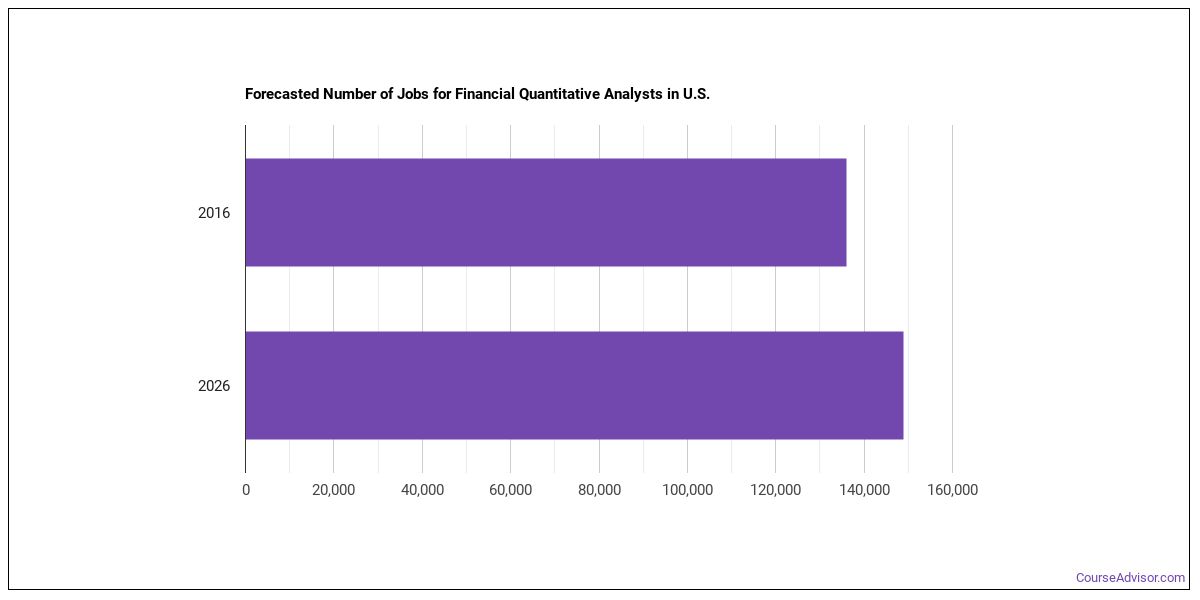
There are roughly 304,801 financial quantitative analysts working in the United States today. Demand is forecast to grow by +10.7% over the projection horizon.
Salary for Financial Quantitative Analysts
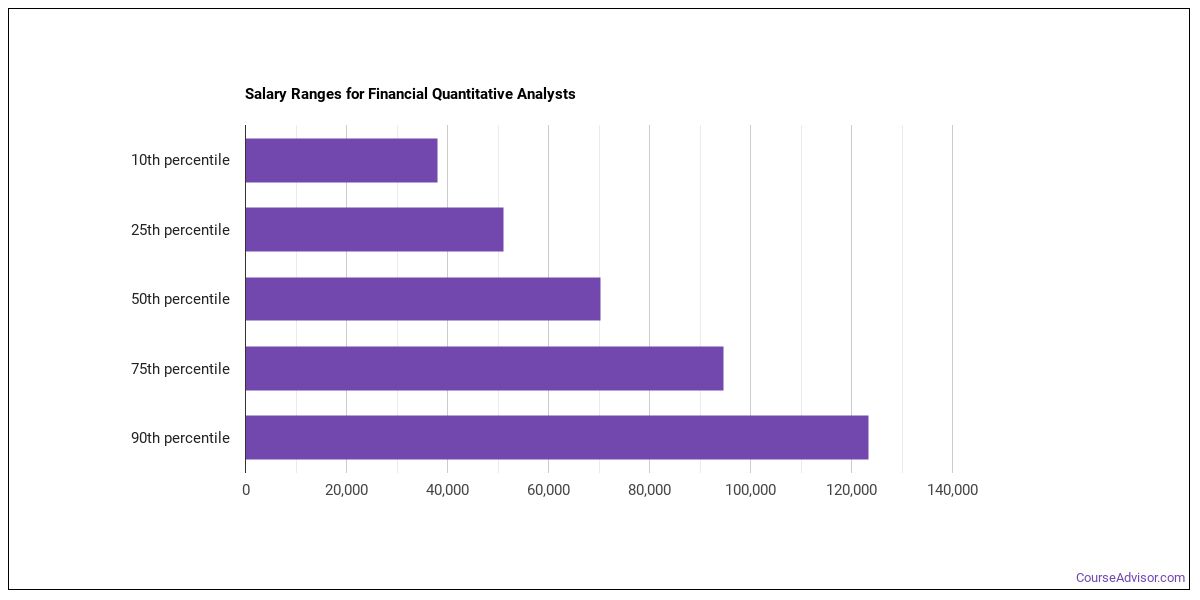
| Statistic | Value |
|---|---|
| Annual median | $126,371 |
| Hourly median | $60.76 |
| 10th percentile | $69,608 |
| 25th percentile | $97,990 |
| 75th percentile | $154,753 |
| 90th percentile | $183,135 |
Compensation varies based on experience, location, and industry.
Pay by State
| State | Annual median salary |
|---|---|
| District of Columbia | $123,450 |
| New York | $122,510 |
| Maryland | $102,500 |
| New Jersey | $92,820 |
| Ohio | $90,170 |
| Rhode Island | $88,500 |
| Indiana | $87,760 |
| Colorado | $87,270 |
| West Virginia | $86,940 |
| Massachusetts | $85,950 |
| California | $85,850 |
| Virginia | $85,670 |
| Pennsylvania | $84,700 |
| Maine | $83,780 |
| Minnesota | $82,260 |
| North Carolina | $82,240 |
| Michigan | $81,470 |
| Illinois | $81,190 |
| Delaware | $79,590 |
| Oregon | $79,570 |
| Arizona | $78,910 |
| New Hampshire | $78,650 |
| Alabama | $78,370 |
| Connecticut | $78,000 |
| Utah | $77,940 |
| North Dakota | $77,380 |
| Hawaii | $76,740 |
| Iowa | $75,770 |
| Georgia | $75,760 |
| Missouri | $75,690 |
| Wyoming | $75,580 |
| Washington | $75,560 |
| New Mexico | $75,550 |
| South Carolina | $75,380 |
| Mississippi | $74,960 |
| Alaska | $74,510 |
| Oklahoma | $72,920 |
| Montana | $72,600 |
| Texas | $72,400 |
| Nevada | $71,480 |
| Vermont | $70,460 |
| Idaho | $68,920 |
| Nebraska | $66,580 |
| Tennessee | $65,960 |
| Wisconsin | $63,700 |
| Florida | $63,060 |
| Kentucky | $62,500 |
| Louisiana | $53,360 |
| Kansas | $50,660 |
| Arkansas | $46,380 |
| Puerto Rico | $38,480 |
Where Financial Quantitative Analysts Earn the Most
Earnings for financial quantitative analysts differ across the country. Top regions by median wage:
| Region | Median annual wage | Share of U.S. jobs | Location quotient |
|---|---|---|---|
| Middle Atlantic | $103,528 | 19.1% | 1.87 |
| Rocky Mountains | $83,365 | 4.9% | 1.50 |
| New England | $83,287 | 4.5% | 0.98 |
| Far Western US | $83,064 | 16.5% | 1.02 |
| Great Lakes | $82,490 | 13.2% | 1.06 |
| Southwest | $73,062 | 11.6% | 0.99 |
| Plains States | $71,702 | 5.4% | 0.97 |
| Southeast | $71,533 | 24.1% | 1.18 |
Top Metro Areas
| Metro area | State | Median annual wage | Employment |
|---|---|---|---|
| Lexington Park, MD | MD | $129,650 | 730 |
| San Jose-Sunnyvale-Santa Clara, CA | CA | $119,060 | 1,250 |
| St. George, UT | UT | $118,950 | 30 |
| Washington-Arlington-Alexandria, DC-VA-MD-WV | DC | $112,420 | 6,540 |
| New York-Newark-Jersey City, NY-NJ | NY | $108,970 | 8,690 |
| Dayton-Kettering-Beavercreek, OH | OH | $108,200 | 990 |
| San Francisco-Oakland-Fremont, CA | CA | $108,010 | 2,720 |
| Chambersburg, PA | PA | $105,810 | 40 |
Which Industries Hire Financial Quantitative Analysts
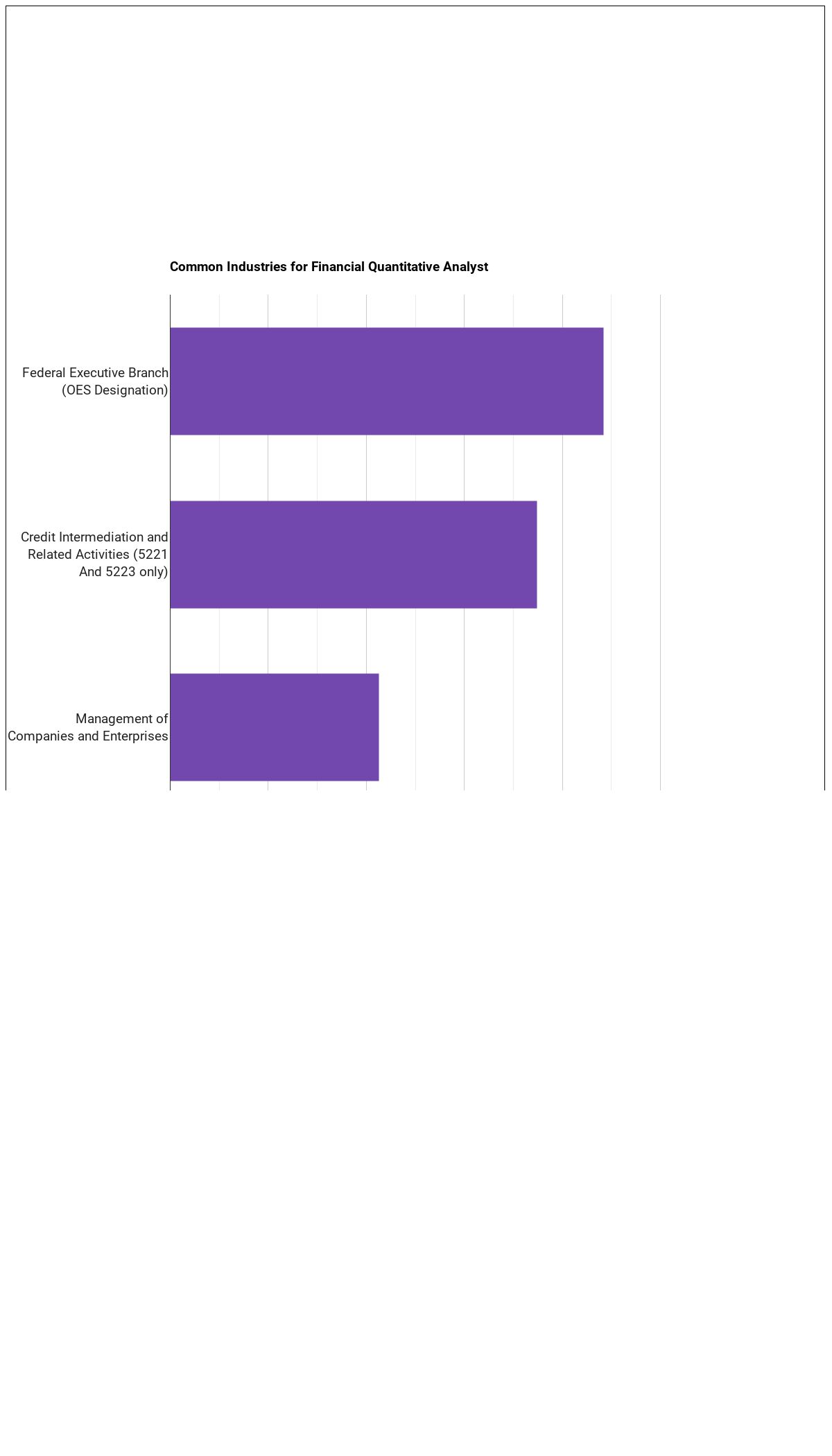
The bulk of financial quantitative analysts work in these industries:
| Industry | Employment | Median annual wage |
|---|---|---|
| Finance and Insurance | 40,340 | $78,030 |
| Management of Companies and Enterprises | 10,290 | $81,030 |
| Educational Services | 7,640 | $63,750 |
| Professional, Scientific, and Technical Services | 7,510 | $93,690 |
| Health Care and Social Assistance | 7,030 | $64,930 |
| Other Services (except Public Administration) | 5,080 | $52,770 |
| Administrative and Support and Waste Management and Remediation Services | 4,220 | $64,070 |
| Information | 2,700 | $82,900 |

Below are examples of industries where financial quantitative analysts work:
Software Financial Quantitative Analysts Use
- Data base user interface and query software: Amazon Web Services AWS software (hot technology)
- Data base management system software: Apache Hive (hot technology)
- Object or component oriented development software: C# (hot technology)
- Object or component oriented development software: C++ (hot technology)
- Analytical or scientific software: IBM SPSS Statistics (hot technology)
- Web platform development software: JavaScript (hot technology)
- Operating system software: Linux (hot technology)
- Data base user interface and query software: Microsoft Access (hot technology)
- Development environment software: Microsoft Azure software (hot technology)
- Spreadsheet software: Microsoft Excel (hot technology)
- Office suite software: Microsoft Office software (hot technology)
- Business intelligence and data analysis software: Microsoft Power BI (hot technology)
The Day-to-Day Environment
The work environment for financial quantitative analysts is shaped by the following characteristics:
- Spend Time Sitting
- Level of Competition
- Telephone Conversations
- Face-to-Face Discussions with Individuals and Within Teams
How to Become Financial Quantitative Analysts
Most financial quantitative analysts positions require a doctoral or professional degree as the typical entry-level education. This career aligns with Extensive Preparation Needed (Job Zone 5), indicating the level of preparation typically expected.
Other Careers to Consider
Similar Occupations
- Investment Fund Managers (Primary-Long)
- Management Analysts (Primary-Long)
- Market Research Analysts and Marketing Specialists (Supplemental)
- Credit Analysts (Primary-Long)
- Financial and Investment Analysts (Primary-Short)
- Personal Financial Advisors (Supplemental)
- Financial Risk Specialists (Primary-Short)
- Computer Systems Analysts (Supplemental)
Where to Study
Aspiring financial quantitative analysts typically earn programs in:
Business, Management, Marketing, and Related Support Services
2 programs across 2 majors
Mathematics and Statistics
1 programs across 1 majors
Theology and Religious Vocations
1 programs across 1 majors
References
Statistics shown above are sourced from the following authoritative sources:
- U.S. Bureau of Labor Statistics — Occupational Employment and Wage Statistics (OEWS) for employment and wage data by state and industry.
- BLS Employment Projections for total employment and growth forecasts.
- O*NET (Occupational Information Network) for skills, knowledge, tasks, work activities, work context, technology, and education-zone data.
SOC code: 13-2099.01 (Financial Specialists, All Other).

Course Advisor provides higher-education, college and university, degree, program, career, salary, and other helpful information to students, faculty, institutions, and other internet audiences. Presented information and data are subject to change. Inclusion on this website does not imply or represent a direct relationship with the company, school, or brand. Information, though believed correct at time of publication, may not be correct, and no warranty is provided. Contact the schools to verify any information before relying on it. Financial aid may be available for those who qualify. The displayed options may include sponsored or recommended results, not necessarily based on your preferences.
© Course Advisor – All Rights Reserved.