Farmworkers and Laborers, Crop, Nursery, and Greenhouse in West Virginia
Want to work as a Farmworkers and Laborers, Crop, Nursery, and Greenhouse in West Virginia? Here’s what you need to know. Manually plant, cultivate, and harvest vegetables, fruits, nuts, horticultural specialties, and field crops. Use hand tools, such as shovels, trowels, hoes, tampers, pruning hooks, shears, and knives. Duties may include tilling soil and applying fertilizers; transplanting, weeding, thinning, or pruning crops; applying pesticides; or cleaning, grading, sorting, packing, and loading harvested products. May construct trellises, repair fences and farm buildings, or participate in irrigation activities. Excludes “Pesticide Handlers, Sprayers, and Applicators, Vegetation” (37-3012), “Graders and Sorters, Agricultural Products” (45-2041), and “Forest, Conservation, and Logging Workers” (45-4011 through 45-4029).
What do Farmworkers and Laborers, Crop, Nursery, and Greenhouse Make in West Virginia?
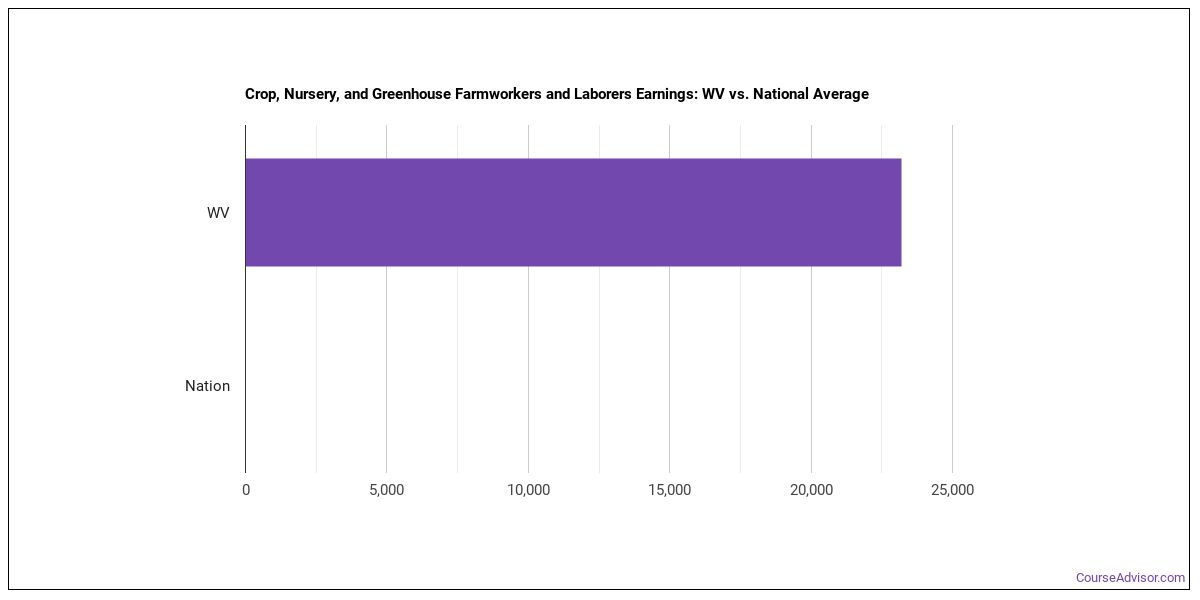
For farmworkers and laborers, crop, nursery, and greenhouse working in West Virginia, the median annual wage is $29,320 per year (or roughly $14.10/hour).Pay can range from $21,960 at the 10th percentile to $44,260 at the 90th percentile.
| Wage Statistic | Annual | Hourly |
|---|---|---|
| 10th percentile | $21,960 | $10.56 |
| 25th percentile | $22,520 | $10.83 |
| Median (50th) | $29,320 | $14.10 |
| 75th percentile | $34,400 | $16.54 |
| 90th percentile | $44,260 | $21.28 |

Location quotient — how concentrated this career is in West Virginia compared to the national average — is 0.10, indicating fewer farmworkers and laborers, crop, nursery, and greenhouse per worker than the national average.
National Wage Comparison
Nationally, farmworkers and laborers, crop, nursery, and greenhouse earn a median of $31,937 per year ($15.35/hour), below the West Virginia median.
Employment Outlook
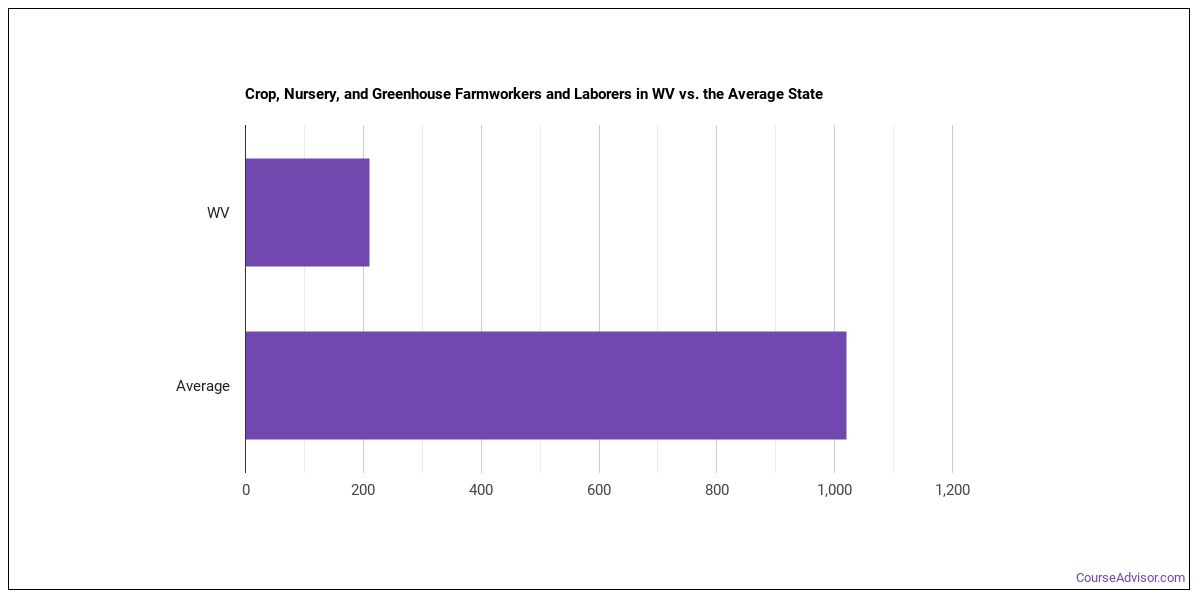
There are roughly 72,906 farmworkers and laborers, crop, nursery, and greenhouse in the U.S.. In West Virginia alone, about 120 people work in this role. That trails the typical state, which employs around 1,170 farmworkers and laborers, crop, nursery, and greenhouse.

Top States for Farmworkers and Laborers, Crop, Nursery, and Greenhouse Employment
The table below shows the states where the most farmworkers and laborers, crop, nursery, and greenhouse work.
| State | Number Employed |
|---|---|
| California | 175,340 |
| Florida | 9,640 |
| Washington | 7,280 |
| Oregon | 6,980 |
| Arizona | 5,720 |
| Texas | 4,470 |
| Michigan | 3,680 |
| Pennsylvania | 3,660 |
| New Jersey | 3,460 |
| North Carolina | 2,980 |
| Colorado | 2,730 |
| New York | 2,570 |
| Georgia | 2,440 |
| Illinois | 2,410 |
| Ohio | 2,290 |
| Idaho | 2,070 |
| Tennessee | 1,700 |
| New Mexico | 1,670 |
| Missouri | 1,660 |
| Maryland | 1,630 |
Highest-Paying States for Farmworkers and Laborers, Crop, Nursery, and Greenhouse
The highest-paying states for farmworkers and laborers, crop, nursery, and greenhouse.
| State | Annual Median Salary |
|---|---|
| Wyoming | $44,760 |
| Nebraska | $43,980 |
| Maine | $43,870 |
| Montana | $41,840 |
| District of Columbia | $41,610 |
| Illinois | $40,400 |
| Massachusetts | $40,370 |
| New York | $39,370 |
| Minnesota | $38,900 |
| Colorado | $38,870 |
Skills
Top farmworkers and laborers, crop, nursery, and greenhouse skills, rated on an importance scale of 0 to 5:
Knowledge Areas
Core knowledge areas for this occupation, rated on an importance scale of 0 to 5:
Abilities
The abilities that matter most for farmworkers and laborers, crop, nursery, and greenhouse, rated on an importance scale of 0 to 5:
Daily Tasks
Farmworkers and Laborers, Crop, Nursery, and Greenhouse typically:
- Record information about crops, such as pesticide use, yields, or costs.
- Direct and monitor the work of casual and seasonal help during planting and harvesting.
- Participate in the inspection, grading, sorting, storage, and post-harvest treatment of crops.
- Harvest plants, and transplant or pot and label them.
- Repair and maintain farm vehicles, implements, and mechanical equipment.
- Harvest fruits and vegetables by hand.
- Set up and operate irrigation equipment.
- Inform farmers or farm managers of crop progress.
- Identify plants, pests, and weeds to determine the selection and application of pesticides and fertilizers.
- Operate tractors, tractor-drawn machinery, and self-propelled machinery to plow, harrow and fertilize soil, or to plant, cultivate, spray and harvest crops.
- Load agricultural products into trucks, and drive trucks to market or storage facilities.
- Clean work areas, and maintain grounds and landscaping.
Work Activities
- Performing General Physical Activities
- Handling and Moving Objects
- Getting Information
- Identifying Objects, Actions, and Events
- Communicating with Supervisors, Peers, or Subordinates
- Controlling Machines and Processes
- Updating and Using Relevant Knowledge
- Operating Vehicles, Mechanized Devices, or Equipment
- Inspecting Equipment, Structures, or Materials
- Making Decisions and Solving Problems
- Repairing and Maintaining Mechanical Equipment
- Evaluating Information to Determine Compliance with Standards
Tools & Technology
Technologies frequently used: Hot technologies: Microsoft Excel
Related Careers
Careers similar to farmworkers and laborers, crop, nursery, and greenhouse include:
- Farmers, Ranchers, and Other Agricultural Managers
- Soil and Plant Scientists
- Agricultural Technicians
- Landscaping and Groundskeeping Workers
- Pesticide Handlers, Sprayers, and Applicators, Vegetation
- Tree Trimmers and Pruners
Also Known As
Agriculture Laborer, Agriculture Worker, Apple Picker, Apple Thinner, Apple Turner, Asparagus Cutter, Bale Sewer, Baller, Bean Picker, Beet Topper, Beet Worker, Berry Picker, Berry Planter, Berry and Nut Harvester, Bog Worker.
References
- U.S. Bureau of Labor Statistics, Occupational Employment and Wage Statistics — https://www.bls.gov/oes/
- O*NET Online — https://www.onetonline.org/
- BLS Employment Projections — https://www.bls.gov/emp/
- O*NET-SOC code: 45-2092.00

Course Advisor provides higher-education, college and university, degree, program, career, salary, and other helpful information to students, faculty, institutions, and other internet audiences. Presented information and data are subject to change. Inclusion on this website does not imply or represent a direct relationship with the company, school, or brand. Information, though believed correct at time of publication, may not be correct, and no warranty is provided. Contact the schools to verify any information before relying on it. Financial aid may be available for those who qualify. The displayed options may include sponsored or recommended results, not necessarily based on your preferences.
© Course Advisor – All Rights Reserved.