Commercial and Industrial Designers: Career Overview
Design and develop manufactured products, such as cars, home appliances, and children's toys. Combine artistic talent with research on product use, marketing, and materials to create the most functional and appealing product design.
Featured schools near , edit
The Daily Work of Commercial and Industrial Designers Perform?
The core tasks performed by commercial and industrial designers span:
- Prepare sketches of ideas, detailed drawings, illustrations, artwork, or blueprints, using drafting instruments, paints and brushes, or computer-aided design equipment.
- Modify and refine designs, using working models, to conform with customer specifications, production limitations, or changes in design trends.
- Evaluate feasibility of design ideas, based on factors such as appearance, safety, function, serviceability, budget, production costs/methods, and market characteristics.
- Confer with engineering, marketing, production, or sales departments, or with customers, to establish and evaluate design concepts for manufactured products.
- Present designs and reports to customers or design committees for approval and discuss need for modification.
- Research production specifications, costs, production materials, and manufacturing methods and provide cost estimates and itemized production requirements.
- Direct and coordinate the fabrication of models or samples and the drafting of working drawings and specification sheets from sketches.
- Investigate product characteristics such as the product's safety and handling qualities, its market appeal, how efficiently it can be produced, and ways of distributing, using, and maintaining it.
Key Skills and Knowledge
Effective commercial and industrial designers combine a mix of skills and domain knowledge.
Top Skills
The abilities most important for this role, rated on an importance scale of 0 to 5:
Top Knowledge Areas
Other Commercial and Industrial Designers Job Titles
This career also goes by job titles like:
- Art Glass Designer
- Automobile Designer
- Bank Note Designer
- Bicycle Designer
- Bike Designer
- Boat Designer
- Body Stylist
- Car Body Designer
How Many Commercial and Industrial Designers Are There?
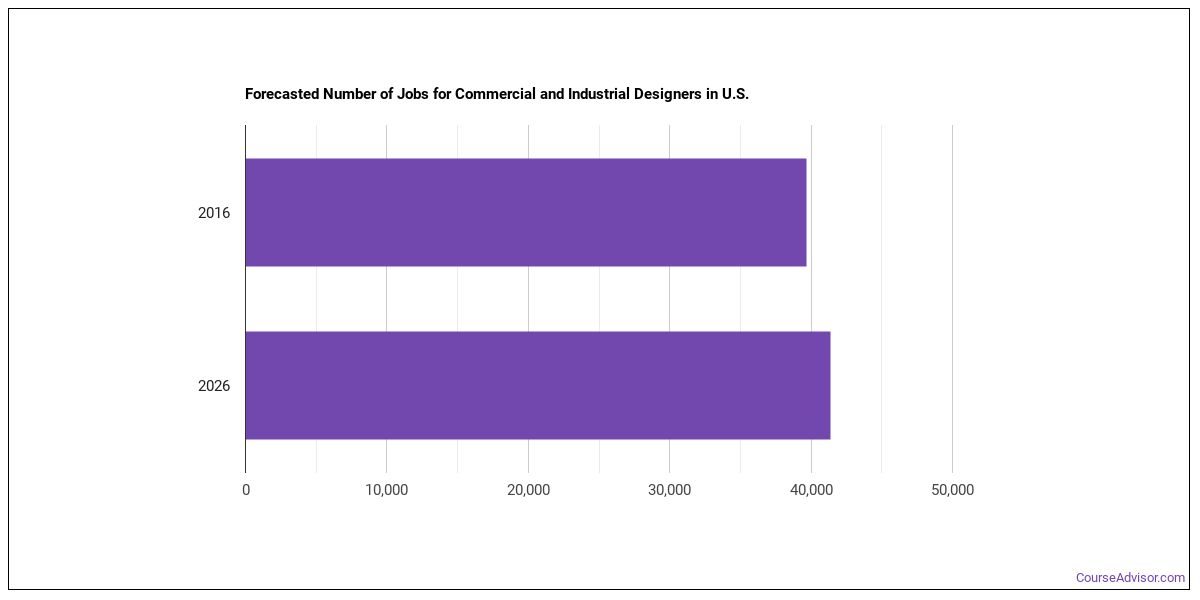
The U.S. employs around 344,427 commercial and industrial designers working in the United States today. This occupation is expected to grow by +12.4% over the projection horizon.
Commercial and Industrial Designers Pay
| Statistic | Value |
|---|---|
| Annual median | $56,384 |
| Hourly median | $27.11 |
| 10th percentile | $34,120 |
| 25th percentile | $45,252 |
| 75th percentile | $67,516 |
| 90th percentile | $78,648 |
Pay can vary substantially based on experience, location, and industry.

How Much Do Commercial and Industrial Designers Make in Different U.S. States?
| State | Annual median salary |
|---|---|
| Washington | $106,720 |
| Kansas | $100,010 |
| Massachusetts | $99,310 |
| Indiana | $93,860 |
| Rhode Island | $93,340 |
| California | $93,300 |
| Nevada | $87,800 |
| Michigan | $85,460 |
| New York | $85,240 |
| South Carolina | $83,610 |
| Georgia | $81,940 |
| New Jersey | $81,330 |
| Arizona | $80,860 |
| Arkansas | $80,340 |
| Montana | $79,360 |
| Connecticut | $79,060 |
| Louisiana | $79,060 |
| Virginia | $78,190 |
| Minnesota | $78,010 |
| Missouri | $77,790 |
| Texas | $77,540 |
| New Hampshire | $77,240 |
| Wisconsin | $76,160 |
| Nebraska | $76,060 |
| Pennsylvania | $75,960 |
| Oklahoma | $75,940 |
| Oregon | $75,340 |
| Maryland | $75,240 |
| North Carolina | $74,330 |
| Alabama | $74,090 |
| Ohio | $71,370 |
| Kentucky | $70,470 |
| Iowa | $69,210 |
| Idaho | $67,530 |
| Vermont | $67,040 |
| Florida | $66,210 |
| Utah | $66,040 |
| Illinois | $65,290 |
| Tennessee | $59,990 |
| New Mexico | $59,020 |
| South Dakota | $53,020 |
| North Dakota | $51,310 |
Where Commercial and Industrial Designers Earn the Most
Earnings for commercial and industrial designers differ across the country. These regions lead on median pay:
| Region | Median annual wage | Share of U.S. jobs | Location quotient |
|---|---|---|---|
| Far Western US | $93,117 | 18.6% | 1.18 |
| New England | $92,567 | 5.6% | 1.40 |
| Great Lakes | $81,085 | 16.2% | 1.99 |
| Middle Atlantic | $80,977 | 15.4% | 1.05 |
| Southwest | $77,733 | 7.6% | 0.64 |
| Plains States | $76,066 | 7.1% | 1.14 |
| Southeast | $67,679 | 25.8% | 1.27 |
| Rocky Mountains | $46,172 | 3.7% | 1.08 |
Top Metro Areas
| Metro area | State | Median annual wage | Employment |
|---|---|---|---|
| Santa Cruz-Watsonville, CA | CA | $132,230 | 50 |
| Kiryas Joel-Poughkeepsie-Newburgh, NY | NY | $116,070 | 70 |
| Baton Rouge, LA | LA | $114,850 | |
| Seattle-Tacoma-Bellevue, WA | WA | $114,200 | 400 |
| San Jose-Sunnyvale-Santa Clara, CA | CA | $107,780 | 330 |
| Boston-Cambridge-Newton, MA-NH | MA | $104,470 | 830 |
| Detroit-Warren-Dearborn, MI | MI | $101,090 | 1,600 |
| Fort Wayne, IN | IN | $99,110 | 50 |
Which Industries Hire Commercial and Industrial Designers
Most commercial and industrial designers are concentrated in the following sectors:
| Industry | Employment | Median annual wage |
|---|---|---|
| Manufacturing | 10,250 | $76,240 |
| Professional, Scientific, and Technical Services | 7,130 | $89,920 |
| Wholesale Trade | 4,610 | $82,300 |
| Management of Companies and Enterprises | 3,220 | $98,240 |
| Retail Trade | 1,510 | $67,980 |
| Construction | 1,290 | $72,640 |
| Administrative and Support and Waste Management and Remediation Services | 1,090 | $79,490 |
| Information | 230 | $108,530 |
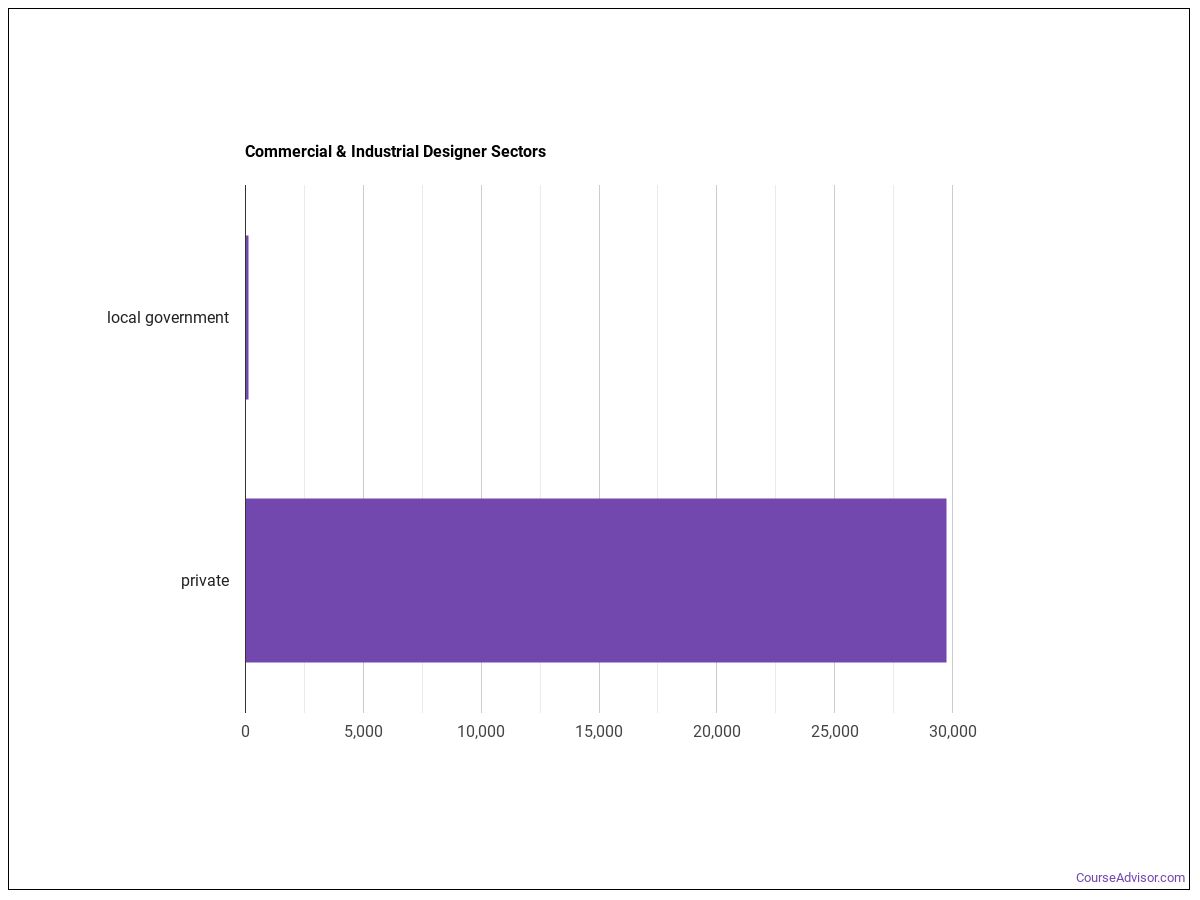
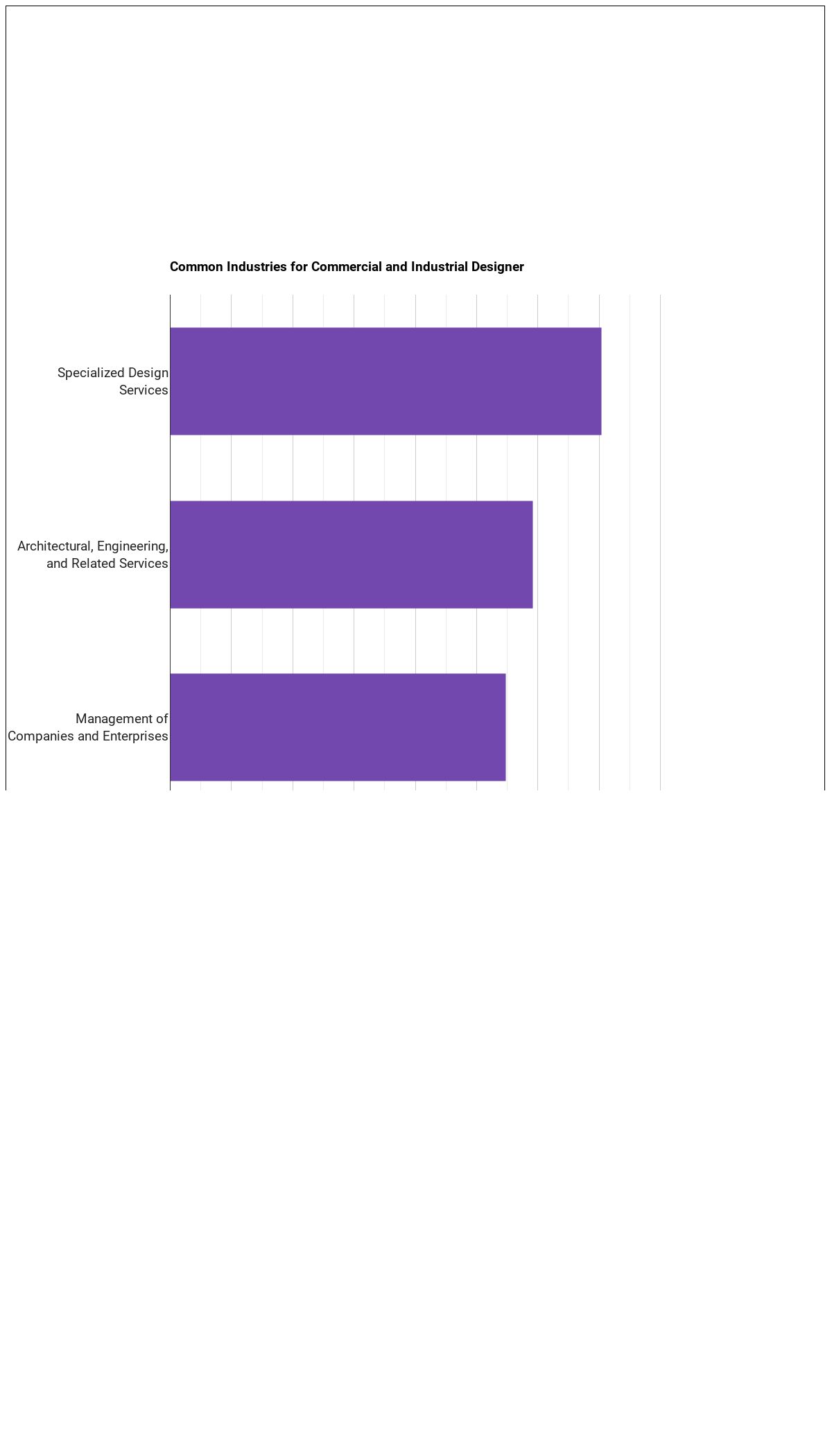
Below are examples of industries where commercial and industrial designers work:
Software Commercial and Industrial Designers Use
- Document management software: Adobe Acrobat (hot technology)
- Video creation and editing software: Adobe After Effects (hot technology)
- Graphics or photo imaging software: Adobe Creative Cloud software (hot technology)
- Graphics or photo imaging software: Adobe Illustrator (hot technology)
- Desktop publishing software: Adobe InDesign (hot technology)
- Graphics or photo imaging software: Adobe Photoshop (hot technology)
- Development environment software: Apache Maven (hot technology)
- Operating system software: Apple iOS (hot technology)
- Computer aided design CAD software: Autodesk AutoCAD (hot technology)
- Computer aided design CAD software: Autodesk Revit (hot technology)
- Development environment software: C (hot technology)
- Object or component oriented development software: C# (hot technology)
The Day-to-Day Environment
The work environment for commercial and industrial designers tends to involve the following characteristics:
- Face-to-Face Discussions with Individuals and Within Teams
- Indoors, Environmentally Controlled
- Work With or Contribute to a Work Group or Team
- Telephone Conversations
Getting Started in This Career
Typical commercial and industrial designers positions require a bachelor’s degree as the typical entry-level education. This career aligns with Considerable Preparation Needed (Job Zone 4), signaling the level of preparation typically expected.
Other Careers to Consider
Similar Occupations
- Industrial Engineers (Primary-Long)
- Manufacturing Engineers (Primary-Long)
- Materials Engineers (Primary-Long)
- Mechanical Engineers (Supplemental)
- Electrical and Electronics Drafters (Supplemental)
- Mechanical Drafters (Primary-Short)
- Electrical and Electronic Engineering Technologists and Technicians (Supplemental)
- Industrial Engineering Technologists and Technicians (Supplemental)
Degree Programs
Aspiring commercial and industrial designers often complete programs in:
Visual and Performing Arts
3 programs across 1 majors
Engineering Technologies and Engineering-Related Fields
2 programs across 2 majors
Sources
Data on this page comes from the following authoritative sources:
- U.S. Bureau of Labor Statistics — Occupational Employment and Wage Statistics (OEWS) for employment and wage data by state and industry.
- BLS Employment Projections for total employment and growth forecasts.
- O*NET (Occupational Information Network) for skills, knowledge, tasks, work activities, work context, technology, and education-zone data.
SOC code: 27-1021.00 (Commercial and Industrial Designers).

Course Advisor provides higher-education, college and university, degree, program, career, salary, and other helpful information to students, faculty, institutions, and other internet audiences. Presented information and data are subject to change. Inclusion on this website does not imply or represent a direct relationship with the company, school, or brand. Information, though believed correct at time of publication, may not be correct, and no warranty is provided. Contact the schools to verify any information before relying on it. Financial aid may be available for those who qualify. The displayed options may include sponsored or recommended results, not necessarily based on your preferences.
© Course Advisor – All Rights Reserved.