Choreographers: Career Overview
Create new dance routines. Rehearse performance of routines. May direct and stage presentations.
Featured schools near , edit
The Daily Work of Choreographers Perform?
The core tasks performed by choreographers include:
- Direct rehearsals to instruct dancers in dance steps and in techniques to achieve desired effects.
- Advise dancers on standing and moving properly, teaching correct dance techniques to help prevent injuries.
- Teach students, dancers, and other performers about rhythm and interpretive movement.
- Record dance movements and their technical aspects, using a technical understanding of the patterns and formations of choreography.
- Direct and stage dance presentations for various forms of entertainment.
- Choose the music, sound effects, or spoken narrative to accompany a dance.
- Experiment with different types of dancers, steps, dances, and placements, testing ideas informally to get feedback from dancers.
- Seek influences from other art forms, such as theatre, the visual arts, and architecture.
Key Skills and Knowledge
Effective choreographers draw on a mix of skills and domain knowledge.
Most Important Skills
These are the skills most central to this role, rated on an importance scale of 0 to 5:
Core Knowledge
Related Job Titles
People in this occupation may also be known by titles such as:
- Ballet Director
- Choreographer
- Choreography Director
- Dance Choreographer
- Dance Director
- Dance Instructor
- Dance Maker
- Dance Master
How Many Choreographers Are There?
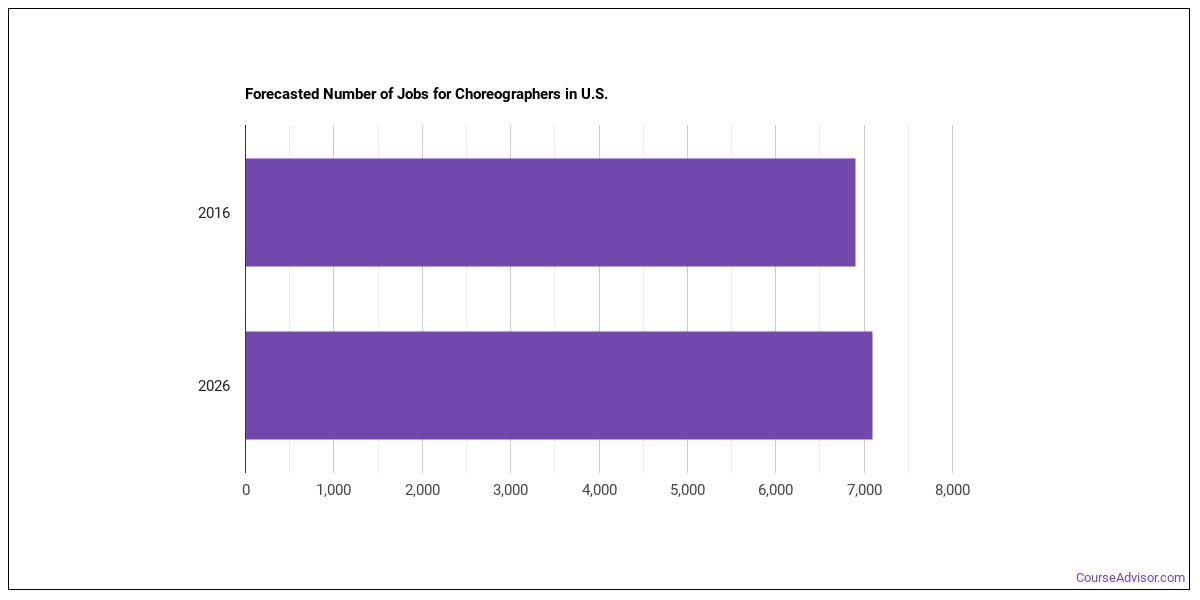
There are about 318,556 choreographers working in the United States today. Employment is projected to grow by +14.8% over the projection horizon.
How Much Do Choreographers Make?
| Statistic | Value |
|---|---|
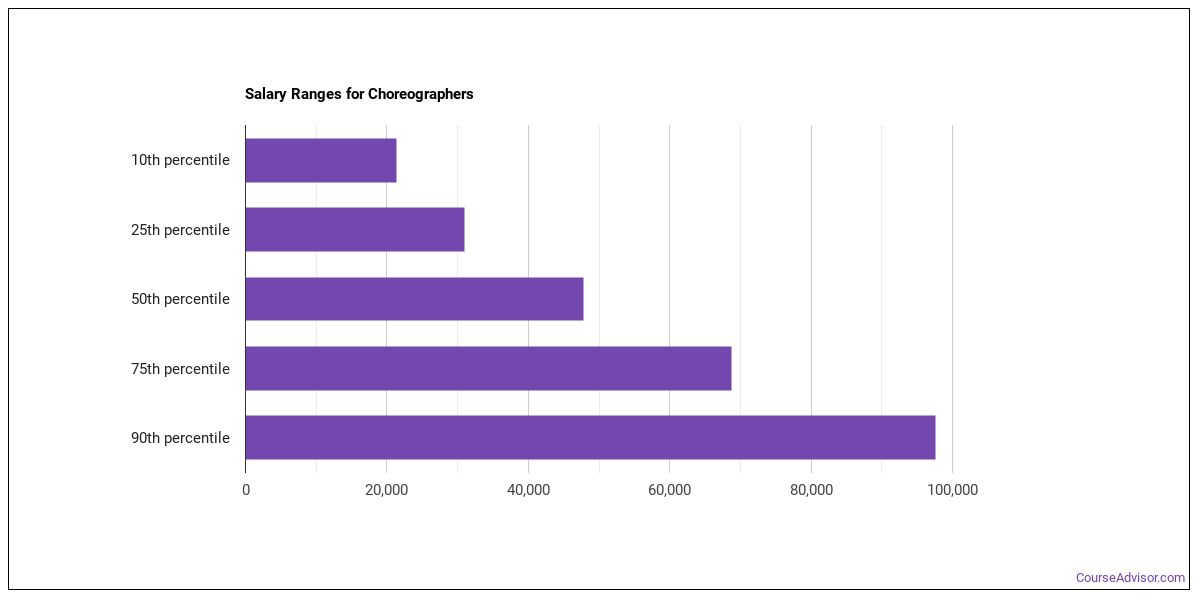
| Annual median | $109,380 |
| Hourly median | $52.59 |
| 10th percentile | $61,873 |
| 25th percentile | $85,627 |
| 75th percentile | $133,134 |
| 90th percentile | $156,887 |
Compensation varies based on experience, location, and industry.
How Much Do Choreographers Make in Different U.S. States?
| State | Annual median salary |
|---|---|
| New York | $94,090 |
| North Carolina | $79,630 |
| Maryland | $64,770 |
| Ohio | $62,970 |
| Tennessee | $62,500 |
| California | $61,320 |
| Louisiana | $44,880 |
| Virginia | $44,740 |
| Texas | $44,660 |
| South Carolina | $42,580 |
| South Dakota | $38,230 |
| Utah | $37,710 |
| Alabama | $37,580 |
| Florida | $35,270 |
| Kansas | $33,790 |
| Illinois | $31,570 |
Pay by U.S. Region
Compensation for choreographers vary by region. These regions lead on median pay:
| Region | Median annual wage | Share of U.S. jobs | Location quotient |
|---|---|---|---|
| Middle Atlantic | $76,101 | 16.9% | 1.63 |
| Great Lakes | $62,970 | 5.0% | 1.16 |
| Far Western US | $61,320 | 28.8% | 1.98 |
| Southwest | $44,660 | 17.6% | 1.59 |
| Southeast | $44,487 | 17.3% | 2.77 |
| Rocky Mountains | $37,710 | 5.8% | 4.29 |
| Plains States | $37,675 | 8.6% | 18.18 |
Where the Jobs Cluster
| Metro area | State | Median annual wage | Employment |
|---|---|---|---|
| New York-Newark-Jersey City, NY-NJ | NY | $94,090 | 270 |
| Washington-Arlington-Alexandria, DC-VA-MD-WV | DC | $72,160 | 60 |
| Baltimore-Columbia-Towson, MD | MD | $65,180 | 90 |
| San Francisco-Oakland-Fremont, CA | CA | $64,910 | 190 |
| Boston-Cambridge-Newton, MA-NH | MA | $63,640 | 30 |
| San Jose-Sunnyvale-Santa Clara, CA | CA | $62,300 | 70 |
| Los Angeles-Long Beach-Anaheim, CA | CA | $61,090 | 240 |
| Salt Lake City-Murray, UT | UT | $60,870 | 60 |
Industry Breakdown
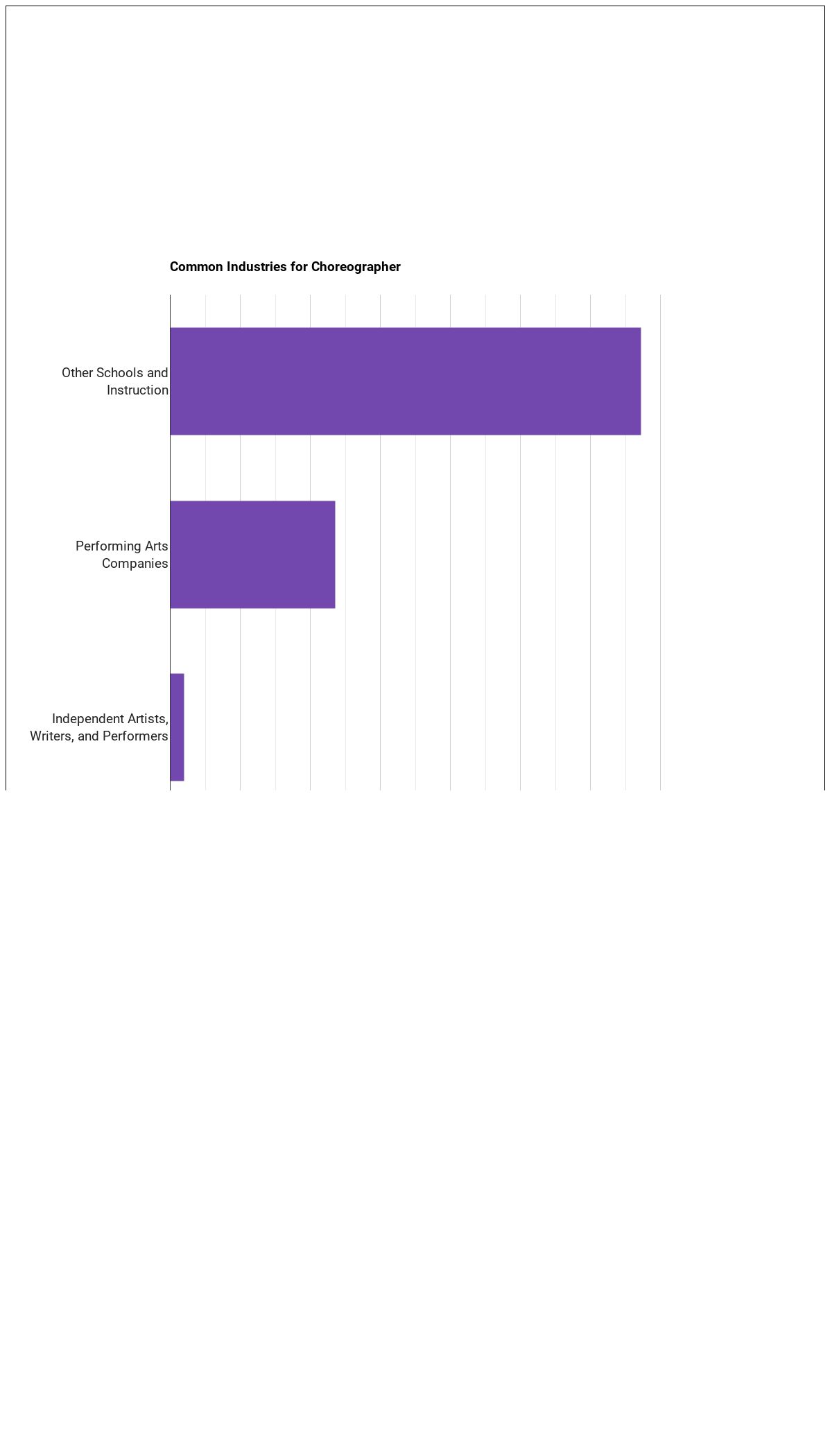
The bulk of choreographers are concentrated in the following sectors:
| Industry | Employment | Median annual wage |
|---|---|---|
| Educational Services | 1,860 | $50,970 |
| Arts, Entertainment, and Recreation | 1,440 | $61,680 |

The table below shows some of the most common industries where those employed in this career field work.
Tech Stack
- Web page creation and editing software: Facebook (hot technology)
- Spreadsheet software: Microsoft Excel (hot technology)
- Office suite software: Microsoft Office software (hot technology)
- Presentation software: Microsoft PowerPoint (hot technology)
- Word processing software: Microsoft Word (hot technology)
- Customer relationship management CRM software: Salesforce software (hot technology)
The Day-to-Day Environment
The work environment for choreographers reflects the following characteristics:
- Physical Proximity
- Face-to-Face Discussions with Individuals and Within Teams
- Contact With Others
- Spend Time Bending or Twisting Your Body
How to Become Choreographers
Most choreographers positions require a high school diploma or equivalent as the typical entry-level education. This career aligns with Medium Preparation Needed (Job Zone 3), indicating the level of preparation typically expected.
Similar Occupations
Similar Occupations
- Art, Drama, and Music Teachers, Postsecondary (Primary-Short)
- Self-Enrichment Teachers (Primary-Long)
- Instructional Coordinators (Supplemental)
- Art Directors (Primary-Long)
- Fine Artists, Including Painters, Sculptors, and Illustrators (Supplemental)
- Special Effects Artists and Animators (Supplemental)
- Graphic Designers (Supplemental)
- Set and Exhibit Designers (Supplemental)
Where to Study
Students preparing for choreographers commonly pursue programs in:
Visual and Performing Arts
5 programs across 2 majors
References
This profile draws on the following authoritative sources:
- U.S. Bureau of Labor Statistics — Occupational Employment and Wage Statistics (OEWS) for employment and wage data by state and industry.
- BLS Employment Projections for total employment and growth forecasts.
- O*NET (Occupational Information Network) for skills, knowledge, tasks, work activities, work context, technology, and education-zone data.
SOC code: 27-2032.00 (Choreographers).

Course Advisor provides higher-education, college and university, degree, program, career, salary, and other helpful information to students, faculty, institutions, and other internet audiences. Presented information and data are subject to change. Inclusion on this website does not imply or represent a direct relationship with the company, school, or brand. Information, though believed correct at time of publication, may not be correct, and no warranty is provided. Contact the schools to verify any information before relying on it. Financial aid may be available for those who qualify. The displayed options may include sponsored or recommended results, not necessarily based on your preferences.
© Course Advisor – All Rights Reserved.