Business Continuity Planners: Career Overview
Develop, maintain, or implement business continuity and disaster recovery strategies and solutions, including risk assessments, business impact analyses, strategy selection, and documentation of business continuity and disaster recovery procedures. Plan, conduct, and debrief regular mock-disaster exercises to test the adequacy of existing plans and strategies, updating procedures and plans regularly. Act as a coordinator for continuity efforts after a disruption event.
Featured schools near , edit
What Do Business Continuity Planners Do?
The core tasks performed by business continuity planners cover:
- Develop emergency management plans for recovery decision making and communications, continuity of critical departmental processes, or temporary shut-down of non-critical departments to ensure continuity of operation and governance.
- Test documented disaster recovery strategies and plans.
- Develop disaster recovery plans for physical locations with critical assets, such as data centers.
- Establish, maintain, or test call trees to ensure appropriate communication during disaster.
- Identify opportunities for strategic improvement or mitigation of business interruption and other risks caused by business, regulatory, or industry-specific change initiatives.
- Maintain and update organization information technology applications and network systems blueprints.
- Review existing disaster recovery, crisis management, or business continuity plans.
- Analyze impact on, and risk to, essential business functions or information systems to identify acceptable recovery time periods and resource requirements.
Skills and Knowledge
Top business continuity planners combine a mix of skills and domain knowledge.
Most Important Skills
These are the skills most central to this role, rated on an importance scale of 0 to 5:
Core Knowledge
Types of Business Continuity Planners Jobs
People in this occupation may also be known by titles such as:
- Business Change Advisor
- Business Consultant
- Business Continuity Administrator (Business Continuity Admin)
- Business Continuity Analyst
- Business Continuity And Disaster Recovery Specialist
- Business Continuity Consultant
- Business Continuity Coordinator
- Business Continuity Planner
Job Outlook
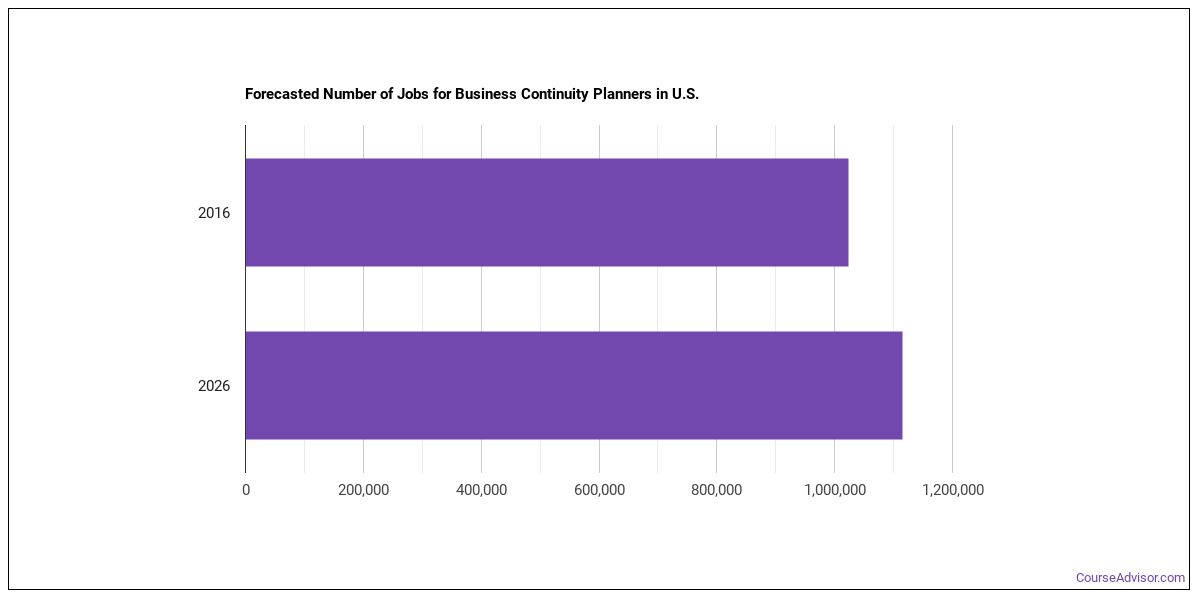
There are roughly 603,306 business continuity planners working in the United States today. Employment is projected to grow by +12.4% over the projection horizon.
Business Continuity Planners Pay
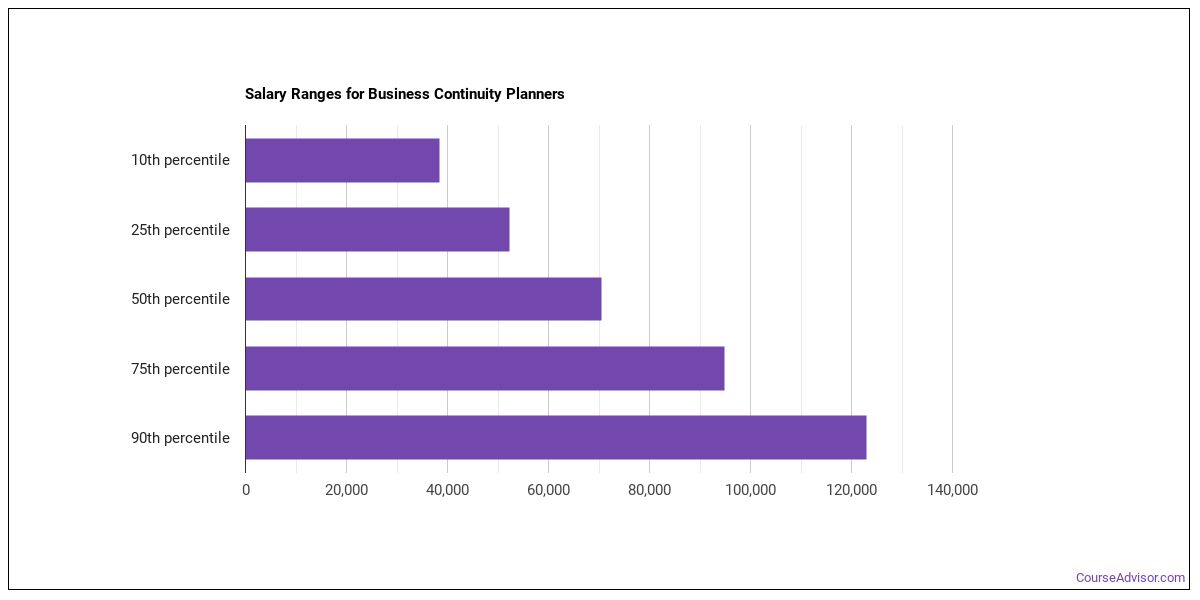
| Statistic | Value |
|---|---|
| Annual median | $53,239 |
| Hourly median | $25.60 |
| 10th percentile | $34,733 |
| 25th percentile | $43,986 |
| 75th percentile | $62,491 |
| 90th percentile | $71,744 |
Wages vary widely based on experience, location, and industry.
How Much Do Business Continuity Planners Make in Different U.S. States?
| State | Annual median salary |
|---|---|
| District of Columbia | $106,810 |
| Maryland | $100,740 |
| Alabama | $98,070 |
| Washington | $93,450 |
| Hawaii | $90,580 |
| Alaska | $90,150 |
| Colorado | $89,860 |
| Oklahoma | $89,170 |
| New Hampshire | $88,860 |
| New Jersey | $88,070 |
| Rhode Island | $86,880 |
| Massachusetts | $86,030 |
| Virginia | $85,800 |
| Arizona | $85,390 |
| New York | $84,310 |
| Connecticut | $84,170 |
| California | $83,820 |
| South Dakota | $82,900 |
| Guam | $82,220 |
| Pennsylvania | $81,340 |
| Kansas | $81,100 |
| Missouri | $81,060 |
| North Dakota | $80,200 |
| Utah | $79,790 |
| Texas | $79,540 |
| South Carolina | $79,190 |
| Iowa | $78,970 |
| Nebraska | $78,590 |
| Illinois | $77,980 |
| Florida | $77,930 |
| Michigan | $77,920 |
| Ohio | $77,710 |
| Minnesota | $77,340 |
| North Carolina | $77,090 |
| New Mexico | $76,490 |
| Georgia | $75,820 |
| Indiana | $75,800 |
| Kentucky | $75,800 |
| Mississippi | $74,990 |
| Idaho | $74,960 |
| Maine | $74,510 |
| Wyoming | $74,470 |
| Montana | $72,690 |
| Tennessee | $72,550 |
| Oregon | $72,370 |
| Vermont | $67,160 |
| Wisconsin | $66,600 |
| Nevada | $63,970 |
| Virgin Islands | $62,510 |
| Louisiana | $62,300 |
| West Virginia | $62,210 |
| Arkansas | $60,610 |
| Puerto Rico | $45,510 |
Top-Paying U.S. Regions
Compensation for business continuity planners shift depending on where you work. These regions lead on median pay:
| Region | Median annual wage | Share of U.S. jobs | Location quotient |
|---|---|---|---|
| Middle Atlantic | $92,280 | 15.3% | 2.46 |
| Rocky Mountains | $86,084 | 5.7% | 1.80 |
| Far Western US | $84,231 | 22.0% | 1.36 |
| New England | $83,073 | 3.1% | 0.73 |
| Southwest | $80,519 | 10.7% | 0.89 |
| Plains States | $79,575 | 5.3% | 0.83 |
| Southeast | $77,005 | 26.6% | 1.35 |
| Great Lakes | $76,365 | 10.4% | 0.79 |
Highest-Paying Metro Areas for Business Continuity Planners
| Metro area | State | Median annual wage | Employment |
|---|---|---|---|
| Lexington Park, MD | MD | $131,610 | 2,210 |
| Huntsville, AL | AL | $120,910 | 3,130 |
| San Jose-Sunnyvale-Santa Clara, CA | CA | $106,680 | 13,710 |
| Washington-Arlington-Alexandria, DC-VA-MD-WV | DC | $104,000 | 77,770 |
| Gettysburg, PA | PA | $102,500 | 110 |
| Decatur, IL | IL | $101,950 | 400 |
| Seattle-Tacoma-Bellevue, WA | WA | $101,420 | 34,600 |
| Bremerton-Silverdale-Port Orchard, WA | WA | $100,610 | 2,310 |
Industry Breakdown
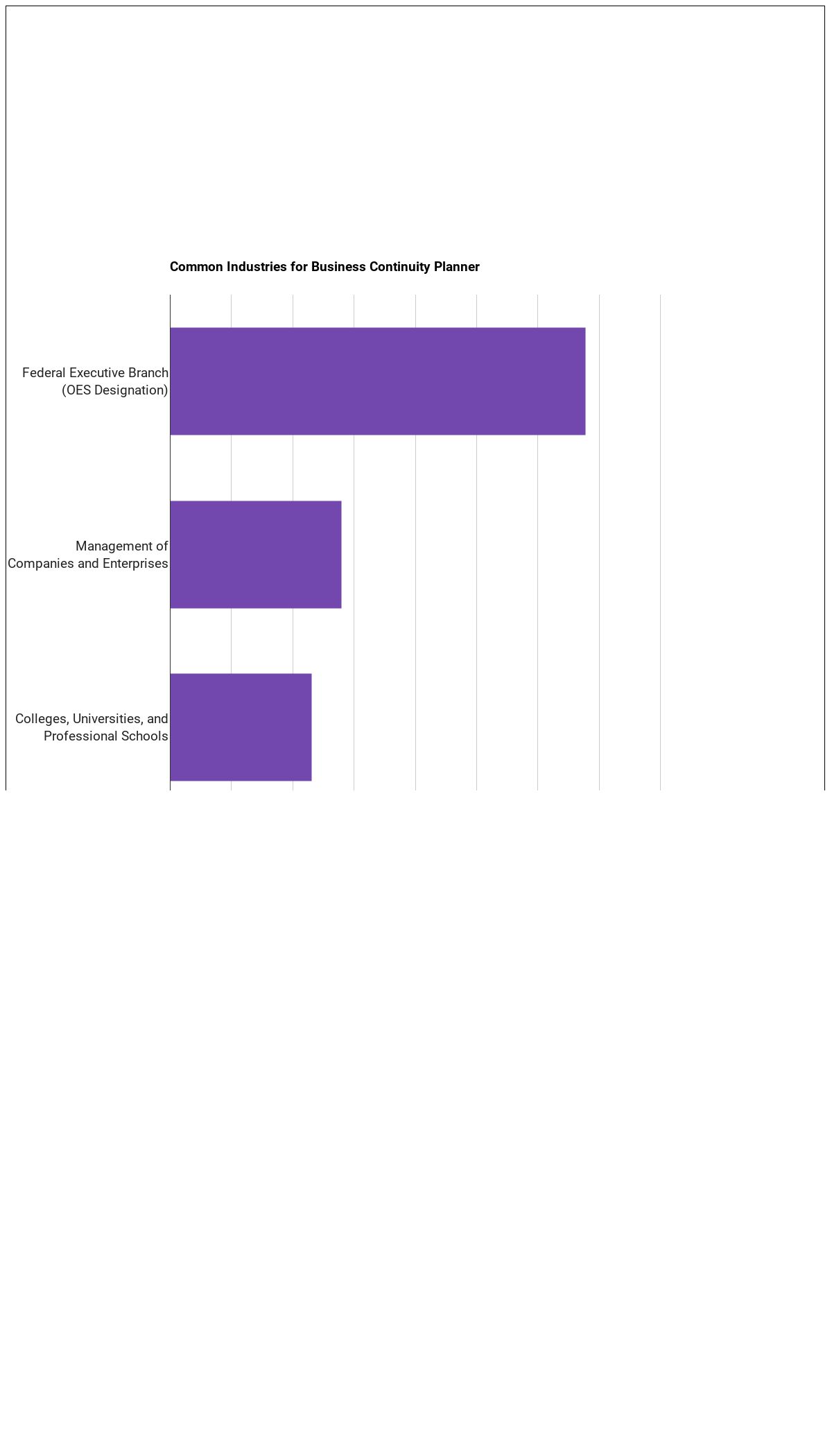
The bulk of business continuity planners are found across these industries:
| Industry | Employment | Median annual wage |
|---|---|---|
| Professional, Scientific, and Technical Services | 155,730 | $85,150 |
| Educational Services | 100,750 | $66,200 |
| Finance and Insurance | 76,760 | $83,480 |
| Health Care and Social Assistance | 71,430 | $68,010 |
| Manufacturing | 70,690 | $101,460 |
| Management of Companies and Enterprises | 67,210 | $85,920 |
| Administrative and Support and Waste Management and Remediation Services | 62,030 | $66,550 |
| Other Services (except Public Administration) | 46,900 | $66,050 |
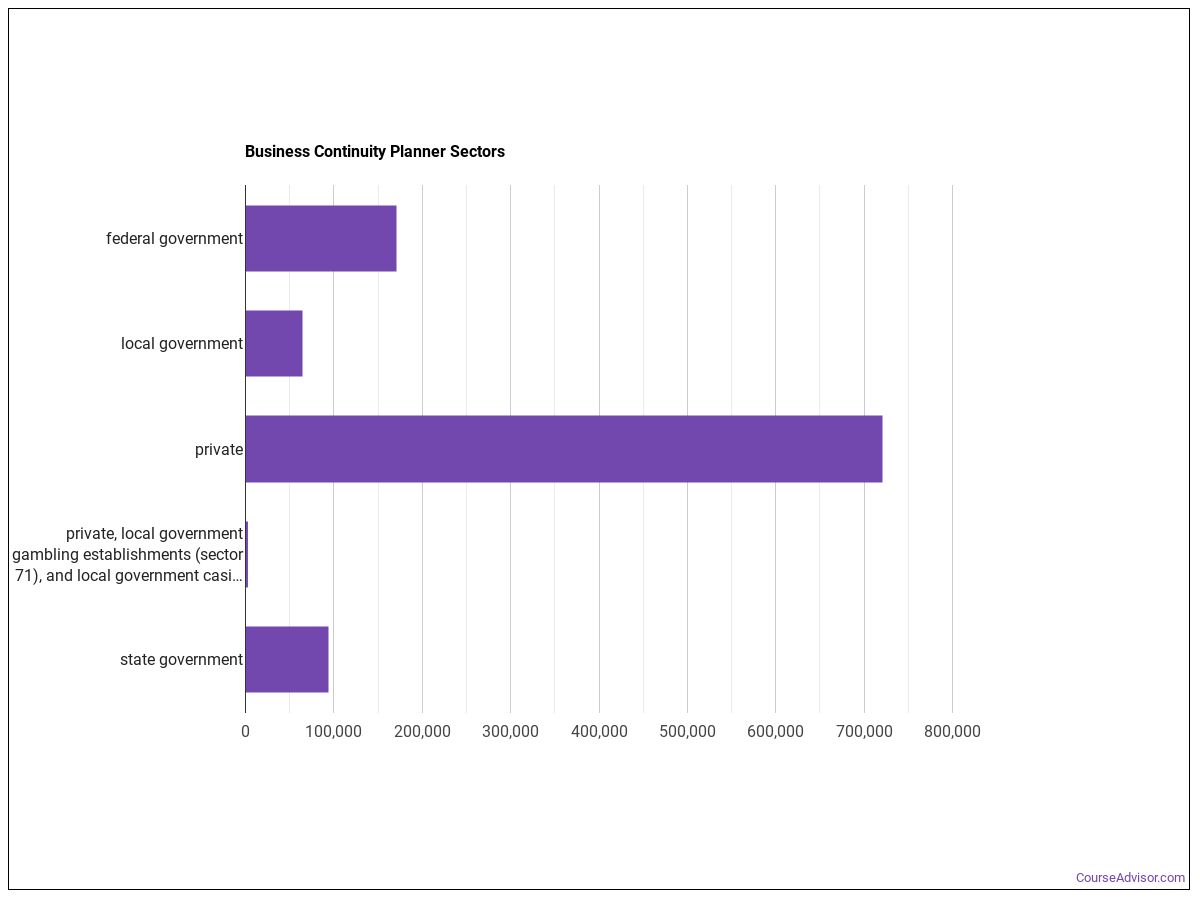
Business Continuity Planners work in the following industries:
Software Business Continuity Planners Use
- Document management software: Adobe Acrobat (hot technology)
- Project management software: Atlassian Confluence (hot technology)
- Content workflow software: Atlassian JIRA (hot technology)
- Data base user interface and query software: Microsoft Access (hot technology)
- Spreadsheet software: Microsoft Excel (hot technology)
- Office suite software: Microsoft Office software (hot technology)
- Electronic mail software: Microsoft Outlook (hot technology)
- Presentation software: Microsoft PowerPoint (hot technology)
- Project management software: Microsoft Project (hot technology)
- Document management software: Microsoft SharePoint (hot technology)
- Data base user interface and query software: Microsoft SQL Server (hot technology)
- Process mapping and design software: Microsoft Visio (hot technology)
Work Environment
The work environment for business continuity planners reflects the following characteristics:
- Telephone Conversations
- Spend Time Sitting
- Work With or Contribute to a Work Group or Team
- Contact With Others
How to Become Business Continuity Planners
Most business continuity planners positions require a bachelor’s degree as the typical entry-level education. The role falls in Considerable Preparation Needed (Job Zone 4), reflecting the level of preparation typically expected.
Other Careers to Consider
Similar Occupations
- Security Managers (Primary-Long)
- Computer and Information Systems Managers (Supplemental)
- Emergency Management Directors (Primary-Short)
- Compliance Managers (Primary-Short)
- Logisticians (Supplemental)
- Logistics Analysts (Supplemental)
- Project Management Specialists (Primary-Short)
- Management Analysts (Supplemental)
Where to Study
Students preparing for business continuity planners typically earn programs in:
Business, Management, Marketing, and Related Support Services
5 programs across 4 majors
- Business Administration & Management
- International Business
- Hospitality Management
- Business Support & Assistance
About the Data
Data on this page comes from the following authoritative sources:
- U.S. Bureau of Labor Statistics — Occupational Employment and Wage Statistics (OEWS) for employment and wage data by state and industry.
- BLS Employment Projections for total employment and growth forecasts.
- O*NET (Occupational Information Network) for skills, knowledge, tasks, work activities, work context, technology, and education-zone data.
SOC code: 13-1199.04 (Business Operations Specialists, All Other).

Course Advisor provides higher-education, college and university, degree, program, career, salary, and other helpful information to students, faculty, institutions, and other internet audiences. Presented information and data are subject to change. Inclusion on this website does not imply or represent a direct relationship with the company, school, or brand. Information, though believed correct at time of publication, may not be correct, and no warranty is provided. Contact the schools to verify any information before relying on it. Financial aid may be available for those who qualify. The displayed options may include sponsored or recommended results, not necessarily based on your preferences.
© Course Advisor – All Rights Reserved.