Biological Technicians: Career Overview
Assist biological and medical scientists. Set up, operate, and maintain laboratory instruments and equipment, monitor experiments, collect data and samples, make observations, and calculate and record results. May analyze organic substances, such as blood, food, and drugs.
Featured schools near , edit
The Daily Work of Biological Technicians Do?
The core tasks performed by biological technicians include:
- Conduct research, or assist in the conduct of research, including the collection of information and samples, such as blood, water, soil, plants and animals.
- Use computers, computer-interfaced equipment, robotics or high-technology industrial applications to perform work duties.
- Monitor and observe experiments, recording production and test data for evaluation by research personnel.
- Analyze experimental data and interpret results to write reports and summaries of findings.
- Provide technical support and services for scientists and engineers working in fields such as agriculture, environmental science, resource management, biology, and health sciences.
- Keep detailed logs of all work-related activities.
- Input data into databases.
- Isolate, identify and prepare specimens for examination.
Key Skills and Knowledge
Successful biological technicians draw on a mix of skills and domain knowledge.
Key Skills
The competencies that matter most in this role, rated on an importance scale of 0 to 5:
Top Knowledge Areas
Other Biological Technicians Job Titles
This career also goes by job titles like:
- Aquatic Technician (Aquatic Tech)
- Aquatics Technician
- Artificial Breeding Laboratory Technician (Artificial Breeding Lab Tech)
- Artificial Breeding Technician
- Artificial Inseminator
- Babcock Tester
- Bacteriology Research Assistant
- Bacteriology Technician
How Many Biological Technicians Are There?
The U.S. employs around 198,553 biological technicians working in the United States today. Demand is forecast to grow by +12.8% over the projection horizon.

Biological Technicians Pay
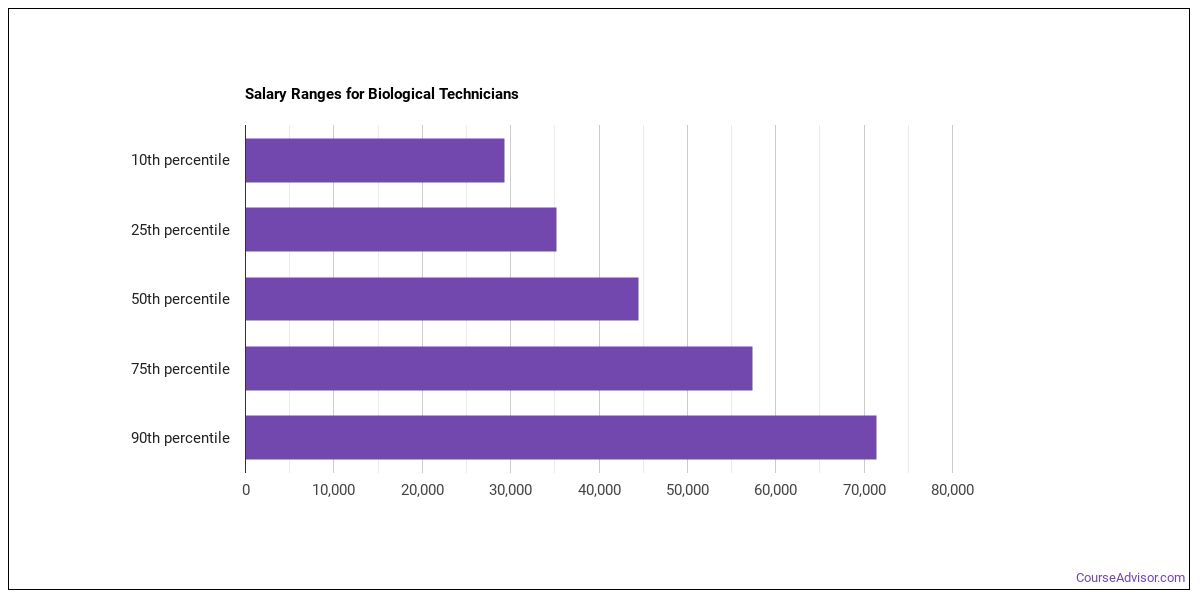
| Statistic | Value |
|---|---|
| Annual median | $100,160 |
| Hourly median | $48.15 |
| 10th percentile | $58,118 |
| 25th percentile | $79,139 |
| 75th percentile | $121,181 |
| 90th percentile | $142,202 |
Pay can vary substantially based on experience, location, and industry.
Biological Technicians Salary by State
| State | Annual median salary |
|---|---|
| Massachusetts | $65,020 |
| Connecticut | $64,860 |
| California | $64,020 |
| New Jersey | $63,430 |
| New York | $58,750 |
| Tennessee | $58,520 |
| District of Columbia | $55,910 |
| Delaware | $55,740 |
| Colorado | $54,600 |
| Alaska | $53,830 |
| Louisiana | $53,620 |
| Washington | $52,680 |
| New Hampshire | $51,960 |
| Arizona | $51,850 |
| Iowa | $51,300 |
| Utah | $50,690 |
| Mississippi | $50,650 |
| Indiana | $50,070 |
| Georgia | $49,970 |
| Ohio | $49,910 |
| Illinois | $49,710 |
| Wisconsin | $49,570 |
| Maine | $49,280 |
| Virginia | $49,250 |
| Maryland | $49,110 |
| Texas | $48,830 |
| Nevada | $48,650 |
| North Dakota | $48,550 |
| Vermont | $48,420 |
| Kansas | $48,400 |
| Michigan | $47,900 |
| Pennsylvania | $47,820 |
| Oregon | $47,690 |
| Missouri | $47,360 |
| Nebraska | $47,210 |
| South Carolina | $47,190 |
| West Virginia | $47,130 |
| Montana | $47,090 |
| Arkansas | $47,050 |
| Florida | $46,840 |
| Oklahoma | $46,440 |
| North Carolina | $46,050 |
| Alabama | $45,880 |
| Minnesota | $45,430 |
| Hawaii | $45,000 |
| Puerto Rico | $44,570 |
| Wyoming | $44,490 |
| Rhode Island | $43,390 |
| Kentucky | $42,890 |
| Guam | $42,740 |
| Idaho | $39,560 |
| South Dakota | $39,560 |
Pay by U.S. Region
Compensation for biological technicians shift depending on where you work. Top regions by median wage:
| Region | Median annual wage | Share of U.S. jobs | Location quotient |
|---|---|---|---|
| New England | $63,450 | 13.5% | 4.16 |
| Far Western US | $57,947 | 24.8% | 1.79 |
| Middle Atlantic | $54,126 | 18.2% | 1.49 |
| Rocky Mountains | $50,582 | 5.3% | 1.40 |
| Great Lakes | $49,434 | 9.7% | 0.81 |
| Southwest | $49,208 | 6.2% | 0.52 |
| Southeast | $48,733 | 15.1% | 0.72 |
| Plains States | $46,977 | 6.1% | 1.02 |
Where the Jobs Cluster
| Metro area | State | Median annual wage | Employment |
|---|---|---|---|
| San Francisco-Oakland-Fremont, CA | CA | $79,270 | 3,510 |
| Trenton-Princeton, NJ | NJ | $74,310 | 250 |
| San Jose-Sunnyvale-Santa Clara, CA | CA | $71,920 | 720 |
| Albany-Schenectady-Troy, NY | NY | $68,890 | 840 |
| Worcester, MA | MA | $65,960 | 660 |
| Boston-Cambridge-Newton, MA-NH | MA | $64,380 | 7,680 |
| Barnstable Town, MA | MA | $64,260 | 110 |
| Los Angeles-Long Beach-Anaheim, CA | CA | $63,270 | 1,740 |
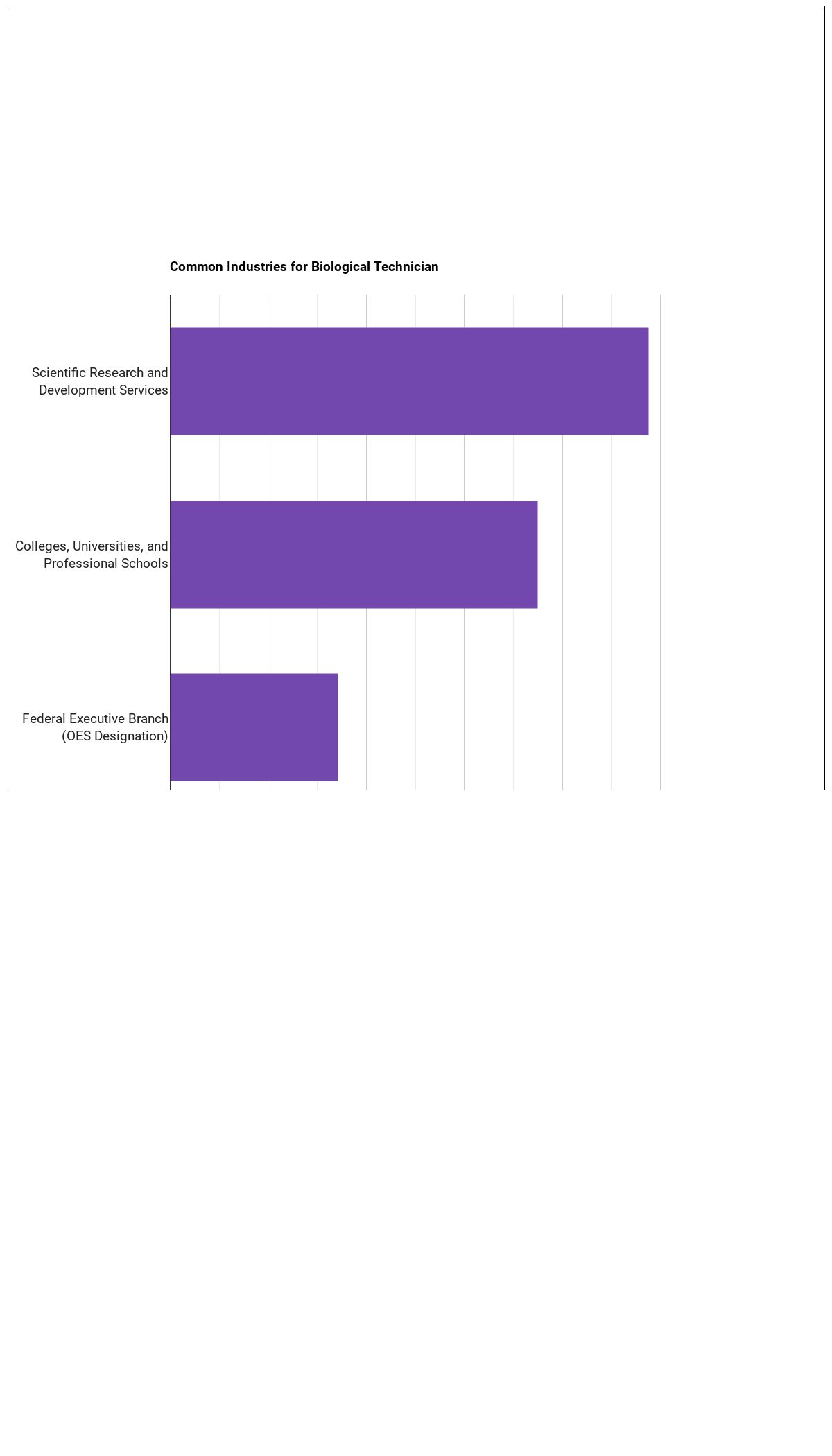
Which Industries Hire Biological Technicians
Most biological technicians work in these industries:
| Industry | Employment | Median annual wage |
|---|---|---|
| Professional, Scientific, and Technical Services | 31,340 | $59,520 |
| Educational Services | 14,790 | $49,950 |
| Health Care and Social Assistance | 8,990 | $48,490 |
| Manufacturing | 6,820 | $59,660 |
| Retail Trade | 600 | $38,860 |
| Management of Companies and Enterprises | 440 | $61,830 |
| Other Services (except Public Administration) | 200 | $48,640 |
| Arts, Entertainment, and Recreation | 160 | $48,980 |
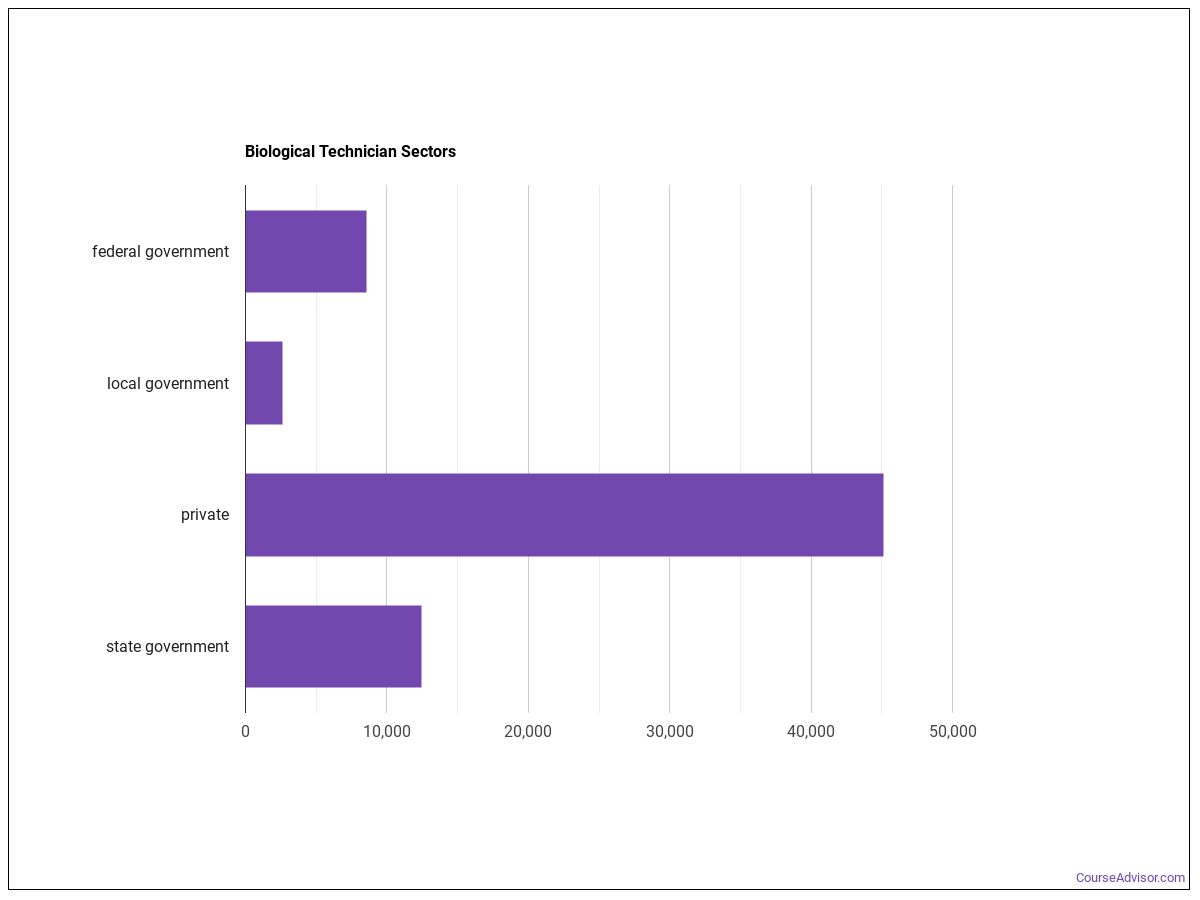
Biological Technicians work in the following industries:
Software Biological Technicians Use
- Document management software: Adobe Acrobat (hot technology)
- Graphics or photo imaging software: Adobe Photoshop (hot technology)
- Geographic information system: ESRI ArcGIS software (hot technology)
- Development environment software: Microsoft .NET Framework (hot technology)
- Data base user interface and query software: Microsoft Access (hot technology)
- Spreadsheet software: Microsoft Excel (hot technology)
- Office suite software: Microsoft Office software (hot technology)
- Word processing software: Microsoft Outlook (hot technology)
- Presentation software: Microsoft PowerPoint (hot technology)
- Project management software: Microsoft Project (hot technology)
- Word processing software: Microsoft Word (hot technology)
- Analytical or scientific software: SAS (hot technology)
Work Environment
The on-the-job environment of biological technicians is shaped by the following characteristics:
- Face-to-Face Discussions with Individuals and Within Teams
- Importance of Being Exact or Accurate
- Indoors, Environmentally Controlled
- Wear Common Protective or Safety Equipment such as Safety Shoes, Glasses, Gloves, Hearing Protection, Hard Hats, or Life Jackets
Getting Started in This Career
Typical biological technicians positions require a bachelor’s degree as the typical entry-level education. The role falls in Considerable Preparation Needed (Job Zone 4), reflecting the level of preparation typically expected.
Similar Occupations
Similar Occupations
- Natural Sciences Managers (Supplemental)
- Bioinformatics Technicians (Primary-Long)
- Bioengineers and Biomedical Engineers (Supplemental)
- Nanotechnology Engineering Technologists and Technicians (Primary-Long)
- Calibration Technologists and Technicians (Primary-Long)
- Biochemists and Biophysicists (Supplemental)
- Microbiologists (Supplemental)
- Bioinformatics Scientists (Supplemental)
Degree Programs
Future biological technicians typically earn programs in:
Biological and Biomedical Sciences
18 programs across 9 majors
- General Biology
- Neurobiology & Neurosciences
- Biochemistry & Biophysics
- Cell Biology & Anatomical Sciences
- Microbiology Science & Immunology
- Biomathematics & Bioinformatics
- Zoology
- Ecology & Systematics Biology
- Genetics
Science Technologies/Technicians
1 programs across 1 majors
Sources
This profile draws on the following authoritative sources:
- U.S. Bureau of Labor Statistics — Occupational Employment and Wage Statistics (OEWS) for employment and wage data by state and industry.
- BLS Employment Projections for total employment and growth forecasts.
- O*NET (Occupational Information Network) for skills, knowledge, tasks, work activities, work context, technology, and education-zone data.
SOC code: 19-4021.00 (Biological Technicians).

Course Advisor provides higher-education, college and university, degree, program, career, salary, and other helpful information to students, faculty, institutions, and other internet audiences. Presented information and data are subject to change. Inclusion on this website does not imply or represent a direct relationship with the company, school, or brand. Information, though believed correct at time of publication, may not be correct, and no warranty is provided. Contact the schools to verify any information before relying on it. Financial aid may be available for those who qualify. The displayed options may include sponsored or recommended results, not necessarily based on your preferences.
© Course Advisor – All Rights Reserved.