Airline Pilots, Copilots, and Flight Engineers in Montana
Want to work as an Airline Pilots, Copilots, and Flight Engineers in Montana? Here’s what the data says. Pilot and navigate the flight of fixed-wing aircraft, usually on scheduled air carrier routes, for the transport of passengers and cargo. Requires Federal Air Transport certificate and rating for specific aircraft type used. Includes regional, national, and international airline pilots and flight instructors of airline pilots. Excludes “Electro-Mechanical and Mechatronics Technologists and Technicians” (17-3024).
What do Airline Pilots, Copilots, and Flight Engineers Make in Montana?
The airline pilots, copilots, and flight engineers working in Montana, wages run about $49,800 per year.Earnings range from $38,670 at the 10th percentile to $95,640 at the 90th percentile.
| Wage Statistic | Annual | Hourly |
|---|---|---|
| 10th percentile | $38,670 | n/a |
| 25th percentile | $48,340 | n/a |
| Median (50th) | $49,800 | $0.00 |
| 75th percentile | $63,810 | n/a |
| 90th percentile | $95,640 | n/a |

Location quotient — how concentrated this career is in Montana nationwide is 0.42, indicating fewer airline pilots, copilots, and flight engineers per worker than the national average.
National Wage Comparison
Nationally, airline pilots, copilots, and flight engineers earn a median of $58,648 per year ($28.20/hour), below the Montana median.

Employment Outlook
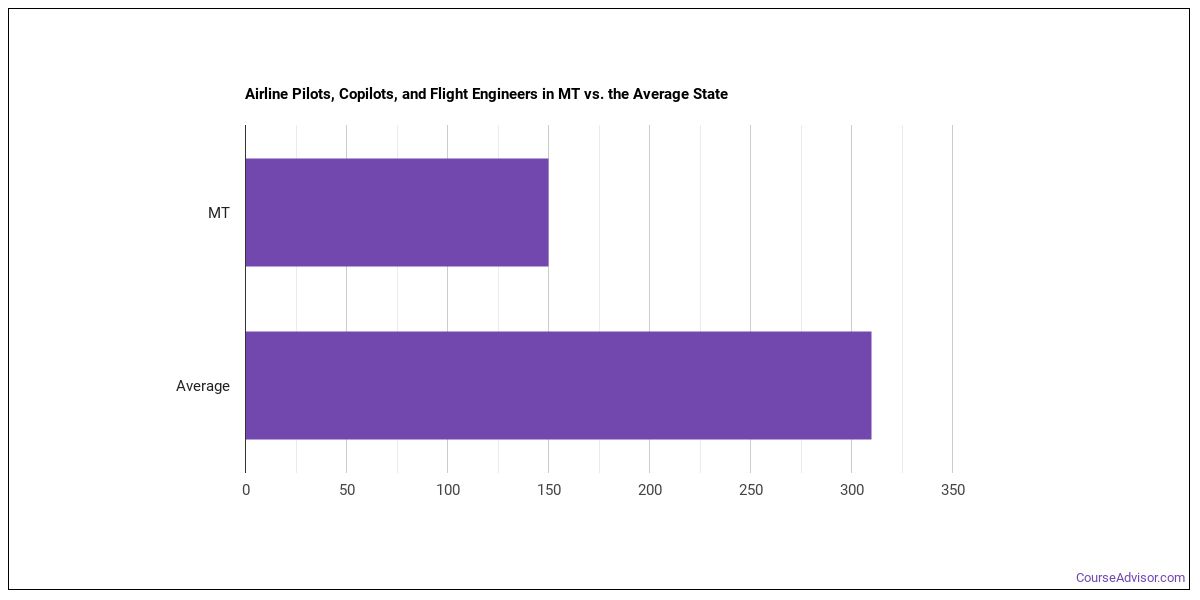
There are roughly 1,116,538 airline pilots, copilots, and flight engineers across the United States. In Montana alone, approximately 140 people work in this role. That’s below the typical state, which employs around 340 airline pilots, copilots, and flight engineers.

Top Montana Metros for Airline Pilots, Copilots, and Flight Engineers
The largest metro-area employers of airline pilots, copilots, and flight engineers in Montana.
| Metro Area | Number Employed | Annual Median Salary |
|---|---|---|
| Billings, MT | 70 | n/a |
Top States for Airline Pilots, Copilots, and Flight Engineers Employment
View the states that employ the most airline pilots, copilots, and flight engineers work.
| State | Number Employed |
|---|---|
| Texas | 10,050 |
| California | 9,890 |
| Florida | 6,640 |
| New York | 6,530 |
| Illinois | 6,440 |
| Colorado | 5,840 |
| North Carolina | 4,310 |
| Pennsylvania | 4,030 |
| Washington | 3,650 |
| Michigan | 2,650 |
| Arizona | 2,070 |
| Utah | 1,780 |
| Nevada | 1,710 |
| Alaska | 1,620 |
| Ohio | 1,070 |
| Oregon | 740 |
| Alabama | 340 |
| Arkansas | 340 |
| Idaho | 300 |
| Tennessee | 190 |
Highest-Paying States for Airline Pilots, Copilots, and Flight Engineers
These states pay the most for airline pilots, copilots, and flight engineers.
| State | Annual Median Salary |
|---|---|
| Alaska | $226,490 |
| Florida | $220,350 |
| Texas | $214,670 |
| Oregon | $214,520 |
| Colorado | $211,860 |
| Arizona | $198,800 |
| Connecticut | $189,630 |
| Minnesota | $184,560 |
| Nevada | $180,600 |
| Pennsylvania | $172,710 |
Skills
The most important airline pilots, copilots, and flight engineers skills, rated on an importance scale of 0 to 5:
Knowledge Areas
Important knowledge areas for this occupation, rated on an importance scale of 0 to 5:
Abilities
The abilities that matter most for airline pilots, copilots, and flight engineers, rated on an importance scale of 0 to 5:
Daily Tasks
Common tasks include:
- Use instrumentation to guide flights when visibility is poor.
- Start engines, operate controls, and pilot airplanes to transport passengers, mail, or freight, adhering to flight plans, regulations, and procedures.
- Work as part of a flight team with other crew members, especially during takeoffs and landings.
- Respond to and report in-flight emergencies and malfunctions.
- Inspect aircraft for defects and malfunctions, according to pre-flight checklists.
- Contact control towers for takeoff clearances, arrival instructions, and other information, using radio equipment.
- Monitor engine operation, fuel consumption, and functioning of aircraft systems during flights.
- Monitor gauges, warning devices, and control panels to verify aircraft performance and to regulate engine speed.
- Steer aircraft along planned routes, using autopilot and flight management computers.
- Check passenger and cargo distributions and fuel amounts to ensure that weight and balance specifications are met.
- Confer with flight dispatchers and weather forecasters to keep abreast of flight conditions.
- Order changes in fuel supplies, loads, routes, or schedules to ensure safety of flights.
Work Activities
- Identifying Objects, Actions, and Events
- Inspecting Equipment, Structures, or Materials
- Making Decisions and Solving Problems
- Monitoring Processes, Materials, or Surroundings
- Evaluating Information to Determine Compliance with Standards
- Getting Information
- Operating Vehicles, Mechanized Devices, or Equipment
- Processing Information
- Updating and Using Relevant Knowledge
- Controlling Machines and Processes
- Communicating with Supervisors, Peers, or Subordinates
- Analyzing Data or Information
Tools & Technology
Technologies frequently used: Hot technologies: Microsoft Excel In-demand technologies: R
What Major Will Prepare You For This Career?
Related college programs include:
- Air Transportation
Featured schools near , edit
Related Careers
Careers similar to airline pilots, copilots, and flight engineers include:
- Aerospace Engineers
- Aerospace Engineering and Operations Technologists and Technicians
- Avionics Technicians
- Aircraft Mechanics and Service Technicians
- Aircraft Cargo Handling Supervisors
- First-Line Supervisors of Passenger Attendants
Also Known As
Air Force Pilot, Airbus Captain, Aircraft Captain, Aircraft Pilot, Airline Captain, Airline Pilot, Airline Pilot Flight Instructor, Airline Transport Pilot, Airplane Pilot, Army Helicopter Pilot, Captain, Check Airman, Co-Pilot, Commercial Airline Pilot, Copilot.
References
- U.S. Bureau of Labor Statistics, Occupational Employment and Wage Statistics — https://www.bls.gov/oes/
- O*NET Online — https://www.onetonline.org/
- BLS Employment Projections — https://www.bls.gov/emp/
- O*NET-SOC code: 53-2011.00

Course Advisor provides higher-education, college and university, degree, program, career, salary, and other helpful information to students, faculty, institutions, and other internet audiences. Presented information and data are subject to change. Inclusion on this website does not imply or represent a direct relationship with the company, school, or brand. Information, though believed correct at time of publication, may not be correct, and no warranty is provided. Contact the schools to verify any information before relying on it. Financial aid may be available for those who qualify. The displayed options may include sponsored or recommended results, not necessarily based on your preferences.
© Course Advisor – All Rights Reserved.